Cookbook:Chiles
| Chiles | |
|---|---|
 | |
| Category | Vegetables |
Cookbook | Recipes | Ingredients | Vegetables | Herbs and Spices | Chilli

The chile or chile pepper is the spicy fruit of the plant capsicum. To avoid confusion, this cookbook—like several other sources[1][2][3]—uses "chile" with an "e" to refer to the pure chile pepper (either fresh or processed), and "chili" with an "i" to refer to the stew and its associates such as the spice blend chili powder. However, do know that the spellings can be ambiguous in other sources, and make sure to use the correct ingredient required in a given recipe.
Characteristics[edit | edit source]
With many varieties, chiles come in a wide array of shapes, sizes, and colors.[4] They are all hollow, with crisp watery flesh, tapered ends, and inner seeds. The shape can be long, rounded, narrow, wrinkled, and more, with colors ranging from greens (when unripe)[5] to yellows, oranges, and reds of various shades.[6][5]
Chiles are infamous for their spicy heat, which is caused by the substance capsaicin found in the chile's inner membrane.[4][5][7] This compound triggers heat sensors in the body to cause pain and inflammation when consumed.[7][8] The "heat" is measured in Scoville Heat Units (SHU) and varies according to chile variety and growing seasons[4][6][7][9][10]—bell peppers rank at 0 SHU, jalapeños at 3000–6000 SHU, and habaneros at 300,000 SHU. Heat aside, fresh chiles also have fruity and vegetal flavors that vary between varieties.[5]
Chiles may be dried[5]—whereupon they may be given new names[11]—and can be processed to make smoked chiles, chile flakes, chili powder, chili pastes, and more.[4] During these processes, they may gain and/or lose flavors according to the preparation method.[4][5][8]
Varieties[edit | edit source]
Chile varieties are derived from cultivars of four primary species: Capsicum annuum (e.g. jalapeños); Capsicum frutescens (e.g. cayenne), Capsicum chinense (e.g. habaneros), Capsicum pubescens (e.g. rocoto), and Capsicum baccatum (e.g. ají amarillo).
Selection and storage[edit | edit source]
Select fresh chiles like you would many other fresh vegetables. The flesh and skin should be firm, crisp, and unblemished. Overly soft or wrinkled skin indicates chiles past their prime. High-quality dried chiles should still have some moisture, much like raisins, and should not feel like paper or cardboard.[11]
Fresh chiles should be stored in the refrigerator for several days. They can also be frozen after chopping,[12] though this will destroy their fresh texture—frozen chiles should be used puréed and/or cooked. Dried chiles should be stored in an airtight container away from light and heat for several months.[11] Chile powders lose their complex aromas during storage and are primarily used to contribute heat to a dish.[5]
Preparation[edit | edit source]
To prepare all chiles for use, remove the tough stem. The inner membrane can be removed to reduce the heat if desired.[5][6] The seeds, while not very spicy, are bitter and may also be removed accordingly.[5][7] Dried chiles may be toasted to amplify their flavors.[9]
Safety[edit | edit source]
Be very cautious in handling chiles, and do not touch your eyes or any other sensitive body part after handling.[7] For some especially strong chiles, it is advisable to wear gloves while handling them and to wash the hands with soap immediately after.
Use[edit | edit source]
Chiles are eaten cooked or raw for the hot flavor they contribute to dishes.[13] Though unknown to the Old World prior to colonization of the Americas, chiles have become well integrated into many European, Asian, and African cuisines, which originally used peppercorn and other spices for heat.[13] Well-known dishes with a strong chile flavor include salsa, New Mexican chili con carne and Indian vindaloo.
To tame their heat, chiles are often paired with foods high in fat and protein (such as dairy), which both help interrupt the capsaicin binding to the body's receptors—water will not help.[7][8] Acidic ingredients make the heat more intense.[8] People who are regularly exposed to a lot of chile become less sensitized to the heat over time, so make sure to tailor the spice level of your dishes to the specific palate of the diner.[7]
Gallery[edit | edit source]
-
 Aji amarillo
 -
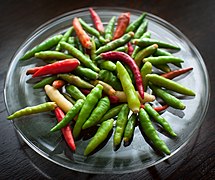 Green and red Thai bird chiles
 -
 Jolokia chiles
 -
 Banana peppers
 -
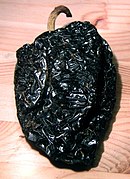 Ancho chile
 -
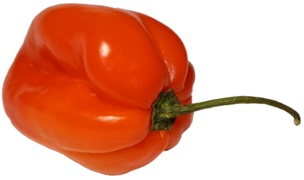 Habanero chile
 -
 Kkwari chiles
 -
 Filipino labuyo chiles
 -
 Assorted fresh chiles
 -
 Chile powder


_(39581333034).jpg)


Recipes[edit | edit source]
References[edit | edit source]
- ↑ Nast, Condé (2019-08-27). "Yes, Chili Powder and Chile Powder Are Different Things". Bon Appétit. Retrieved 2024-03-18.
- ↑ "Chile Powder vs. Chili Powder: Yes, There's a Huge Difference". Simply Recipes. Retrieved 2024-03-18.
- ↑ "What's The Difference Between Chile And Chili Powder". Southern Living. Retrieved 2024-03-18.
- ↑ a b c d e Davidson, Alan (2014-01-01). Jaine, Tom (ed.). The Oxford Companion to Food. Oxford University Press. doi:10.1093/acref/9780199677337.001.0001. ISBN 978-0-19-967733-7.
- ↑ a b c d e f g h i Farrimond, Dr Stuart (2018-11-06). The Science of Spice: Understand Flavor Connections and Revolutionize Your Cooking. National Geographic Books. ISBN 978-1-4654-7557-2.
- ↑ a b c "Red Chile Peppers". specialtyproduce.com. Retrieved 2024-03-10.
- ↑ a b c d e f g Provost, Joseph J.; Colabroy, Keri L.; Kelly, Brenda S.; Wallert, Mark A. (2016-05-02). The Science of Cooking: Understanding the Biology and Chemistry Behind Food and Cooking. John Wiley & Sons. ISBN 978-1-118-67420-8.
- ↑ a b c d Farrimond, Stuart (2017-09-19). The Science of Cooking: Every question answered to perfect your cooking. Penguin. ISBN 978-1-4654-7079-9.
- ↑ a b Ruhlman, Michael (2008). The Elements of Cooking: Translating the Chef's Craft for Every Kitchen. Black Incorporated. ISBN 978-1-86395-143-2.
- ↑ Wolke, Robert L. (2011-01-12). What Einstein Told His Cook 2: The Sequel: Further Adventures in Kitchen Science. W. W. Norton & Company. ISBN 978-0-393-07982-1.
- ↑ a b c "What to Do With Dried Chiles: Recipes, Cooking Techniques, and Shopping Tips". Serious Eats. Retrieved 2024-03-10.
- ↑ Cox, Jeff; Moine, Marie-Pierre (2010-03). The Cook's Herb Garden. Dorling Kindersley Limited. ISBN 978-1-4053-4993-2.
{{cite book}}: Check date values in:|date=(help) - ↑ a b Van Wyk, Ben-Erik (2014-09-26). Culinary Herbs and Spices of the World. University of Chicago Press. ISBN 978-0-226-09183-9.