Statistics/Summary/Averages/Harmonic Mean


Harmonic Mean[edit | edit source]
The arithmetic mean cannot be used when we want to average quantities such as speed.
Consider the example below:
Example 1: The distance from my house to town is 40 km. I drove to town at a speed of 40 km per hour and returned home at a speed of 80 km per hour. What was my average speed for the whole trip?.
Solution: If we just took the arithmetic mean of the two speeds I drove at, we would get 60 km per hour. This isn't the correct average speed, however: it ignores the fact that I drove at 40 km per hour for twice as long as I drove at 80 km per hour. To find the correct average speed, we must instead calculate the harmonic mean.
For two quantities A and B, the harmonic mean is given by:

This can be simplified by adding in the denominator and multiplying by the reciprocal:
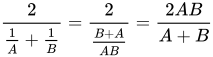
For N quantities: A, B, C......
Harmonic mean =
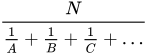
Let us try out the formula above on our example:
Harmonic mean =

Our values are A = 40, B = 80. Therefore, harmonic mean

Is this result correct? We can verify it. In the example above, the distance between the two towns is 40 km. So the trip from A to B at a speed of 40 km will take 1 hour. The trip from B to A at a speed to 80 km will take 0.5 hours. The total time taken for the round distance (80 km) will be 1.5 hours. The average speed will then be 53.33 km/hour.

The harmonic mean also has physical significance.