Statistics/Distributions/Bernoulli
 |
A Wikibookian suggests that R_Programming/Probability_Functions/Bernoulli be merged into this chapter. Discuss whether or not this merger should happen on the discussion page. |
Bernoulli Distribution: The coin toss[edit | edit source]
| Parameters | |
|---|---|
| Support | |
| PMF | |
| CDF | |
| Mean | |
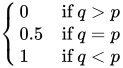
| Median | |
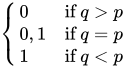
| Mode | |
| Variance | |
| Skewness | |
| Ex. kurtosis | |
| Entropy | |
| MGF | |
| CF | |
| PGF | |
| Fisher information |


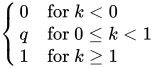






There is no more basic random event than the flipping of a coin. Heads or tails. It's as simple as you can get! The "Bernoulli Trial" refers to a single event which can have one of two possible outcomes with a fixed probability of each occurring. You can describe these events as "yes or no" questions. For example:
- Will the coin land heads?
- Will the newborn child be a girl?
- Are a random person's eyes green?
- Will a mosquito die after the area was sprayed with insecticide?
- Will a potential customer decide to buy my product?
- Will a citizen vote for a specific candidate?
- Is an employee going to vote pro-union?
- Will this person be abducted by aliens in their lifetime?
The Bernoulli Distribution has one controlling parameter: the probability of success. A "fair coin" or an experiment where success and failure are equally likely will have a probability of 0.5 (50%). Typically the variable p is used to represent this parameter.
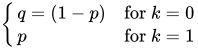
If a random variable X is distributed with a Bernoulli Distribution with a parameter p we write its probability mass function as:

Where the event X=1 represents the "yes."
This distribution may seem trivial, but it is still a very important building block in probability. The Binomial distribution extends the Bernoulli distribution to encompass multiple "yes" or "no" cases with a fixed probability. Take a close look at the examples cited above. Some similar questions will be presented in the next section which might give an understanding of how these distributions are related.
Mean[edit | edit source]
The mean (E[X]) can be derived:
![{\displaystyle \operatorname {E} [X]=\sum _{i}f(x_{i})\cdot x_{i}}](https://wikimedia.org/api/rest_v1/media/math/render/svg/828e6e9a3c1deb8df217f10c8fd2cff3682ef2a3)
![{\displaystyle \operatorname {E} [X]=p\cdot 1+(1-p)\cdot 0}](https://wikimedia.org/api/rest_v1/media/math/render/svg/8c586a80bc9ac3deedc09cb0bf551c85456ed563)
![{\displaystyle \operatorname {E} [X]=p\,}](https://wikimedia.org/api/rest_v1/media/math/render/svg/fc6c97877071d6785321a33d605961e61633576a)
![{\displaystyle \operatorname {Var} (X)=\operatorname {E} [(X-\operatorname {E} [X])^{2}]=\sum _{i}f(x_{i})\cdot (x_{i}-\operatorname {E} [X])^{2}}](https://wikimedia.org/api/rest_v1/media/math/render/svg/85916f74c29d4a9946dbc8d6d12f8fdaba650dcc)

\,}](https://wikimedia.org/api/rest_v1/media/math/render/svg/09209d46f65b342076b628fa4b4d1025f4227539)
