Statistics/Distributions/Continuous
A continuous statistic is a random variable that does not have any points at which there is any distinct probability that the variable will be the corresponding number.
General Properties[edit | edit source]
Cumulative Distribution Function[edit | edit source]
A continuous random variable, like a discrete random variable, has a cumulative distribution function. Like the one for a discrete random variable, it also increases towards 1. Depending on the random variable, it may reach one at a finite number, or it may not. The cdf is represented by a capital F.
Probability Distribution Function[edit | edit source]
Unlike a discrete random variable, a continuous random variable has a probability density function instead of a probability mass function. The difference is that the former must integrate to 1, while the latter must have a total value of 1. The two are very similar, otherwise. The pdf is represented by a lowercase f.
Special Values[edit | edit source]
Let R be the set of points of the distribution.
The expected value for a continuous variable X with probability density function f is defined as .

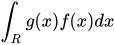
More generally, the expected value of any continuously transformed variable g(X) with probability density function f is defined as .
The mean of a continuous or discrete distribution is defined as .
![{\displaystyle E[X]}](https://wikimedia.org/api/rest_v1/media/math/render/svg/e455a34363c03fc5df8208d8b81fa29e3cdd524e)
The variance of a continuous or discrete distribution is defined as .
![{\displaystyle E[(X-E[X]^{2})]}](https://wikimedia.org/api/rest_v1/media/math/render/svg/62e702258475ed39e0c1d2adcf70037b11a9955f)
Expectations can also be derived by producing the Moment Generating Function for the distribution in question. This is done by finding the expected value . Once the Moment Generating Function has been created, each derivative of the function gives a different piece of information about the distribution function.
![{\displaystyle E[\exp(tX)]}](https://wikimedia.org/api/rest_v1/media/math/render/svg/551b062fdc21eea6d3d8c6092cf3650bd083a3b2)
= mean
= variance
= skewness
= kurtosis
![{\displaystyle {\frac {dE[\exp(tX)]}{dt}}}](https://wikimedia.org/api/rest_v1/media/math/render/svg/ee4d4de7d968658bf7c423fb4b871f802850aaa9)
![{\displaystyle {\frac {d^{2}E[\exp(tX)]}{dt^{2}}}}](https://wikimedia.org/api/rest_v1/media/math/render/svg/9ab428b9fc2d6de74a61b5a8a96871bdf6cc4a59)
![{\displaystyle {\frac {d^{3}E[\exp(tX)]}{dt^{3}}}}](https://wikimedia.org/api/rest_v1/media/math/render/svg/116a5182d24a980cea50dc18e4d190bbe1ef8a4c)
![{\displaystyle {\frac {d^{4}E[\exp(tX)]}{dt^{4}}}}](https://wikimedia.org/api/rest_v1/media/math/render/svg/6aa9ead6641087902016c6dbf87b0a5f09c24f3c)