Basically, all the sections found here can be also found in a linear algebra book. However, the Gram-Schmidt Orthogonalization is used in statistical algorithm and in the solution of statistical problems. Therefore, we briefly jump into the linear algebra theory which is necessary to understand Gram-Schmidt Orthogonalization.
The following subsections also contain examples. It is very important for further understanding that the concepts presented here are not only valid for typical vectors as tuple of real numbers, but also functions that can be considered vectors.
A set  with two operations
  and
and  on its elements is called a field (or short
  ), if the following conditions hold:
- For all
 holds
holds 
- For all holds
 (commutativity)
- For all
 holds
holds  (associativity)
- It exist a unique element
 , called zero, such that for all
  holds
holds 
- For all a unique element
 , such that holds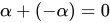
- For all holds

- For all holds
 (commutativity)
- For all holds
 (associativity)
- It exist a unique element
 , called one, such that for all holds
- For all non-zero a unique element
 , such that holds
- For all holds
 (distributivity)
The elements of are also called scalars.
It can easily be proven that real numbers with the well known addition and multiplication  are a field. The same holds for complex numbers with the addition and multiplication. Actually, there are not many more sets with two operations which fulfill all of these conditions.
For statistics, only the real and complex numbers with the addition and multiplication are important.
A set  with two operations and on its elements is called a vector space over R, if the following conditions hold:
- For all
 holds
holds 
- For all holds
 (commutativity)
- For all
 holds
holds  (associativity)
- It exist a unique element
 , called origin, such that for all
  holds
holds 
- For all exists a unique element
 , such that holds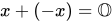
- For all and holds

- For all and holds
 (associativity)
- For all and
 holds
holds 
- For all and for all holds
 (distributivity wrt. vector addition)
- For all and for all holds
 (distributivity wrt. scalar addition)
Note that we used the same symbols and for different operations in and . The elements of are also called vectors.
Examples:
- The set
 with the real-valued vectors
  with elementwise addition
  and the elementwise multiplication
  is a vector space over
  .
.
- The set of polynomials of degree
 ,
,  , with usual addition and multiplication is a vector space over .
A vector  can be written as a linear combination of vectors
  , if
, if
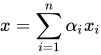
with  .
.
Examples:
 is a linear combination of
  since
since 
 is a linear combination of
  since
since 
A set of vectors  is called a basis of the vector space , if
1. for each vector exist scalars  such that
 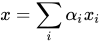 2. there is no subset of
  such that 1. is fulfilled.
Note, that a vector space can have several bases.
Examples:
- Each vector
 can be written as
  . Therefore is
  a basis of
  .
.
- Each polynomial of degree can be written as linear combination of
 and therefore forms a basis for this vector space.
Actually, for both examples we would have to prove condition 2., but it is clear that it holds.
Dimension of a vector space[edit | edit source]
A dimension of a vector space is the number of vectors which are necessary for a basis. A vector space has infinitely many number of basis, but the dimension is uniquely determined. Note that the vector space may have a dimension of infinity, e.g. consider the space of continuous functions.
Examples:
- The dimension of is three, the dimension of is .
- The dimension of the polynomials of degree is
 .
.
A mapping  is called a scalar product if the following holds for all
  and
and  :
:


 with
with 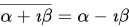
 with
with 
Examples:
- The typical scalar product in is
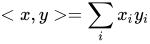 .
.
 is a scalar product on the vector space of polynomials of degree .
A norm of a vector is a mapping 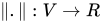 , if holds
 for all and
  (positive definiteness)
 for all and all
  for all (triangle inequality)
Examples:
- The
 norm of a vector in is defined as
 ![{\displaystyle \|x\|_{q}={\sqrt[{q}]{\sum _{i=1}^{p}x_{i}^{q}}}}](https://wikimedia.org/api/rest_v1/media/math/render/svg/f3dd504664536b58841695c57bbac2e7ad9cda02) .
.
- Each scalar product generates a norm by
 , therefore
 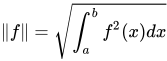 is a norm for the polynomials of degree .
Two vectors and  are orthogonal to each other if
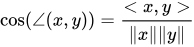
  . In it holds that the cosine of the angle between two vectors can expressed as
 .
.
If the angle between and is ninety degree (orthogonal) then the cosine is zero and it follows that .
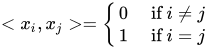
A set of vectors  is called orthonormal, if
 .
.
If we consider a basis  of a vector space then we would like to have a orthonormal basis. Why ?
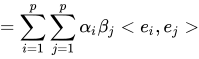
Since we have a basis, each vector and can be expressed by  and
and  . Therefore the scalar product of and reduces to

|

|
|
|
|
|
|

|
|
|

|
Consequently, the computation of a scalar product is reduced to simple multiplication and addition if the coefficients are known.
Remember that for our polynomials we would have to solve an integral!
Gram-Schmidt orthogonalization[edit | edit source]
The aim of the Gram-Schmidt orthogonalization is to find for a set of vectors an equivalent set of orthonormal vectors  such that any vector which can be expressed as linear combination of can also be expressed as linear combination of :
1. Set  and
and 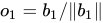
2. For each  set
set 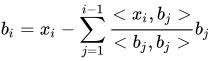 and
and  , in each step the vector
  is projected on
  and the result is subtracted from .

Consider the polynomials of degree two in the interval![{\displaystyle [-1,1]}](https://wikimedia.org/api/rest_v1/media/math/render/svg/51e3b7f14a6f70e614728c583409a0b9a8b9de01) with the scalar product
with the scalar product 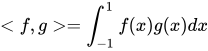 and the norm
 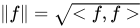 . We know that
  and
and  are a basis for this vector space. Let us now construct an orthonormal basis:
Step 1a: 
Step 1b: 
Step 2a: 
Step 2b: 
Step 3a: 
Step 3b: 
It can be proven that 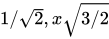 and
and 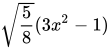 form a orthonormal basis with the above scalarproduct and norm.
Consider the vectors  and
and  . Assume that
  is so small that computing
  holds on a computer (see http://en.wikipedia.org/wiki/Machine_epsilon). Let compute a orthonormal basis for this vectors in
  with the standard scalar product
  and the norm
  .
.
Step 1a. 
Step 1b. 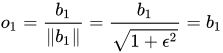 with
with 
Step 2a. 
Step 2b. 
Step 3a. 
Step 3b. 
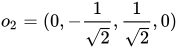
It obvious that for the vectors
- 
- 
- 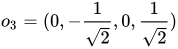
the scalarproduct  . All other pairs are also not zero, but they are multiplied with such that we get a result near zero.
To solve the problem a modified Gram-Schmidt algorithm is used:
- Set
 for all
- for each from to
 compute

- for each
 from
from  to compute
The difference is that we compute first our new  and subtract it from all other . We apply the wrongly computed vector to all vectors instead of computing each separately.
Step 1.  ,
,  ,
, 
Step 2a.  with
with
Step 2b. 
Step 2c. 
Step 3a.
Step 3b. 
Step 4a. 
We can easily verify that  .
.
Exploratory Project Pursuit[edit | edit source]
In the analysis of high-dimensional data we usually analyze projections of the data. The approach results from the Theorem of Cramer-Wold that states that the multidimensional distribution is fixed if we know all one-dimensional projections. Another theorem states that most (one-dimensional) projections of multivariate data are looking normal, even if the multivariate distribution of the data is highly non-normal.
Therefore in Exploratory Projection Pursuit we jugde the interestingness of a projection by comparison with a (standard) normal distribution. If we assume that the one-dimensional data are standard normal distributed then after the transformation  with
with  the cumulative distribution function of the standard normal distribution then
  is uniformly distributed in the interval
 ![{\displaystyle [-1;1]}](https://wikimedia.org/api/rest_v1/media/math/render/svg/c8bc389ca678dffbedd0d41ca0fecb9806c9b7cf) .
.
Thus the interesting can measured by 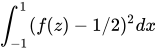 with
with  a density estimated from the data. If the density is equal to
  in the interval then the integral becomes zero and we have found that our projected data are normally distributed. An value larger than zero indicates a deviation from the normal distribution of the projected data and hopefully an interesting distribution.
Expansion with orthonormal polynomials[edit | edit source]
Let  a set of orthonormal polynomials with the scalar product
 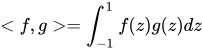 and the norm . What can we derive about a densities in the interval ?
If 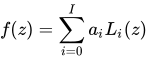 for some maximal degree
  then it holds

We can also write 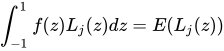 or empirically we get an estimator
 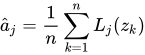 .
.
We describe the term 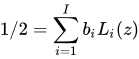 and get for our integral

So using a orthonormal function set allows us to reduce the integral to a summation of coefficient which can be estimated from the data by plugging  in the formula above. The coefficients can be precomputed in advance.
Normalized Legendre polynomials[edit | edit source]
The only problem left is to find the set of orthonormal polynomials upto degree . We know that  form a basis for this space. We have to apply the Gram-Schmidt orthogonalization to find the orthonormal polynomials. This has been started in the first example.
The resulting polynomials are called normalized Legendre polynomials. Up to a scaling factor the normalized Legendre polynomials are identical to Legendre polynomials. The Legendre polynomials have a recursive expression of the form

So computing our integral reduces to computing  and
and  and using the recursive relationship to compute the 's. Please note that the recursion can be numerically unstable!
- Halmos, P.R. (1974). Finite-Dimensional Vector Spaces, Springer: New York
