Guitar/Movable Chords
Because of the relative tuning of the strings on a guitar, it is very easy to play a variety of chords that can be moved up and down the neck. The most basic types of movable chords are the power chord and barre chord. This section deals with chords that, in general, do not use open strings. Once the shape of the chord is memorised, it can be played anywhere on the fretboard.
Major and Minor shapes[edit | edit source]
Movable chords often use the general shapes of open chords. However, not all open chords are easy to play as a movable chord. Note that C major and G major is absent. This is because the shape of the chords, particularly G major, demands of the guitarist an advanced technique. Classical guitarists use a foot-stool and adopt a specific playing posture and hand position when they play and this allows them to form these chords with relative ease. The classical guitar also has nylon strings and these offer hardly any resistance to fretting. That is not to say that the C major and G major shape cannot be played on a steel-string acoustic; its just more difficult because of the string tension. They are slightly easier to play on the electric guitar. After mastering the easier shapes, try learning the C major and G shapes. The D major shape and D minor movable chords (as shown below) are usable but tend not to be used regularly due to the shape being slightly awkward to hold and move to other chords. The easiest shapes to learn are the E major and A minor chords shape. Tip: the more difficult shapes can be broken down into smaller units and they also make ideal arpeggio studies where you can approach them more as a succession of notes in a riff without the need for forming the full chord.
-
 E major
 -
 A major
 -
 D major
 -
 E minor
 -
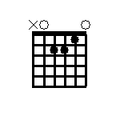 A minor
 -
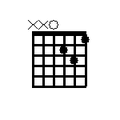 D minor
.png)
.png)
.png)
.png)
.png)
.png)
If you examine the notes that make up the chords, it becomes clear that the thickest string plays the root note of the chords. Thus, in order to turn these into movable chords, you also have to fret down an extra string to complete the chord. Here are the same chords, but higher up the neck in a movable shape. Notice how the shapes of the chord on the strings you play are exactly the same as the open chords, except with the thickest string now being fretted.
-
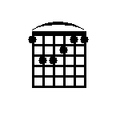 F major
 -
 B major
 -
 E major
 -
 G minor
 -
 B minor
 -
 E minor
.png)
.png)
.png)
.png)
.png)
.png)
Inversions of Major and Minor[edit | edit source]
"Artist" Chords[edit | edit source]
Although these guitarists certainly did not invent the chords, they made them popular by using them in many of their songs. More often than not, a player will first encounter them trying to learn a famous song. These are loose categorizations, and are easily applicable to more than one artist, so please keep that in mind.
7#9 (Hendrix Chords)[edit | edit source]
No chord reminds people more of Jimi Hendrix than the 7#9. These are also used widely by Prince. The voicing for this shape is 1-3-7-#9.
-
 B7/#9
B7/#9 -
 E7/#9
E7/#9 -
 A7/#9
A7/#9


7/9 and 7/9/13 (James Brown Chords)[edit | edit source]
These chords are essential for getting a funk sound. The voicing for this 7/9 shape is 1-3-7-9-5.
-
 B7/9
B7/9 -
 E7/9
E7/9 -
 A7/9
A7/9


The 7/9/13chord is an easy modification of the 7/9 chord. It was perhaps most famously used in "Sex Machine" by James Brown, as a change between the 7/9 chord. Little changes like that give music some extra texture and they also work particularly well in jazz.
Because the 7/9/13 chord requires five notes, you cannot play it with less than five strings, or else you would be playing a different chord. The voicing for this shape is 1-3-7-9-13.
-
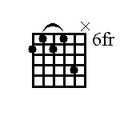 B7/9/13
 -
 E7/9/13

