Guitar/Jazz
Jazz basics[edit | edit source]
Jazz chords:
Early jazz bands used the banjo as an accompaniment instrument because its loud volume gave it the ability to be heard, unamplified, against brass and percussion. As an acoustic instrument, the banjo was limited to a rhythmic role.
The electric guitar eventually replaced the banjo mainly due to its extended range and improvements in timbre and the volume boost provided by amplification. The early jazz guitarists played block chords to provide the rhythmic support that was once the role of the banjo. They had to adopt an economic chordal style to match some of the fast tempos they were expected to play. This involved three or four note chords and this legacy is to be found in all jazz guitar styles. Here are three movable exercises illustrating the basic jazz chord vocabulary:
Exercise one: Four note jazz chords in root position
-
 G major
 -
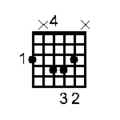 G maj7
 -
 G7
G7 -
 G6
G6
.png)
.png)
.png)
.png)
Exercise two: four note jazz chords in first inversion
-
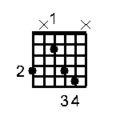 E major
 -
 E maj7
 -
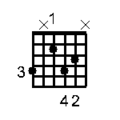 E7
E7 -
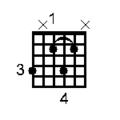 E6
E6
.png)
.png)
.png)
.png)
Exercise three: three note jazz chords in second inversion
-
 C major
 -
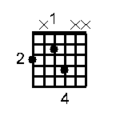 C maj7
 -
 C7
C7 -
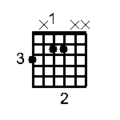 C6
C6
.png)
.png)
.png)
.png)
Note that in each of the above exercises there is a change of only one note to form the next chord and that this change takes place on one string.
Jazz forms[edit | edit source]
The two main forms in Jazz are the twelve bar blues and the thirty-two-bar ballad. The "rhythm changes" chord progression is a 32-bar form.
The thirty-two-bar ballad will normally take the sectional formː
A - A - B - A
Each section consisting of eight bars. Section B is sometimes described as the bridge and will usually modulate to a related key eventually returning to the home key towards the end of the section. Each section can respectively be labelledː
Statement - Statement - Development - Recapitulation (Return of Statement)
A famous thirty-two bar ballad is "Misty" by Erroll Garner with lyrics written by Johnny Burke. Using the lyrics from the Sarah Vaughan version of "Misty" and taking into account the four bar instrumental introduction we can separate the sections into their respective componentsː
A (Statement)ː
"Look at me. I'm as helpless as a kitten up a tree. And I feel like I'm clinging to a cloud. I can't understand. I get misty just holding your hand"
A (Statement)ː
"Walk my way. And a thousand violins begin to play. Or it might be the sound of your hello. That music I hear. I get misty the moment you're near"
B (Development)ː
"You can say that you're leading me on. But it's just what I want you to do. Don't you notice how hopelessly I'm lost. That's why I'm following you"
A (Recapitulation)ː
"On my own. Would I wander through this wonderland alone. Not knowing my right foot from my left. My hat from my glove. I'm too misty and too much in love"
Jazz style[edit | edit source]
Jazz rhythms are meant to swing. While not all jazz consists of swinging rhythms, some may have a straight eighth note feel, it is important to become familiar with this style of playing. Swing is a difficult style to notate because it involves pulling and pushing against the beat and therefore students approach jazz by listening to the music first. If you are new to jazz then the song "My Favorite Things" from the musical The Sound Of Music is a good place to start. Listen to John Coltrane's jazz version and compare it against the original soundtrack version. You will notice that the original version swings less and that Coltrane's version lasts longer. Jazz musicians are expected to be able to improvise and this is exactly what Coltrane does by extending the song's harmony and melody beyond its original form. The drums and piano in Coltrane's version swing in comparison to the backing instruments of the original. Swing may be difficult to notate on manuscript paper but it is easy to hear in performance.
The use of octaves is a common technique in jazz guitar. Once a jazz guitarist has learned the notes to a melody they will then play the same melody using octaves. Audiences hear octaves as a single melodic line and therefore using octaves is a highly effective technique for reinforcing the melody line. Jazz guitarists are also very adept at playing scales backwards. The jazz guitarist Kenny Burrell on the album Midnight Blue uses simple minor pentatonic scales to great effect starting on their highest note and descending through the scale to the lowest note. Playing scales backwards is a technique that provides for surprise openings, unusual bridges and tension releasing.
Many famous early jazz guitarists cited horn players as a major influence. The rise of jazz coincided with the development of the radio and gramophone and early recordings of jazz played a major role in developing the main stylistic elements of the genre. Louis Armstrong's "West End Blues" (Louis Armstrong and his Hot Five - 1928) is considered one of the masterpieces of early jazz and cemented the role of the brass soloist. Jazz guitarists from that period took note and soon it became standard practice for guitarists to copy horn riffs.
Charlie Christian (Benny Goodman Band 1939 - 1941) is still considered by many as one of the great players of the instrument with many of his riffs displaying horn-like qualities. Christian also played a role in the development of Be-Bop participating in jams with Dizzy Gillespie and Theolonius Monk at Minton's Playhouse in New York (1941) which were recorded by a jazz fan. These recordings represent the transition from Swing to Be-Bop and offer a rare chance to hear the informal after-hours meetings of some of the greatest players in jazz.
A good jazz guitarist will normally have a few horn riffs in his vocabulary. Try playing along to a Miles Davis or John Coltrane recording and preferably choose a slow tempo ballad which will allow you time to hear and emulate. Brass instruments are melodic instruments and therefore, unlike the guitar, horn players cannot form chords. This means that horn players develop very strong melodic capabilities and this provides an ideal opportunity for a guitarist to improve their solo lines.
The sound of the city. The age of the automobile. The wireless radio and electric neon lights. Jazz must be placed in its social context. Duke Ellington's "Take the A Train" invokes a New York train journey and the pace of urban life. A listener's response to the Miles Davis and Gil Evans interpretation of the slow movement from "Concierto de Arunjuez", the most popular guitar concerto in the Classical repertoire, can only conclude that the style is jazz but the themes are Spanish. Music transcends geography and time offering the listener's imagination new ground to traverse.
The study of jazz styles is the study of context. The importance of this should be borne in mind to avoid dismissing certain jazz styles. The validity of "Early Autumn" by Woody Herman is equal to the validity of "Take The A Train" by Duke Ellington. The soulful sound of "Mercy Mercy Mercy" by Cannonball Adderley is no less jazz than the live performance in Berlin of "How High The Moon" by Ella Fitzgerald. Context must be extended to take into account the length of career and the artist's complete output. The later work of Billie Holiday was marred by personal problems and is not a true indication of her artistry. The popularity of Louis Armstrong and his later commercial pop music does not tell you why he was so important to the development of Jazz.
The black-tie Sinatra singing "My Way" in his later years masks the original vocal phrasing that he developed with the Tommy Dorsey Band that Miles Davis based his own trumpet style upon. To know that Benny Goodman acquired some of his music charts from Fletcher Henderson provides the opportunity to discover Chu Berry and Coleman Hawkins. Context provides the means to see that jazz style is not exclusively or independently developed by genius or any one group or person. Two versions of "Sugar Foot Stomp", as performed by Fletcher Henderson, will illustrate the style analysis of early Jazz stated in the introduction - block chords, fast tempos, and the change from banjo to guitar - "Sugar Foot Stomp" recorded in 1925 by Fletcher Henderson with banjo played by Charlie Dixon and the 1931 version recorded by Fletcher Henderson under the name Connie's Inn Orchestra with guitar played by Clarence Holiday.
Exercise one[edit | edit source]
The following exercise is a single chorus of the twelve bar blues with a solo in the style of Charlie Christian. It is a simplified version of the first chorus from "Profoundly Blue" and is transposed down a semi-tone from the original key of E flat.

You can tune your guitar up a semi-tone to compensate for the transposition. Play the Charlie Christian version and tune your open D string up a semi-tone to E flat which is the key of the original recording. Tune the rest of the strings to the open D string.
Movement exercises[edit | edit source]
These three exercises lend themselves to the 12-bar blues form. They are designed to aid movement along the fretboard and to give the student the chance to practice applying one chord on each beat of a bar.
Exercise one
-
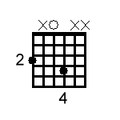 G major
 -
 C major
 -
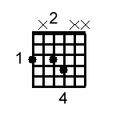 G7
G7 -
 C major
.png)
.png)
.png)
.png)
Exercise two
-
 C major
 -
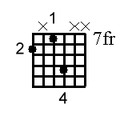 F major
 -
 C7
C7 -
 F major
.png)
.png)
.png)
.png)
Jazz Movement Exercise Three
-
 D major
 -
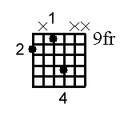 G major
 -
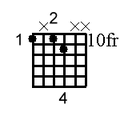 D7
D7 -
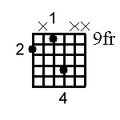 G major
.png)
.png)
.png)
.png)
Essential guitarists and recordings[edit | edit source]

The following list of influential jazz guitarists illustrates the major stylistic changes in Jazz ranging from Swing to Progressiveː
- Django Reinhardt was gypsy guitarist born in Belgium who played swinging jazz lines on a Maccaferri acoustic guitar. His signature tune was the Debussy inspired "Nuages" whose opening motif alludes to the Impressionist composer's "Prelude to the Afternoon of a Faun".
- Charlie Christian was the first guitarist to popularize the electric guitar as a solo instrument in jazz. Listen to the recordings he made with Benny Goodman in the late 1930s, including "Solo Flight."
- Tal Farlow brought the harmonic and melodic innovations of the Bebop style of jazz to the guitar. His mid-1950s recordings are recommended listening.
- Jim Hall brought a motif-based style of improvisational development to the jazz guitar. His recordings with Bill Evans are an excellent starting point.
- Wes Montgomery is renowned for his horn-like single lines, innovative octaves, and chord solos. The three essential Wes Montgomery recordings, all from the early 1960s, are The Incredible Jazz Guitar of Wes Montgomery, Full House, and Smokin' At The Half Note.
- George Benson is known for his improvisation as well as his more popular later works. Listen to his work with organists Jack McDuff and Dr. Lonnie Smith or the album Live At Casa Caribe.
- Pat Martino is known for his fluid single-line improvisation. A good introduction to his playing is Live At Yoshi's, featuring organist Joey DeFrancesco and drummer Billy Hart.
- Joe Pass was a great improvisor, but he is known especially for his solo chord-melody arrangements of jazz standards. Essential listening includes the Virtuoso series of recordings which showcases his solo pieces.
- John McLaughlin is known as a pioneering jazz-rock guitarist. His work in the 1970s with the Mahavishnu Orchestra should be considered essential listening.
- John Scofield is known for his angular lines and use of dissonance. For new jazz listeners, his two recordings with Medeski Martin and Wood are probably the best introduction to his playing.
- Allan Holdsworth is a jazz-rock guitarist known for his peerless technique and his unique approach to harmony. Believe It, a mid-1970s jazz-rock album by the New Tony Williams Lifetime, and None Too Soon, a more straight-ahead jazz album by Holdsworth, are both essential listening.
- Pat Metheny is a modern Jazz guitarist whose popularity has never diminished his art. His collaboration with Steve Reich on "Electric Counterpoint" is a notable example of his commitment to creativity. The Pat Metheny Group debut album, Bright Size Life, features the electric bassist Jaco Pastorius.