


Guitar/Intervals and Power Chords
An interval is the distance between two notes.
Each interval has a distinctive sound.
Intervals are named with reference to scales. For example, the interval from the root of the major scale to the second note of the major scale is called a "major second"; the interval from the root to the third note of that scale is a "major third", and so on. A "minor third" is the interval from the root to the third of a minor scale, and is a semitone (one fret) less than a major third.
Major scale played on a single string:

 nut                                                                    12th fret

O||-----|--●--|-----|--●--|--●--|-----|--●--|-----|--●--|-----|--●--|--●--|----
^          ^           ^     ^           ^           ^           ^     ^
root      2nd         3rd   4th         5th         6th         7th   octave
                                                                      (8th)
Natural minor scale played on a single string:

 nut                                                                    12th fret

O||-----|--●--|--●--|-----|--●--|-----|--●--|--●--|-----|--●--|-----|--●--|----
^          ^     ^           ^           ^     ^           ^           ^
root      2nd  minor         4th         5th  minor       minor      octave
                3rd                            6th         7th        (8th)
Major 2nd interval played on one string (say, the 6th string):

 ||-----|-----|-----|-----|-----|-----|-----|-----|-----|-----|-----|-----|---
 ||-----|-----|-----|-----|--●--|-----|--●--|-----|-----|-----|-----|-----|---
Same interval played on two strings (6th and 5th):

 ||-----|--●--|-----|-----|-----|-----|-----|-----|-----|-----|-----|-----|---
 ||-----|-----|-----|-----|--●--|-----|-----|-----|-----|-----|-----|-----|---
Exception. If played on 2nd and 3rd strings, the shape of a major 2nd becomes this, because of the tuning irregularity:

 ||-----|-----|--●--|-----|-----|-----|-----|-----|-----|-----|-----|-----|---
 ||-----|-----|-----|-----|--●--|-----|-----|-----|-----|-----|-----|-----|---
Major 3rd on two strings (but not 2nd to 3rd strings)

 ||-----|-----|-----|--●--|-----|-----|-----|-----|-----|-----|-----|-----|---
 ||-----|-----|-----|-----|--●--|-----|-----|-----|-----|-----|-----|-----|---
Major 3rd on 2nd and 3rd strings:

 ||-----|-----|-----|-----|--●--|-----|-----|-----|-----|-----|-----|-----|---
 ||-----|-----|-----|-----|--●--|-----|-----|-----|-----|-----|-----|-----|---
If the two notes are played at the same time, an interval is called a harmonic interval. If they are played one after the other, it is called a melodic interval. (Only melodic intervals can be played on a single string.)
Power chords
[edit | edit source]Power chords are simple chords consisting of root, fifth, and possibly octave. An advantage to understanding power chords is their shape can be used to quickly determine the location of the perfect fifth and the octave. This improves one's overall understanding of the location of notes on the fingerboard by relation to one another and builds the groundwork for understanding scales. Power chords are a staple of heavy distortion guitar styles, where the distortion creates harmonics that give a rich sound despite the bare-bones simplicity of the chord.
Perfect fifths (e.g., C-G) and their inversion, perfect fourths (e.g., G-C), are the most consonant interval on the guitar (and in all of music for that matter), not counting unison and octaves.
It is more difficult to play the octave for a root note on the D string, because the B string is tuned differently than the other strings, and you will need to stretch further to reach the octave. Power chords are most commonly played on the thicker strings, and many songs exclusively use perfect fifth power chords.
Perfect Fifth above octave
[edit | edit source]The simplest perfect fifth power chord uses the same fingering as an E minor chord, except only the thickest three strings are played. Here is the fretting for the E5 power chord:
-
 E5 Power Chord
.png)
When you play a power chord in the open position (or any power chord), you have to be careful to mute the other strings so they do not ring out. In this case, if you also played the G string, you would be playing a full chord, not a power chord. Use your extra fingers to lightly touch the other strings, use your fretting fingers to smother the unnecessary strings, or just avoid hitting the unnecessary strings with your impact hand.
Power chords, and really any chord types, are useful because they can be moved anywhere on the neck, as long as the relationship between the notes is the same. For example, in the E5, the thickest string plays an E, the next string plays a B (which is the fifth note of any E scale), and the next string plays another E, but an octave above it.
If you take the same chord pattern, and move it up the neck to make a different power chord. For example, take the two fretted notes, then use your first finger and fret the thick E string two frets behind the others. For example, if you were fretting the E string at the third fret, you would be playing a G5 which looks like this:
-
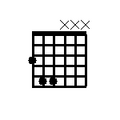 G5 Power Chord
.png)
There are several different fingerings you can use to play a power chord, but it is best to choose one that lets you easily move the power chord up and down the neck.
Here are three most common fingerings for a power chord, in this case, a G5. In the second and third fingering, the two strings are barred at the fifth fret. The numbers indicate the number of finger to use. Finger #1 is the index finger, #2 the middle finger, #3 the ring finger, and finger #4 is the little finger.
   EADGBE        EADGBE        EADGBE
   ---xxx        ---xxx        ---xxx
 1 ......      1 ......      1 ......
 2 ......      2 ......      2 ......
 3 1.....      3 1.....      3 1.....
 4 ......      4 ......      4 ......
 5 .34...      5 .33...      5 .44...
Alternate Fingerings
[edit | edit source]One common variation on the power chord involved omitting the second, higher octave note. For example, a G5 without the second G would look like this:
-
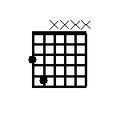 G5 Power Chord with the octave omitted
.png)
These are easier to play because you only need two fingers and the sound is similar to the three string version.
Since a power chord is just playing multiple strings that produce only two tones, it is possible to play all six strings and still be playing a power chord. Some open tunings set the guitar up so that when you strum it open, it plays a power chord. Here is an example of a full G5 chord, where all strings are either playing a G or a D.
   EADGBE
   --00--
 1 ......
 2 ......
 3 2...11
 4 ......
 5 .4....
This chord can be considered a non-traditional power chord, since in popular music, power chords usually use only two or three strings. This is also a hard fingering for the beginner, but it emphasizes an important fact about double stops: as long as you keep adding octave or unison notes, you will always be playing the same interval. Playing a non-octave or unison note will instead produce a chord.
Adding unison notes may sound different even though they are supposed to produce the same pitch. This may be because the strings have different tension or thickness. In general, the guitar's thinner strings will have a brighter, more ringing sound.
Perfect Fourths
[edit | edit source]This type of power chord can be regarded as root plus perfect fifth in the octave below.
Perfect fourths have a slightly more suspended sound than perfect fifth chords. These are easy to play, because most of the strings on the guitar are tuned in fourths. This means that playing any two of the thickest four strings, when they are beside one another and played at the same fret. For example, a D4 is played like this:
-
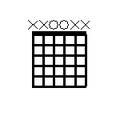 D4 Power Chord with the octave omitted

   EADGBE
   xx00xx
These can easily be moved up the neck. For example, a G4 or a B4 would be played like this:
-
 G4 Power Chord with the octave omitted
 -
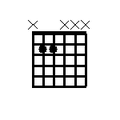 B4 Power Chord with the octave omitted


   EADGBE     EADGBE
  (33xxxx)   (x22xxx)
Perfect fourths are the same as the upper two notes of the original three-string power chord. It is rare to add a new top octave, but it may done. The following Power chords show the G4 and B4 with the octave added:
-
 G4 Power Chord with the octave
 -
 B4 Power Chord with the octave


   EADGBE     EADGBE
  (335xxx)   (x224xx)
Other Double Stops
[edit | edit source]You can play a huge variety of different intervals by playing chords, and just plucking two notes at the same time. Often you can add variety to chord strumming by playing a quick fill by playing different sections of a chord, and achieving different intervals.