Guitar/Scales

Western music uses twelve notes called the complete chromatic scale. The seven white keys and their corresponding black keys on a keyboard allows for easy visualization of the complete chromatic scale and the twelve semitones. From this simple twelve note system are all the other scales derived. A scale is simply a way of ordering the twelve sounds found in Western Music. It must be borne in mind that music as an activity precedes musical theory and that the scales we use now have an evolution that predates written records. Today's scale system is referred to as the major-minor system. Go back to the Medieval period and the system used then was called the Church Modes. The study of scales should start with the major scales and minor scales or the blues and pentatonic scales. Unlike the piano where each semitone is represented by a key; on the guitar each semitone is represented by a fret. Pianists visualize the chromatic scale as the seven white keys and five black keys but guitarists should visualize their complete chromatic scale as all the notes from the open E string (low) up to the open high e string. Basically play all the open notes and fretted notes on the first four frets in sequence starting with the low open E string and ending on the high open e string. This is the complete chromatic scale over two octaves as visualized on the guitar. Scales take their names from the first note played - the C major, C minor, C diminished are all scales that start with C. For historical reasons the major scale and the minor scale consists of seven notes. Other scales may use more than seven notes and some (e.g. pentatonic = 5) less than seven notes.
It is important to remember that on the guitar, if you know the pattern of a particular scale, you can move that pattern anywhere else on the fret board and be playing in a different key. By this, I mean if you are playing a major scale, beginning on the low E string at the fifth fret, which is an A note and then you played the same pattern of notes, but you started on the 3rd fret of the low E string, you will be playing a G major scale. If this sounds confusing to you, read the entire article, and if it is still unclear, see the musical scale article on Wikipedia or the Music Theory wikibook.
There are many different scales: the major scale, three different forms of the minor scale, the blues scale, the pentatonic scale, the whole tone scale, the diminished scale and some scales that originated in Spain and India. There are also very interesting scales from eastern music. It is possible to create your own scales by altering another as you wish, or completely coming up with your own. Note that though there are three minor scales (Natural. Harmonic and Melodic) you don't actually have to learn three different scales. The Harmonic and Melodic Minor scales are variations of the Natural Minor scale. After you have learnt, for example, the A natural minor scale, you only have to sharpen the seventh note to change it to a Harmonic minor scale. The Melodic Minor has two notes sharpened - the sixth and seventh note. Once again the reasons for the existence of these scales is historical. The Harmonic minor scale is so called because it is from this scale that minor harmony is usually taken. A simpler way of saying this is that the Harmonic minor scale is the scale we use to build the chords in a minor key. The Melodic Minor scale is so called because this scale is frequently used for building melodies.
The "Circle of Fifths" is a memory aid for learning the major and minor scales which can equally be applied to all scales. The scales in common use have evolved over many centuries and the established major scale, followed by the natural minor and then the two variants: the harmonic minor scale and the melodic minor scale form the basis of Western music. The "Circle of Fifths" and major scales in tab can be found in the Scale Manual section of this book.
All scales in this section are in the key of A and presented in tab except the Hungarian Minor which is given in the key of C. This means that the root note of all these scales is A.
Pentatonic Scales[edit | edit source]
Pentatonic scales are the least complicated, because they have five notes rather than the seven notes used in the major scale. The pentatonic scale is used extensively by blues and rock guitarists and provides an ideal starting point for jamming along with recorded music. A very famous song that uses the A minor pentatonic is "Stairway To Heaven" by Led Zeppelin.
A Minor Pentatonic[edit | edit source]
A-C-D-E-G-A
Most guitarists feel comfortable beginning with the A minor pentatonic, which is the single most popular scale for solos in Western music. Most guitarists know this shape of the Am pentatonic scale by heart, mainly because it is so frequently used in solos. It can also be used for pretty much anything, especially if you want to give it a slightly melancholy sound.
Remember that this scale pattern (and any other scale pattern) can be moved up and down the fretboard therefore allowing the guitarist to play in many different keys using the one shape.

In this diagram, the notes are ordered sequentially up the scale (going higher in pitch). The different octaves of the first degree of the scale (in this case, the A note) are highlighted with a yellow dot.
Learning the Scale[edit | edit source]
When you are learning any scale, it is helpful to break it down into smaller chunks, which can be practiced and memorized much more easily. With the A minor pentatonic scale, it is most commonly broken down into these sections.
Section 1:
e |--0-------3--
B |-----1----3--
G |--0-----2----
D |--0-----2----
A |--0-------3--
E |--0-------3--

Section 2:
e |-----3-----5--
B |-----3-----5--
G |--2--------5--
D |--2--------5--
A |-----3-----5--
E |-----3-----5--

Section 3:
e |--5--------8--
B |--5--------8--
G |--5-----7-----
D |--5-----7-----
A |--5-----7-----
E |--5--------8--

Section 4:
e |-----8-----10-
B |-----8-----10-
G |--7-----9-----
D |--7--------10-
A |--7--------10-
E |-----8-----10-

Section 5:
e |----10----12--
B |----10------13
G |--9-------12--
D |----10----12--
A |----10----12--
E |----10----12--

Scales should be practiced repeatedly and slowly. Scales are an ideal way to improve hand co-ordination and finger memory which in turn leads to a personal technique. A common technical problem associated with the guitar is string noise. Even a simple chord movement from C to Am should be played at the slowest speed possible with care being taken not to bend the strings and for each note, open or fretted, to ring out clearly. The A minor pentatonic shapes shown above should be played slowly up and down. If you are playing with a plectrum then practice alternate picking or tremolo picking. To play scales with fingers just alternate the index and middle finger of the right hand. If you are using a steel-string acoustic then to avoid tendonitis and hand fatigue it is advised that you tune your guitar down a tone when practising scales.
The Blues scale[edit | edit source]
Please see the Blues section for more lessons.
You can easily modify the minor pentatonic scale by adding a single note and turning it into the blues scale - the flatted fifth note (b5) of the scale. In the diagram below, A blues scale is shown at the fifth fret. The number represent the frets played, and the numbers in parentheses represent the Blue Note which, as the name suggests, is the major source of the blues vibe in the scale. The blue note is not actually part of the Minor Pentatonic scale, although it is often added in for extra colour.
e |--5--------8--
B |--5--------8--
G |--5-----7-(8)-
D |--5-----7-----
A |--5-(6)-7-----
E |--5--------8--

Major Pentatonic[edit | edit source]
The A major pentatonic also has five notes:
A-B-C#-E-F#-A

The major pentatonic can be formed from any seven note major scale by simply leaving out the fourth and seventh note. The difference between the A minor pentatonic and the A major pentatonic is their modality. They both use the same first degree, however it is the interval between the first degree and the third that defines a scales modality. In the major pentatonic we have a major third (A - C#) so therefore the modal quality of this scale is major. The minor pentatonic has a minor third (A - C) and therefore the modal quality of this scale is minor. Though they both have the same tonality by starting on the same note they differ in sound. Understanding that it is the third of a scale that determines whether a scale is minor mode or major mode is important. In a scale the I, IV and V notes are called the tonal degrees and the III, VI, and VII notes are called the modal degrees.
e |-----5---------
B |-----5-----7---
G |--4-----6------
D |--4--------7---
A |--4--------7---
E |-----5-----7---

Practice this the same way you practice the minor pentatonic scale. When you feel completely comfortable with both pentatonic scales, begin to explore the other different scales.
Major Scale[edit | edit source]
The pattern for any major scale is 2-2-1-2-2-2-1, meaning that the difference from the first note to the second is 2 frets, from the second to the third is 2 frets, from the third to the fourth is 1 fret, etc. The difference in notes can also be called steps, 2 notes being a whole step, and 1 note being a half step. This pattern in steps can be shown as W-W-H-W-W-W-H or as full tones and semitones T-T-S-T-T-T-S.
Major scale in the key of A
A-B-C#-D-E-F#-G#-A
e |-4-5---------
B |---5---7-----
G |-4---6-7-----
D |-4---6-7-----
A |-4-5---7-----
E |---5---7-----

Three scale concepts at a glance[edit | edit source]
Here all major patterns are shown in comparison to each other in the common 3 scale concepts. We are roughly based on the C major scale.
- Start with the CAGED scales
- Find the square and use it to determine the fundamental tone of the major scale.

- Derive the first and second fingerings from this.
- Place the second fingering under the first.
- Connect the lower half of the second fingering to the first fingering using the third fingering.
- first fingerings

- second fingerings

- third fingerings

- Use it to learn the 5 CAGED scales.
- Connect the 5 CAGED scales to the slide module.

- Note the change in position between the G and B strings.

- Familiarize yourself with and engage with the CAGED scales.
- Then learn how to easily expand ANY CAGED scale.


- Learn an alternative third fingering and use it to expand your CAGED scales to the 3 Notes Per Strings scales. (3NPS)
- Alternative third fingering


- Be aware that none of the concepts can be learned and mastered in a weekend. Don't be blinded by false promises on social networks and don't listen to everything that is intended for advanced guitar students.
If you later want to play more demanding polyphonic arrangements (especially jazz, classical and fingerstyle), expand the CAGED and 3NPS scales to the so-called Berklee scales by William Levitt.
- Notes of the C major scale on the fretboard
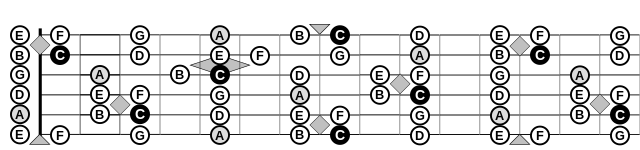
- Intervals of the C major scale (transferable to other keys).


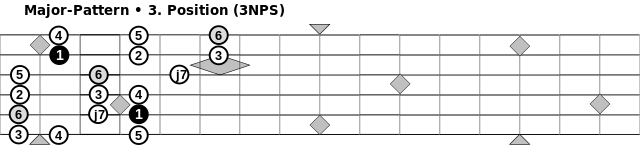

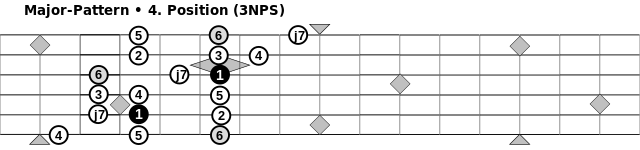


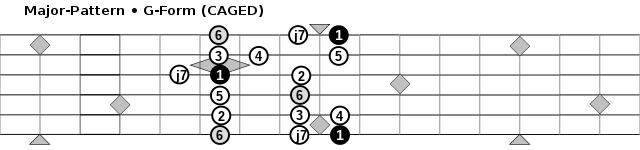

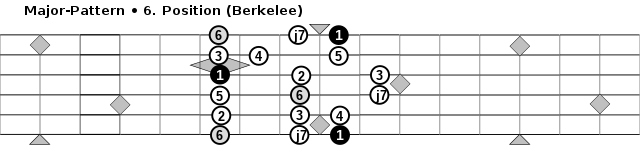


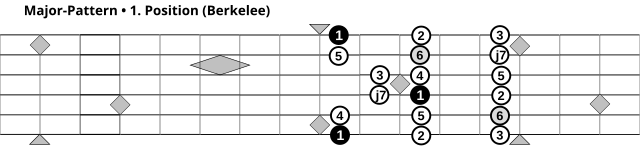


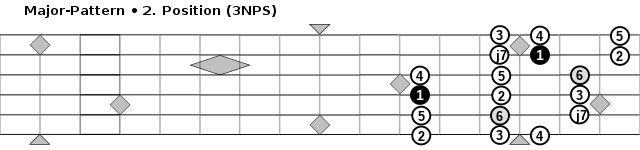
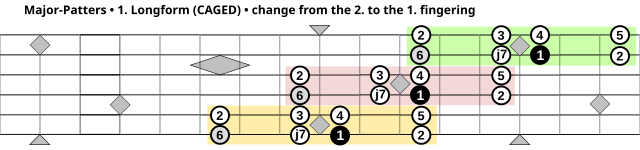


adopted from the German-language Wikibooks. here: chapter about the major scales translated from google.
Natural Minor Scale[edit | edit source]
The pattern for any natural minor scale is 2-1-2-2-1-2-2, shown in steps as W-H-W-W-H-W-W
Natural Minor Scale in the key of A
A-B-C-D-E-F-G-A
e |---5--------
B |---5-6---8--
G |-4-5---7----
D |---5---7----
A |---5---7-8--
E |---5---7-8--

The movable shape for this scale is shown:
e |-------|---x---|-------|-------|-------|
B |-------|---x---|---x---|-------|---x---|
G |---x---|---x---|-------|---x---|-------|
D |-------|---x---|-------|---x---|-------|
A |-------|---x---|-------|---x---|---x---|
E |-------|---x---|-------|---x---|---x---|
             5th
Harmonic Minor Scale[edit | edit source]
The Harmonic minor scale has a very different quality than the minor pentatonic scale. It has a "middle-eastern" sound when used to play lead lines.
A-B-C-D-E-F-G#-A
This is a moveable shape and to play in other keys just move the shape up or down the neck:
e |--4--5-----7--8--
B |-----5--6--------
G |--4--5-----7-----
D |--------6--7-----
A |-----5-----7--8--
E |-----5-----7--8--

This looks a little more complicated, and is certainly more difficult to get to sound nice, but when you have mastered it, it will sound great!
Melodic Minor Scale[edit | edit source]
This scale is actually two scales. Thus when one speaks of a "melodic minor" pattern, one refers to two patterns - one ascending and one descending.
A-B-C-D-E-F#-G#-A (ascending) A-G-F-E-D-C-B-A (descending)
This is best illustrated by playing the melodic minor scale. Below is the A melodic minor scale in tab; note the sharps when ascending and the naturals when descending.

The ascending pattern is constructed by raising the 6th and 7th steps of the natural minor scale.
When descending the normal natural minor scale is used without the 6th and 7th raised. The reason for this is to be found in singing. Vocalists find the augmented second between the F and G sharp in the Harmonic minor scale very awkward to sing. It is not impossible but the dissonance of the interval and the sense of "leaping" meant that a different approach was sought. The answer was to also raise the sixth note. The awkward augmented second was gone and the melody flowed better due to the absence of the leap.
Hungarian Minor[edit | edit source]
The Hungarian minor scale is a type of combined musical scale. It is akin to the harmonic minor scale, except that it bears a raised fourth. Its tonal center is slightly ambiguous, due to the large number of half steps. Also known as Double Harmonic Minor, or Harmonic Minor #4, it figures prominently in Eastern European music, particularly in gypsy music. Melodies based on this scale have an exotic, romantic flavor.
e |--7--8-----10--11--
B |--7--8--9----------
G |--7--8-------------
D |--------9--10------
A |--------9--10--11--
E |-----8-----10--11--

A Hungarian minor scale in the key of C would proceed as follows:
C-D-Eb-F#-G-Ab-B-C
Its scale degrees are 1 2 b3 #4 5 b6 7 and its step pattern w - h - + - h - h - + - h, where w indicates a whole step, h indicates a half step, and + indicates an augmented second.
Derived chords[edit | edit source]
Chords that may be derived from the Hungarian minor scale are:
-
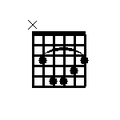 C Minor
 -
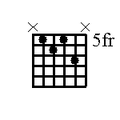 D7 Flat Fifth
 -
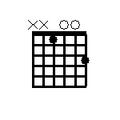 E Flat Augmented
 -
 G Major
 -
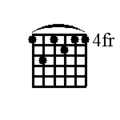 A Flat Seventh
 -
 B Minor Sixth


.png)


This scale is obtainable from the *Arabic scale by starting from the fourth of that scale. Said another way, the C Hungarian minor scale is equivalent to the G Arabic scale.
In the video game, The Illusion of Gaia (published by the Enix Corporation), the flute melody found in the Inca Ruins uses the C Hungarian minor scale (a #4 is used in the second phrase); this music is also quoted when the player reaches the Larai Cliff stage of the game, transposed to D.
Joe Satriani has composed several songs using the Hungarian minor scale.
Church Modes[edit | edit source]
The Church Modes preceded the Major-Minor system. The student is advised to listen to the music of Palestrina as well as the jazz album Kind of Blue by Miles Davis; both use modes to great effect.
For example, in the key of C, the notes are:
C-D-E-F-G-A-B-C
If you wanted to play in the 2nd mode, called the Dorian mode, then you would just play the same notes, but start on the second note. So instead you would play:
D-E-F-G-A-B-C-D
The different modes are called:
- Ionian
- Dorian
- Phrygian
- Lydian
- Mixolydian
- Aeolian
- Locrian
The Phrygian mode - E F G A B C D E - is of special interest to flamenco players. The third and seventh degrees are often sharpened, giving the scale notes E F G# A B C D# E. This arrangement is commonly used in descending form. The second degree of the scale is referred to as a leaning note, which means the note tends to fall one semitone. In this case F falls to E.