Guitar/Chord Types
A chord is two or more different notes played simultaneously. Most chords have three notes though. Chords derive their names from the root note; so a C chord has C for its root note and a G7 chord will have G. The interval between the root note and the third determines whether a chord is a major or minor. Chords may be strummed or the notes picked individually though beginners find strumming much easier. The more advanced technique of picking is examined in the Picking and Plucking chapter.
While chords are primarily used for rhythm guitar, basic chord knowledge can be important for lead playing as well. Knowing how chords are constructed can help when learning the lead parts of many songs since there is always a relationship between a chord and the lead part. For example, if you have to play a lead part over a C major chord (C-E-G) and you use the notes of a D flat major chord (Db-F-Ab) then the result will be very dissonant. Additionally, many lead patterns revolve around arpeggios. These are chords with their notes played in sequence (the word "arpeggio" actually means "broken chord") rather than together. For more information on arpeggios, see the Arpeggio and Sweep Picking chapter.
Chords are easy to play though understanding the theory behind chord construction (harmony) will require some understanding of scales. While it is not essential to have a knowledge of scales to be able to use this section, understanding scales will definitely improve your general musicianship. With that in mind, go ahead and learn and use these chords without worrying too much about the theory and when you have the time take a look at the page on general music theory and the page on scales.
Beginners are advised to start with open chords, which are often the easiest chords to form. Learning open chords is important because it sets the stage for learning how to form barre chords. Barre Chords are chords you form by pressing all (or some) of the strings down with the first finger. This finger acts as the barre (the same job that the nut of the guitar does when you are playing open chords). Because of this barre chords don't usually include open strings and can be moved freely up and down the neck. As you move your barre chord, the shape of the chord remains the same although all the notes change. Barring is an important technique and greatly opens up the neck of the instrument.
Different Kinds of Chords[edit | edit source]
Major chords[edit | edit source]
The most basic chord is called a triad and consists of three different notes. A major triad consists of the root, a major third, and a perfect fifth. The early study of chords should be based around how to build the tonic triad (chord) from any major scale. To build the tonic triad you take the first note of any major scale and the third note (a major 3rd) and the fifth note (a perfect fifth). Take for example building a tonic triad (chord) from the C major scale. If you look at this C major scale:
C-D-E-F-G-A-B-C
you will notice that the first, third and fifth notes of the scale are C, E, and G. The most obvious thing that most guitarists become instantly aware of is that the C major played in the first position actually involves playing 5 strings and therefore must have more notes than a triad. The C major chord shown below has these notes C, E, G, C, E. If you cancel out the doubles you are left with a C major triad. This brings us to an important rule: any chord tone (note) can be doubled without affecting the chords designation. Therefore a C major triad (C-E-G) and the first position C major chord below (C-E-G-C-E) are both still C major chords though the 5 note version will sound fuller due to the note doubling. Major chords have a characteristically bright and happy sound.
-
 C major
.png)
Minor chords[edit | edit source]
The minor triad consists of a root, a minor third and a perfect fifth. The interval between the root and third is a minor third and the interval between the root and fifth is a perfect fifth. Minor chords have a dissonant quality due to the interval of a minor third. It must be remembered that we are talking about building chords from scales and that these intervals, the minor third and perfect fifth, are the interval designations from the scale which are then applied to naming the intervals in a chord. Which is why the triad intervals are not named 1st, 2nd and 3rd respectively.
Minor chords are best understood in relation to their major chord counterpart. In the example below we will use E major and E minor. When we play an E major chord, we can flatten the third of the chord by lifting the finger that is holding down the third string at the first fret, making it an open string. By altering this one note so that the interval is changed from a major third to a minor third, we have formed a new chord: E minor.
-
 E major
 -
 E minor
.png)
.png)
Switching between major and minor chords can be relatively easy, as it involves the change of only one note. Some chord changes, for example changing between an open F major to a F minor, will need a little more effort.
Dominant Seventh chords[edit | edit source]
A minor seventh is added to a major chord. When a minor seventh is added to any major chord that major chord is changed into a dominant seventh. The dominant chord always refers to the chord built on the fifth degree of any major scale. Look at the C major scale below:
C-D-E-F-G-A-B-C
The fifth degree of the scale is G. The chord built on the fifth contains the notes: G-B-D. To change this dominant major chord to a dominant seventh you need to add a fourth note. The note you add is F (the minor seventh) which now makes: G-B-D-F. This chord has very strong need to resolve usually to the tonic. The reason the interval in G-B-D-F is called a minor seventh and not a perfect fourth is that interval designation is determined from the root of the chord being discussed. Take for example the G major scale below:
G-A-B-C-D-E-F#-G
As you can see the interval G-F# is a major seventh. You can form a minor seventh interval by lowering the seventh by a semitone: G-F. This holds true for all major seventh intervals.
At first it seems quite strange looking at the interval relationship of another key to determine the chord intervals of the key you are playing in. With practice it becomes very easy but does involve learning a few major scales.
-
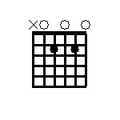 A7
A7 -
 G7
G7
.png)
.png)
Sixth chords[edit | edit source]
Add a sixth to the chord. The two chords below are major chords from the key of C with a sixth added.
-
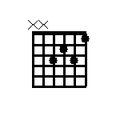 F6 (Subdominant in C major)
 -
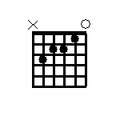 C6 (Tonic in C major)
.png)
.png)
Suspended chords[edit | edit source]
To form a suspended chord the third is replaced with either a second or a fourth. The third of a chord defines its modality - whether a chord is major or minor. By removing the third and replacing it with a second or fourth you have suspended the chord's modal quality. This creates a chord that is neither major or minor and the ear interprets the chord as harmonically ambiguous.
Suspended chords derived from a D major chord:
-
 Dsus2
Dsus2 -
 D major
 -
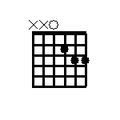 Dsus4
Dsus4
.png)
.png)
.png)
Suspended chords derived from the A major chord:
-
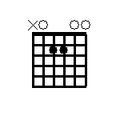 Asus2
Asus2 -
 A major
 -
 Asus4
Asus4
.png)
.png)
.png)
Suspending an E major chord:
-
E major
-
 Esus4
Esus4
.png)
Slash chords[edit | edit source]
Chords that are not in root position. For example, a C/G is a C chord with a bass note of G. They are also referred to as "inversions". Slash chords are always notated with their chord name first followed by the bass note.
-
 C/G
C/G -
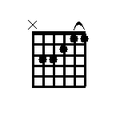 F/C
F/C
.png)
.png)
Diminished chords[edit | edit source]
These consist of a stack of minor thirds. You can extend a diminished triad (three note chord) by adding another minor third; which gives you a four note chord called a diminished seventh chord. The diminished seventh chord is notated as Co7 or dim7. Diminished seventh chords are built entirely from minor thirds, so you can move the chord shape up the neck in intervals of a minor third (three frets) and this will be exactly the same notes as the original chord but in a different order. The term "inversion" is used when chords have their notes rearranged.
-
 Edim7 - root position
 -
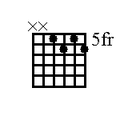 Edim7 - 1st inversion
 -
 Edim7 - 2nd inversion
.png)
.png)
.png)
A half-diminished chord consists of a diminished triad with a major third on top. In other words, a half-diminished chord is a diminished triad with a minor seventh.
Diminished chords are full of tension because of the dissonance created by stacking minor third intervals and they are normally resolved to a consonant major or minor chord.