Guitar/Reggae

Introduction[edit | edit source]
Reggae is a musical form that is rarely treated in guitar books. Its a syncopated music which is often difficult to notate and reggae guitarists are rarely given the chance to play extended solos. In many respects, the reggae guitarist is a fundamental part of the rhythm section. The guitar is often heard doubling the bassline with muted pick work or providing a steady chordal backbeat on the 2nd and 4th beat. This simple assignment of guitar role belies the true complexity of what is a fascinating guitar style.
Reggae was born out of the West Indian 1950s rhythm 'n' blues music scene. It was a unique local rhythmic twist of a very popular world-wide genre. An excellent example is Easy Snappin' by Theophilus Beckford. This huge 1950s West Indian hit record is pure rhythm 'n' blues in structure but there's a change in the syncopation. Its more emphasised and the vocals have a vernacular flavour. The guitarist on this seminal record is Ernest Ranglin. Ranglin plays an incredibly fast blues inflected line to support the rhythm. The guitar sound belongs to the period that gave us Chuck Berry but the solo itself is uniquely Jamaican. The guitar work of Peter Tosh with The Wailers provides a blueprint for the 1970s. To hear Tosh play "Stir It Up" on the recording is a revelation. The effect laden guitar part is so integrated into the performance that it difficult to hear it as a single entity. Rock guitar has given us riffs such as "Satisfaction" by The Rolling Stones or "Sweet Child Of Mine" by Guns and Roses and these riffs can be learned and enjoyed separate from the songs they originated from. Reggae is the opposite; it demands of the guitarist complete rhythmic awareness of the other instruments and the ability to submerge the guitar into the harmonic and rhythmic framework.
Harmony[edit | edit source]
The chords used in reggae are the same as most other genres but due to the need to create a syncopated rhythm open chords are rarely used throughout a piece. The most common chord shapes are barres or half-barres with emphasis placed on the treble strings. It is quite common in reggae to use minor keys and to use the dominant chord in its minor form and therefore the music may never form a perfect cadence. Here is a sixteen bar reggae chord progression in the key of Gm:
| Gm | Gm | Dm | Dm |
| Gm | Gm | Dm | Dm |
| Cm | Cm | Dm | Dm |
| Cm | Cm | Dm | Dm |
Try to play the chord progression with a reggae rhythm using the chords below. Note the fingering given for the Dm chord.
-
 Gm half-barre
 -
 Cm
Cm -
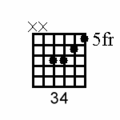 Dm
Dm
.png)
.png)
.png)
Offbeat[edit | edit source]
The most common approach to reggae rhythm guitar is to play the chords on the offbeat. The majority of reggae songs use common time. Common time has four beats to a bar and the offbeats are 2 and 4. To play a reggae rhythm you count "1 - 2 - 3 - 4 -" and only strike the chord on 2 and 4. Its a common technique to dampen the chord after striking so as to create a percussive short sound. Damping can be achieved in two ways: either by using the right-hand palm flesh to stop the notes from sounding or by releasing the finger pressure of the left hand that holds a chord shape. The left-hand technique is favoured by reggae guitarists since the placing of the right-hand palm edge against the strings near the bridge is more awkward to use. When you relieve the finger pressure of the left-hand; do not remove your fingers from the chord. To produce a short precussive sound you only need to release the pressure you are applying ensuring that the chord stops sounding and that your fingers are in-place to press down again. The left-hand offbeat technique is not ideal for chords that contain open strings and is most typically used with chords that have no open strings sounding (see chords above).
Exercise One[edit | edit source]
Here is a typical reggae rhythm played on the offbeat. After striking the chord remember to release the pressure on the strings immediately to produce a short percussive sounding chord.

Doubling The Bassline[edit | edit source]
Reggae guitarists often "double the bassline". The top four strings of the guitar are the same as the bass guitar. The guitarist will play the same notes with the same rhythm as the bass usually in the same position. Sometimes the guitarist will choose to dampen the strings by placing the fleshy edge of their right-hand palm lightly against the strings near the bridge. The aim of this is not to stop the strings from sounding but to slightly dampen the strings so that they have a percussive attack.
Its not always the case that the guitar doubles the bass exactly. A common variation, borrowed from the soul and blues genres, is the playing of triplets using a fast up-and-down pick technique and using the same notes usually in the same position. This use of triplets against a "four-to-the-floor" bassline can impart a sense of driving rhythmic unity with variation.
Working Out Horn Riffs[edit | edit source]
Horns riffs are used in reggae to provide melodic support. For guitarists it helps when counting bars to understand what the horns are doing. A common device is to use horn riffs across barlines. This further adds to the syncopated feel of reggae. The horns may start on the 3rd or 4th beat of a bar playing the riff until the 2nd beat of the next bar. With practice it becomes very easy to count out these "across the barline" horn riffs. It may also provide the guitarist with riffs that he can use across barlines when playing with another guitarist who is strictly playing rhythm.