Guitar/Blues Exercises
Exercise 1[edit | edit source]
The exercise below is a blues in C using seventh chords.
| C7 | C7 | C7 | C7 |
| F7 | F7 | C7 | C7 |
| G7 | F7 | C7 | C7 |
The partial seventh chords below are to be played as stab chords. Play these partial chords on the back beat (play the chord on the snare) using a down-stroke to add to the rhythmic drive. Note that the second finger remains on the same string. This allows easy movement between the chords and fast tempos can be achieved with ease.
-
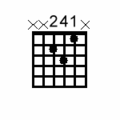 C7
C7 -
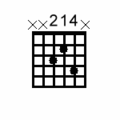 F7
F7 -
 G7
G7
.png)
.png)
.png)
Exercise 2[edit | edit source]
Here is a blues box in Dm
| Dm7 | Dm7 | Dm7 | Dm7 |
| Gm7 | Gm7 | Dm7 | Dm7 |
| Am7 | Gm7 | Dm7 | Am7 |
You can play a blues using only minor seventh chords. In most cases where you form a half-barre the first finger will be used but for the Gm7 and Am7 below you can use the third finger. The choice is yours though I think you'll find in this instance using the third finger is more comfortable.
-
 Dm7
Dm7 -
 Gm7
Gm7 -
 Am7
Am7
.png)
.png)
.png)
In this variation you will be using a single chord shape to play the twelve bar blues. Fingering has been given for the Dm7.
-
 Dm7
Dm7 -
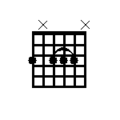 Gm7
Gm7 -
 Am7
Am7
.png)
.png)
.png)
Exercise 3[edit | edit source]
Here is a blues exercise in A using sevenths.
.png)
For a soul feel try jumping from the first note to the fifth note in each bar when starting the riff.
Exercise 4[edit | edit source]
Here is a typical blues rhythm.
.png)