Riemann integration is the formulation of integration most people think of if they ever think about integration. It is the only type of integration considered in most calculus classes; many other forms of integration, notably Lebesgue integrals, are extensions of Riemann integrals to larger classes of functions. The Riemann integral was developed by Bernhard Riemann in 1854 and was, when invented, the first rigorous definition of integration applicable to not necessarily continuous functions.
We will first define some preliminary ideas.
Let
a
,
b
∈
R
{\displaystyle a,b\in \mathbb {R} }
A Partition
P
{\displaystyle {\mathcal {P}}}
n
{\displaystyle n}
-tuple of real numbers
P
=
(
x
0
,
x
1
,
…
,
x
n
)
{\displaystyle {\mathcal {P}}=(x_{0},x_{1},\ldots ,x_{n})}
a
=
x
0
<
x
1
<
…
<
x
n
=
b
{\displaystyle a=x_{0}<x_{1}<\ldots <x_{n}=b}
Let
P
{\displaystyle {\mathcal {P}}}
P
=
(
x
0
,
x
1
,
x
2
,
…
,
x
n
)
{\displaystyle {\mathcal {P}}=(x_{0},x_{1},x_{2},\ldots ,x_{n})}
Then, the Norm (or the "mesh") of
P
{\displaystyle {\mathcal {P}}}
‖
P
‖
=
sup
{
|
x
k
−
x
k
−
1
|
:
1
≤
k
≤
n
}
{\displaystyle \|{\mathcal {P}}\|=\sup {\Big \{}{\big |}x_{k}-x_{k-1}{\big |}:1\leq k\leq n{\Big \}}}
Let
P
=
(
x
0
,
x
1
,
…
,
x
n
)
{\displaystyle {\mathcal {P}}=(x_{0},x_{1},\ldots ,x_{n})}
A Tagged Partition
P
˙
{\displaystyle {\mathcal {\dot {P}}}}
P
˙
=
{
(
[
x
k
−
1
,
x
k
]
,
t
k
)
}
k
=
1
n
{\displaystyle {\mathcal {\dot {P}}}={\Big \{}{\big (}[x_{k-1},x_{k}],t_{k}{\big )}{\Big \}}_{k=1}^{n}}
x
k
−
1
≤
t
k
≤
x
k
{\displaystyle x_{k-1}\leq t_{k}\leq x_{k}}
t
k
{\displaystyle t_{k}}
Tags .
Riemann sum of a function Let
f
:
[
a
,
b
]
→
R
{\displaystyle f:[a,b]\to \mathbb {R} }
Let
P
˙
=
{
(
[
x
k
−
1
,
x
k
]
,
t
k
)
}
k
=
1
n
{\displaystyle {\mathcal {\dot {P}}}={\Big \{}{\big (}[x_{k-1},x_{k}],t_{k}{\big )}{\Big \}}_{k=1}^{n}}
[
a
,
b
]
{\displaystyle [a,b]}
The Riemann Sum of
f
{\displaystyle f}
[
a
,
b
]
{\displaystyle [a,b]}
P
˙
{\displaystyle {\mathcal {\dot {P}}}}
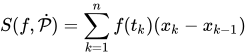
S
(
f
,
P
˙
)
=
∑
k
=
1
n
f
(
t
k
)
(
x
k
−
x
k
−
1
)
{\displaystyle S(f,{\mathcal {\dot {P}}})=\sum _{k=1}^{n}f(t_{k})(x_{k}-x_{k-1})}
Let
f
:
[
a
,
b
]
→
R
{\displaystyle f:[a,b]\to \mathbb {R} }
Let
L
∈
R
{\displaystyle L\in \mathbb {R} }
We say that
f
{\displaystyle f}
Integrable on
[
a
,
b
]
{\displaystyle [a,b]}
ε
>
0
{\displaystyle \varepsilon >0}
δ
>
0
{\displaystyle \delta >0}
P
˙
{\displaystyle {\mathcal {\dot {P}}}}
‖
P
˙
‖
<
δ
{\displaystyle \|{\mathcal {\dot {P}}}\|<\delta }
|
S
(
f
,
P
˙
)
−
L
|
<
ε
{\displaystyle |S(f,{\mathcal {\dot {P}}})-L|<\varepsilon }
L
{\displaystyle L}
integral of
f
{\displaystyle f}
[
a
,
b
]
{\displaystyle [a,b]}
L
=
∫
a
b
f
(
x
)
d
x
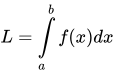
{\displaystyle L=\int \limits _{a}^{b}f(x)dx}
L
=
∫
a
b
f
{\displaystyle L=\int \limits _{a}^{b}f}
Let
f
:
[
a
,
b
]
→
R
{\displaystyle f:[a,b]\to \mathbb {R} }
[
a
,
b
]
{\displaystyle [a,b]}
Then the integral
L
{\displaystyle L}
f
{\displaystyle f}
Assume, if possible that
L
1
≠
L
2
{\displaystyle L_{1}\neq L_{2}}
f
{\displaystyle f}
[
a
,
b
]
{\displaystyle [a,b]}
ε
=
|
L
1
−
L
2
|
2
{\displaystyle \varepsilon ={\tfrac {|L_{1}-L_{2}|}{2}}}
As
L
1
,
L
2
{\displaystyle L_{1},L_{2}}
δ
1
,
δ
2
>
0
{\displaystyle \delta _{1},\delta _{2}>0}
|
S
(
f
,
P
˙
)
−
L
1
|
<
ε
{\displaystyle |S(f,{\mathcal {\dot {P}}})-L_{1}|<\varepsilon }
P
˙
{\displaystyle {\mathcal {\dot {P}}}}
‖
P
˙
‖
<
δ
1
{\displaystyle \|{\mathcal {\dot {P}}}\|<\delta _{1}}
|
S
(
f
,
P
˙
)
−
L
2
|
<
ε
{\displaystyle |S(f,{\mathcal {\dot {P}}})-L_{2}|<\varepsilon }
P
˙
{\displaystyle {\mathcal {\dot {P}}}}
‖
P
˙
‖
<
δ
2
{\displaystyle \|{\mathcal {\dot {P}}}\|<\delta _{2}}
Let
δ
=
inf
{
δ
1
,
δ
2
}
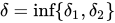
{\displaystyle \delta =\inf\{\delta _{1},\delta _{2}\}}
P
˙
{\displaystyle {\mathcal {\dot {P}}}}
‖
P
˙
‖
<
δ
{\displaystyle \|{\mathcal {\dot {P}}}\|<\delta }
|
S
(
f
,
P
˙
)
−
L
1
|
<
ε
{\displaystyle |S(f,{\mathcal {\dot {P}}})-L_{1}|<\varepsilon }
|
S
(
f
,
P
˙
)
−
L
2
|
<
ε
{\displaystyle |S(f,{\mathcal {\dot {P}}})-L_{2}|<\varepsilon }
That is,
|
L
1
−
L
2
|
<
2
ε
=
|
L
1
−
L
2
|
{\displaystyle |L_{1}-L_{2}|<2\varepsilon =|L_{1}-L_{2}|}
L
{\displaystyle L}
f
{\displaystyle f}
Let
f
,
g
:
[
a
,
b
]
→
R
{\displaystyle f,g:[a,b]\to \mathbb {R} }
c
∈
(
a
,
b
)
{\displaystyle c\in (a,b)}
Then:
(i)
∫
a
b
f
+
∫
a
b
g
=
∫
a
b
(
f
+
g
)
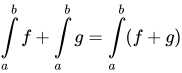
{\displaystyle \int \limits _{a}^{b}f+\int \limits _{a}^{b}g=\int \limits _{a}^{b}(f+g)}
(ii)
∫
a
c
f
+
∫
c
b
f
=
∫
a
b
f
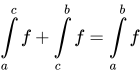
{\displaystyle \int \limits _{a}^{c}f+\int \limits _{c}^{b}f=\int \limits _{a}^{b}f}
Let
f
:
[
a
,
b
]
→
R
{\displaystyle f:[a,b]\to \mathbb {R} }
f
{\displaystyle f}
[
a
,
b
]
{\displaystyle [a,b]}
Assume if possible that
f
{\displaystyle f}
n
∈
N
{\displaystyle n\in \mathbb {N} }
[
a
,
b
]
{\displaystyle [a,b]}
n
{\displaystyle n}
n
∈
N
{\displaystyle n\in \mathbb {N} }
f
{\displaystyle f}
n
{\displaystyle n}
I
n
{\displaystyle I_{n}}
Now, let
ε
>
0
{\displaystyle \varepsilon >0}
δ
>
0
{\displaystyle \delta >0}
P
˙
{\displaystyle {\mathcal {\dot {P}}}}
‖
P
˙
‖
<
δ
{\displaystyle \|{\mathcal {\dot {P}}}\|<\delta }
(
I
n
,
t
n
)
∈
P
˙
{\displaystyle (I_{n},t_{n})\in {\mathcal {\dot {P}}}}
t
n
{\displaystyle t_{n}}
|
f
(
t
n
)
|
>
n
ε
{\displaystyle |f(t_{n})|>n\varepsilon }
Thus we have that
|
S
(
f
,
P
˙
)
−
L
|
>
ε
{\displaystyle |S(f,{\mathcal {\dot {P}}})-L|>\varepsilon }
δ
>
0
{\displaystyle \delta >0}
f
{\displaystyle f}
Hence,
f
{\displaystyle f}
We now study classes of Riemann integrable functions. The first "constraint" on Riemann integrable functions is provided by the Cauchy Integrability Criterion.
Let
f
:
[
a
,
b
]
→
R
{\displaystyle f:[a,b]\to \mathbb {R} }
Then,
(i)
f
{\displaystyle f}
[
a
,
b
]
{\displaystyle [a,b]}
(ii) For every
ε
>
0
{\displaystyle \varepsilon >0}
δ
>
0
{\displaystyle \delta >0}
P
˙
,
Q
˙
{\displaystyle {\mathcal {\dot {P}}},{\mathcal {\dot {Q}}}}
‖
P
˙
‖
,
‖
Q
˙
‖
<
δ
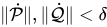
{\displaystyle \|{\mathcal {\dot {P}}}\|,\|{\mathcal {\dot {Q}}}\|<\delta }
|
S
(
f
,
P
˙
)
−
S
(
f
,
Q
˙
)
|
<
ε
{\displaystyle |S(f,{\mathcal {\dot {P}}})-S(f,{\mathcal {\dot {Q}}})|<\varepsilon }
(
⇒
{\displaystyle \Rightarrow }
∫
a
b
f
=
L
{\displaystyle \int _{a}^{b}f=L}
ε
>
0
{\displaystyle \varepsilon >0}
Then, there exists
δ
>
0
{\displaystyle \delta >0}
P
˙
{\displaystyle {\mathcal {\dot {P}}}}
‖
P
˙
‖
<
δ
{\displaystyle \|{\mathcal {\dot {P}}}\|<\delta }
|
S
(
f
,
P
˙
)
−
L
|
<
ε
2
{\displaystyle |S(f,{\mathcal {\dot {P}}})-L|<{\tfrac {\varepsilon }{2}}}
Now, let partitions
P
˙
,
Q
˙
{\displaystyle {\mathcal {\dot {P}}},{\mathcal {\dot {Q}}}}
‖
P
˙
‖
,
‖
Q
˙
‖
<
δ
{\displaystyle \|{\mathcal {\dot {P}}}\|,\|{\mathcal {\dot {Q}}}\|<\delta }
Thus we have that
|
S
(
f
,
P
˙
)
−
L
|
,
|
S
(
f
,
Q
˙
)
−
L
|
<
ε
2
{\displaystyle |S(f,{\mathcal {\dot {P}}})-L|,|S(f,{\mathcal {\dot {Q}}})-L|<{\tfrac {\varepsilon }{2}}}
|
S
(
f
,
P
˙
)
−
S
(
f
,
Q
˙
)
|
<
ε
{\displaystyle |S(f,{\mathcal {\dot {P}}})-S(f,{\mathcal {\dot {Q}}})|<\varepsilon }
(
⇐
{\displaystyle \Leftarrow }
n
∈
N
{\displaystyle n\in \mathbb {N} }
δ
n
>
0
{\displaystyle \delta _{n}>0}
P
˙
,
Q
˙
{\displaystyle {\mathcal {\dot {P}}},{\mathcal {\dot {Q}}}}
‖
P
˙
‖
,
‖
Q
˙
‖
<
δ
n
{\displaystyle \|{\mathcal {\dot {P}}}\|,\|{\mathcal {\dot {Q}}}\|<\delta _{n}}
|
S
(
f
,
P
˙
)
−
S
(
f
,
Q
˙
)
|
<
1
n
{\displaystyle |S(f,{\mathcal {\dot {P}}})-S(f,{\mathcal {\dot {Q}}})|<{\tfrac {1}{n}}}
Without loss of generality, we can assume that
δ
m
>
δ
n
{\displaystyle \delta _{m}>\delta _{n}}
m
<
n
{\displaystyle m<n}
δ
n
{\displaystyle \delta _{n}}
P
˙
n
{\displaystyle {\mathcal {\dot {P}}}_{n}}
‖
P
˙
n
‖
<
δ
n
{\displaystyle \|{\mathcal {\dot {P}}}_{n}\|<\delta _{n}}
The sequence
a
n
=
S
(
f
,
P
˙
n
)
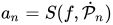
{\displaystyle a_{n}=S(f,{\mathcal {\dot {P}}}_{n})}
L
∈
R
{\displaystyle L\in \mathbb {R} }
Now, for every
ε
>
0
{\displaystyle \varepsilon >0}
δ
>
0
{\displaystyle \delta >0}
‖
P
˙
‖
<
δ
{\displaystyle \|{\mathcal {\dot {P}}}\|<\delta }
|
S
(
f
,
P
˙
)
−
L
|
<
ε
{\displaystyle |S(f,{\mathcal {\dot {P}}})-L|<\varepsilon }
Thus
∫
a
b
f
=
L
{\displaystyle \int _{a}^{b}f=L}
Let
f
:
[
a
,
b
]
→
R
{\displaystyle f:[a,b]\to \mathbb {R} }
Then,
(i)
f
{\displaystyle f}
[
a
,
b
]
{\displaystyle [a,b]}
(ii) For every
ε
>
0
{\displaystyle \varepsilon >0}
Riemann integrable functions
α
ε
,
ω
ε
:
[
a
,
b
]
→
R
{\displaystyle \alpha _{\varepsilon },\omega _{\varepsilon }:[a,b]\to \mathbb {R} }
α
ε
(
x
)
≤
f
(
x
)
≤
ω
ε
(
x
)
{\displaystyle \alpha _{\varepsilon }(x)\leq f(x)\leq \omega _{\varepsilon }(x)}
x
∈
[
a
,
b
]
{\displaystyle x\in [a,b]}
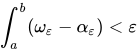
∫
a
b
(
ω
ε
−
α
ε
)
<
ε
{\displaystyle \int _{a}^{b}(\omega _{\varepsilon }-\alpha _{\varepsilon })<\varepsilon }
(
⇒
{\displaystyle \Rightarrow }
α
ε
(
x
)
=
f
(
x
)
=
ω
ε
(
x
)
{\displaystyle \alpha _{\varepsilon }(x)=f(x)=\omega _{\varepsilon }(x)}
∫
a
b
(
ω
ε
−
α
ε
)
<
ε
{\displaystyle \int _{a}^{b}(\omega _{\varepsilon }-\alpha _{\varepsilon })<\varepsilon }
(
⇐
{\displaystyle \Leftarrow }
n
∈
N
{\displaystyle n\in \mathbb {N} }
α
n
,
ω
n
{\displaystyle \alpha _{n},\omega _{n}}
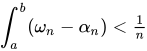
∫
a
b
(
ω
n
−
α
n
)
<
1
n
{\displaystyle \int _{a}^{b}(\omega _{n}-\alpha _{n})<{\tfrac {1}{n}}}
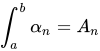
∫
a
b
α
n
=
A
n
{\displaystyle \int _{a}^{b}\alpha _{n}=A_{n}}
∫
a
b
ω
n
=
Z
n
{\displaystyle \int _{a}^{b}\omega _{n}=Z_{n}}
δ
1
,
δ
2
>
0
{\displaystyle \delta _{1},\delta _{2}>0}
P
˙
{\displaystyle {\mathcal {\dot {P}}}}
‖
P
˙
‖
<
δ
1
{\displaystyle \|{\mathcal {\dot {P}}}\|<\delta _{1}}
|
S
(
α
n
,
P
˙
)
−
A
n
|
<
1
n
{\displaystyle |S(\alpha _{n},{\mathcal {\dot {P}}})-A_{n}|<{\tfrac {1}{n}}}
‖
P
˙
‖
<
δ
2
{\displaystyle \|{\mathcal {\dot {P}}}\|<\delta _{2}}
|
S
(
ω
n
,
P
˙
)
−
Z
n
|
<
1
n
{\displaystyle |S(\omega _{n},{\mathcal {\dot {P}}})-Z_{n}|<{\tfrac {1}{n}}}
Now let
P
˙
n
{\displaystyle {\mathcal {\dot {P}}}_{n}}
‖
P
˙
n
‖
<
inf
{
δ
1
,
δ
2
}
{\displaystyle \|{\mathcal {\dot {P}}}_{n}\|<\inf\{\delta _{1},\delta _{2}\}}
Now, we can easily see that
|
S
(
f
,
P
˙
n
)
−
S
(
f
,
P
˙
n
−
1
)
|
<
1
n
{\displaystyle |S(f,{\mathcal {\dot {P}}}_{n})-S(f,{\mathcal {\dot {P}}}_{n-1})|<{\tfrac {1}{n}}}
S
(
f
,
P
˙
n
)
{\displaystyle S(f,{\mathcal {\dot {P}}}_{n})}
L
∈
R
{\displaystyle L\in \mathbb {R} }
∫
a
b
f
=
L
{\displaystyle \int _{a}^{b}f=L}







![{\displaystyle {\mathcal {\dot {P}}}={\Big \{}{\big (}[x_{k-1},x_{k}],t_{k}{\big )}{\Big \}}_{k=1}^{n}}](https://wikimedia.org/api/rest_v1/media/math/render/svg/77f253abdc4e0ce2f10c8420265b4e7f597663e0)



![{\displaystyle f:[a,b]\to \mathbb {R} }](https://wikimedia.org/api/rest_v1/media/math/render/svg/b592d102ccd1ba134d401c5b3ea177baaba3ffac)
![{\displaystyle [a,b]}](https://wikimedia.org/api/rest_v1/media/math/render/svg/9c4b788fc5c637e26ee98b45f89a5c08c85f7935)











![{\displaystyle f,g:[a,b]\to \mathbb {R} }](https://wikimedia.org/api/rest_v1/media/math/render/svg/e569de0fc730b7a75b46b6fd57598e0c94712f91)











![{\displaystyle \alpha _{\varepsilon },\omega _{\varepsilon }:[a,b]\to \mathbb {R} }](https://wikimedia.org/api/rest_v1/media/math/render/svg/0c3bca9583bc996cabc8eea919e87dddb31e31bb)

![{\displaystyle x\in [a,b]}](https://wikimedia.org/api/rest_v1/media/math/render/svg/026357b404ee584c475579fb2302a4e9881b8cce)