Real Analysis/Fundamental Theorem of Calculus
| ←Riemann integration | Real Analysis Fundamental Theorem of Calculus |
Darboux Integral→ |
The Fundamental Theorem of Calculus is often claimed as the central theorem of elementary calculus. Although it can be naturally derived when combining the formal definitions of differentiation and integration, its consequences open up a much wider field of mathematics suitable to justify the entire idea of calculus as a math discipline.
You will be surprised to notice that there are actually two theorems that make up The Fundamental Theorem of Calculus. They both serve to prove the relationship between differentiation and definite integration, but the first proves that they are inverses of each other, only in the sense that they undo each other's operation, and the second proves that there exists a way of computing definite integration using antiderivatives. This theorem, much like the concept of the limit, will form much of the backbone of latter theorems moving forward, so it is crucial to understand what these theorems can do. As such, the layout of this section mirrors that of the limit.
Definition
[edit | edit source]It is essential to understand what the theorems actually state, which are highlighted below
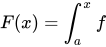
Given a continuous function ƒ and a function F, both over some closed interval I, if the form is valid, then it implies that is valid as well.


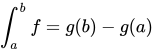
If ƒ is integrable and ƒ is a differentiation of some other function g, then the definite integration is defined as .
However, unlike the section on limits, this is not a definition primarily based on agreed mathematical concepts, as was the case with limits with its definition only needing one theorem to justify, but a theorem relying on several concepts to function together without contradictions. After all, differentiation is composed of a limit and integration summations. Claiming a relationship between them, unless justified, can spell disaster in mathematics. So, we will formally prove that this relationship is valid in the next heading.
Proof
[edit | edit source]Below are not just one, but two proofs justifying our earlier claim; effectively prove the Fundamental Theorem of Calculus. Both rely primarily on the definition of differentiation and integration, but both differ based on which integral one uses. Whereas the first two use the definition of integration where upper and lower sums are defined (Darboux Integration, the last two rely on the definition of integration where only a single summation is used (Riemann Integration). Despite this, since both have already been proven to be equivalent, either proof is fine. Also surprising is that the following proofs are not complex. Neither proofs for both the Darboux or Riemann version rely on any new concepts and thus no need to justify new assumptions. Therefore, this reading will be like a simple application of the theorems learned in the previous section of the integral of one's choice.
Darboux
[edit | edit source]The following proof uses Darboux Integration. The general strategy is using the definition of both differentiation and integration to coax an implication through thoughtful manipulations. However, it relies on more theorems than the Riemann version.
First Fundamental Theorem
[edit | edit source]As always, the left-handed and right-handed differentiation is left to you.
| Given the function and its definition, we will suppose two things. First is the following mathematical statement. Second is the introduction of the variable , which we will use, with its implicit meaning, later. Note that the case where results in slightly different math (the position of inequalities and integral positions, but nothing serious). However, it is surprisingly not a major problem, so it is ignored (if you are curious as to proving us right or wrong, the problem set asks for this proof—and the answer you the proof removed from this section). We will assume for the remainder of the proof. | |
| The following mathematical statement implies this equality | |
| To capitalize on this integral, we will now define a supremum/infimum of the function such that they represent the highest/lowest possible approximation of the integral. It will be influenced based on the value of the variable . | |
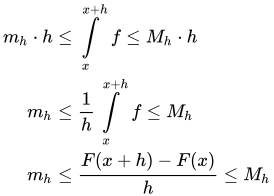
| We can now claim the following inequality relationship (the justification is found in the Darboux Integration section), which can be algebraically manipulated to show the following. | |
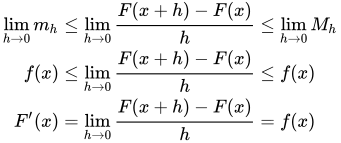
| We can apply limits over the entire inequality. The answer of the now derivative derives from the Squeeze Theorem. Given that the interval used in and relies on the variable , applying the limit over has the effect of reducing the interval to a single variable, meaning that the supremum/infimum of a single set composed of is self explanatory. Thus, the answer in the middle, now fully the definition of the derivative of , is rightfully , what we set out to prove. |





![{\displaystyle {\begin{aligned}m_{h}&=\inf {\Big \{}f(x)\mid x\in [c,c+h]{\Big \}}\\M_{h}&=\sup {\Big \{}f(x)\mid x\in [c,c+h]{\Big \}}\end{aligned}}}](https://wikimedia.org/api/rest_v1/media/math/render/svg/14483da5c36449d076b09f856279a391b9338fdd)


Second Fundamental Theorem
[edit | edit source]Riemann
[edit | edit source]The following proof uses Riemann Integration. The general strategy is using the definition of a limit to imply the conclusion. For those uncomfortable with limits, the Darboux version may be easier.
First Fundamental Theorem
[edit | edit source]This is pretty far down from the original definition, so we will reiterate what we are seeking to prove.
Given the following conditions:
- be continuous at
- be the indefinite integral of
![{\displaystyle f:[a,b]\to \mathbb {R} }](https://wikimedia.org/api/rest_v1/media/math/render/svg/b592d102ccd1ba134d401c5b3ea177baaba3ffac)
![{\displaystyle c\in [a,b]}](https://wikimedia.org/api/rest_v1/media/math/render/svg/997256364b06acf0710e5d24da39e8c42991a249)
![{\displaystyle F:[a,b]\to \mathbb {R} }](https://wikimedia.org/api/rest_v1/media/math/render/svg/3cacd74b0bb95ed9ddf45676b1ad0f3d618c4cdc)
Then, we should prove that the following relationship is valid is differentiable at and

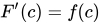
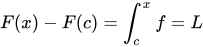
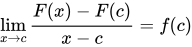
Let be given, and let but Observe that (say). There exists such that if a partition then, (note that in this proof, all the Riemann sums are over the interval ). As is integrable over , it is bounded over that interval. Hence, let . Thus, As is continuous at , there exists such that whenever . Now consider Then,

![{\displaystyle x\in [a,b]}](https://wikimedia.org/api/rest_v1/media/math/render/svg/026357b404ee584c475579fb2302a4e9881b8cce)



![{\displaystyle [c,x]}](https://wikimedia.org/api/rest_v1/media/math/render/svg/9b71283167e9c828a464acdf6642109e84f45478)
![{\displaystyle M=\sup f([c,x])}](https://wikimedia.org/api/rest_v1/media/math/render/svg/c80a3a54072cfb6c28f36e9c44954b3f7c54da71)





That is, , or
Second Fundamental Theorem
[edit | edit source]This is pretty far down from the original definition, so we will reiterate what we are seeking to prove.
Given the following conditions:
- be differentiable on and let for all
- be Riemann integrable on
![{\displaystyle f,F:[a,b]\to \mathbb {R} }](https://wikimedia.org/api/rest_v1/media/math/render/svg/65f5ce58b3f6bd825baf3cbce13a4d4f489c4b04)
![{\displaystyle [a,b]}](https://wikimedia.org/api/rest_v1/media/math/render/svg/9c4b788fc5c637e26ee98b45f89a5c08c85f7935)

Then, we should prove that the following relationship is valid

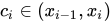
Let and let be given. Then, there exists such that for a partition implies that Consider a partition and let . By Lagrange's Mean Value Theorem, we have that there exists that satisfies Let the tagged partition be the partition along with the tags Thus, But we know that and hence, . As is arbitrary, that is,










Corollaries
[edit | edit source]There are many interpretations based of the definition.
Extras
[edit | edit source]Here is an extra concept, just for your perusal (It's actually here is the integral to a variable bound is unclear to you).
Indefinite Integral
[edit | edit source]Let be Riemann integrable on .
We define the Indefinite Integral of to be the function given by
for all