


Real Analysis/Darboux Integral
| ←Fundamental Theorem of Calculus | Real Analysis Darboux Integral |
Generalized Integration→ |
Another popular definition of "integration" was provided by Jean Gaston Darboux and is often used in more advanced texts, such as this wikibook, due to its introductory ease. In this chapter, we will define the Darboux integral, and demonstrate the equivalence of Darboux integrals and the more widely known Riemann integrals.
Construction
[edit | edit source]Unlike Riemann Integration, this version of the integral will forgo one assumption of the function ƒ — that it must be continuous. It will only assume that the function ƒ is bounded on [a,b]. Of course, normal assumptions for a Real Analysis course such as the function only operating on real numbers over the interval of focus can be presumed (i.e. )
![{\displaystyle f:[a,b]\to \mathbb {R} }](https://wikimedia.org/api/rest_v1/media/math/render/svg/b592d102ccd1ba134d401c5b3ea177baaba3ffac)
Partitions
[edit | edit source]We will modify the definition of partition for the Darboux Integral so that the values a and b are also included in the set. For completeness, we will write out this new definition again.

![{\displaystyle [a,b]}](https://wikimedia.org/api/rest_v1/media/math/render/svg/9c4b788fc5c637e26ee98b45f89a5c08c85f7935)
A finite collection of real numbers such that . It is commonly notated as , with the number of discretely writen x's being arbitrary.


An element of the Partition set.
For now, we will ignore the actual process of indexing these values. However, it should be noted that our definition of the partition does not make a claim about the relationship between the numbers; these values are not necessarily evenly distributed - but they can.
Upper and Lower Sums
[edit | edit source]Let be a partition of
For every , you can define two special numbers:

- and
![{\displaystyle m_{i}\,{\dot {=}}\,\inf {\{f(x)\,|\,x\in [x_{i-1},x_{i}]\}}}](https://wikimedia.org/api/rest_v1/media/math/render/svg/2790bfe65153425736cf589bef3d875e4f7bce03)
![{\displaystyle M_{i}\,{\dot {=}}\,\sup {\{f(x)\,|\,x\in [x_{i-1},x_{i}]\}}}](https://wikimedia.org/api/rest_v1/media/math/render/svg/6f8bbbdb80d429dafb110b7ee3bbaf13fd6e7678)
The verbal definition of these two variables is more clear; mi defines the infimum of the set of valid ƒ(x) values in between two partition points and Mi defines the supremum of the set of valid ƒ(x) values in between two partition points.
Next, we will define the key functional component of the Darboux Integral, the sums.

A function, notated as , and is defined as

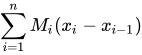
A function, notated as , and is defined as

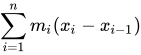
Borrowing from geometry, you will notice that both sums are essentially additions of various rectangular shapes that are tied to the function ƒ due to the definition of length being either a supremum or infimum respectively.
It is important to note that although the upper and lower sum borrows function notation, it is not, necessarily, a function in the normal sense. It takes partitions as the input, which size is a natural number. The function ƒ is treated as a fixed constant.
There is actually only one more construction required in order to reach the Darboux integral. The only problem? This last step is to relate the upper sum and the lower sum. After all, the rectangles generated from this function leave out a lot of gaps because there are too few partition points. The more partition points there are, the more that Mi and mi converge upon the same value. The next task should be clear now; we need to prove that the upper sum and lower sum can converge onto a point.
Refinement
[edit | edit source]The second last piece of the construction requires that we prove the following two lemmas regarding our partition and our sums:


Excuse me, we have to define what the partition P with the asterisk means first before we can analyze this statement.

A partition such that . Alternatively, has more partition points over the same interval [a,b] than

Okay, why do we need to prove this? Simple, these inequalities state that more partitions leads to a better approximation of the actual area. The lower bound will increase as it reaches the "area", while the upper bound will decrease as it reaches the "area". This should be a fact so intuitive that the idea of proving it might have never crossed your mind. However, we will prove this lemma right now. It will be needed for the final piece of the Darboux Integral puzzle.
This proof is simple and will only require inequality algebra.
| For now, let's assume that only has one more partition point than (We will use this special case to prove the general case later). Given that, we will only require three partition points from these partitions in our proof: the extra partition point found only in and its two adjacent partition points found in both and | Let and let be such that . |
| Now, we will generate the special infimum variable mi specifically for these partition points. They are given the variable name m′ and m″. | Let and |
| We will use all of these variables to express the lower sum of the refined partition as something in relation to the lower sum of the partition. | |
| The final relationship to compare between both equations can be distilled by removing the summations from the picture (via subtraction), yielding the following | |
| Given that we have two infimums between the same partition point than only having one, it should be obvious that this relationship holds. This implies that a partition more refined by one partition point is larger. | |
| Using recursion, a refined partition of any arbitrary size can be achieved. The following mathematical statements depict the process of recursion. | |



![{\displaystyle m'_{i}=\inf\{f(x)\,|\,x\in [x_{i-1},x^{*}]\}}](https://wikimedia.org/api/rest_v1/media/math/render/svg/6dc466950f05317cfdcda1c53fe5267f91da448f)
![{\displaystyle m''_{i}=\inf\{f(x)\,|\,x\in [x^{*},x_{i}]\}}](https://wikimedia.org/api/rest_v1/media/math/render/svg/bd1025b0d40656bda4e727c2e956609949d3d6f5)
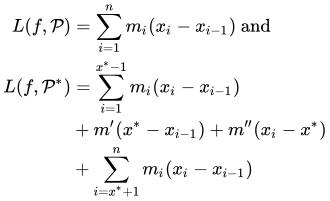




Similarly, we can prove using the same method, by inverting the necessary functions.

Convergence
[edit | edit source]Now that we have proved that our intuition is correct; more partitions will yield an even closer approximation from both the lower sum and the upper sum, it is only fair to see if we can bring them together. If I can use mathematical symbols freely, it can be depicted as

when the upper sum (the area of overestimation) is larger than the actual "area" and the lower sum (the area of underestimation) is smaller, yet both converge upon the "area" when the partition becomes finer. However, thinking like this will lead us to avoid the mathematical pieces we have collected that can also as fairly construct our integral. The roadmap to prove the Darboux Integral leads us to the final piece,

where can be thought of as a partition full enough to yield the perfect approximation. We will call it, for this explanation portion, a perfect partition, although the perfect partition is importantly not infinite. However, you might be wondering how to solve this; the previous lemma does not make any comparisons between the lower and upper sum. That is why we are going to prove this instead:

when and are any partitions of [a,b]. Yes, they do not need to be the same partition, as long as they are over the same interval [a,b]. This is actually going to be simpler, because our proof will use these two sums like bounds — dare I compare it as a squeeze?


| Given that and are subsets of the main partition, we can use our lemma to continually refine our partition until they become the perfect partition. |
|
| Even during the process of creating the perfect partition, it can be noted that the upper bound is larger than the lower bound. This is a consequence of the supremum being, by definition, greater than or equal to any other value. We can rule out that the lower sum can ever be greater. | |
| Speaking of which, we can also imagine that the supremum/infimum of the sums will also obey this property of maintaining the upper sum stance. | |
| Using supremums and infimums on the function mimics the behaviour of the perfect partition. | |
| We can not conclude our proof. |





Conclusion
[edit | edit source]We come at an impasse. Our final piece yields a very strange answer about the lower and upper sum. Namely that they are not an equality, but an inequality
where the certainty of the number remains unknown. However, we can easily sidestep this issue by breaking it into two cases and validating one or the other. What do we mean by validation? We can define the integral, namely the Darboux Integral, as being the number ensuring the equality of the upper and lower sum. We can then define an invalid integral as maintaining the inequality. In mathematical notation, we define the integral as being

and rejecting every other case as being an invalid integral.
From here, we completed the construction of the Darboux Integral from the bottom-up.
Definition
[edit | edit source]is
Alternate Notations Notice. Both definitions are equivalent and only serve to clarify confusing notation.
- If and only if , where the supremum is taken over the Set of all partitions on that interval
- If and only if

![{\displaystyle \sup {\{L(f,{\mathcal {P}})\,:\,{\mathcal {P}}{\text{ a partition of }}[a,b]\}}=\inf {\{U(f,{\mathcal {P}})\,:\,{\mathcal {P}}{\text{ a partition of }}[a,b]\}}}](https://wikimedia.org/api/rest_v1/media/math/render/svg/4173aff178ef250e4a4aaf95a2f5e8611fc8213c)
It is commonly notated as either


Based on whether you are willing to write out the function explicitly (#2) or by name (#1)
Remarks
[edit | edit source]- Of course, the function has to be real i.e. .
- The Darboux Integral is defined on the condition of uniqueness, unlike other concepts in this wikibook, such as limits, that are implied from the definition.
Properties
[edit | edit source]Let
is Darboux integrable over if and only if for every , there exists a partition on such that


Proof
[edit | edit source]()Let and let be given. Thus, by Gap Lemma, there exists a partition such that both , and hence



()Let be any partition on . Observe that is a lower bound of the set is any partition and that is an upper bound of the set is any partition






Thus, let and . As , we have that cannot be true. Also, as are a supremum and infimum respectively, is also not possible. Hence, (say).





As , we have that


Equivalence of Riemann and Darboux Integrals
[edit | edit source]At first sight, it may appear that the Darboux integral is a special case of the Riemann integral. However, this is illusionary, and indeed the two are equivalent.
Lemma
[edit | edit source](1) Let be Darboux Integrable, with integral
![{\displaystyle f:[a,b]\rightarrow \mathbb {R} }](https://wikimedia.org/api/rest_v1/media/math/render/svg/fc0d2d0b70573525d149ab82948308455d1853d0)

Define function

(2) Then

Proof
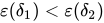
[edit | edit source]Let . Consider set of tagged partitions such that



Let be the set of where and


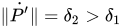
note that and that the set indeed contains all partitions with


Now, for , we can construct such that



Hence,

i.e.
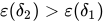
Theorem
[edit | edit source]Let
(1) is Riemann integrable on iff
(2) is Darboux Integrable on
Proof
[edit | edit source]() Let be given.

(1) tagged partition such that .

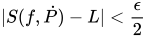
Let partitions and be the same refinement of but with different tags.


Therefore, and


i.e., by the triangle inequality,

Gap Lemma ,

being arbitrary, using Theorem 2.1, we have that is Darboux Integrable.
()Let be given.
(2), Theorem 2.1 partition such that

Hence, as


By Lemma 3.1, if


Thus, if we put , we have (1)

We note here that the crucial element in this proof is Lemma 3.1, as it essentially is giving an order relation between and , which is not directly present in either the Riemann or Darboux definition.

