Wikijunior:Languages/Esperanto
What writing system(s) does this language use?[edit | edit source]
Esperanto uses the Latin alphabet, like English, with a few differences. The letters q, w, x, and y are gone, and there are new letters ĉ, ĝ, ĥ, ĵ, ŝ, and ŭ.
What's really different from English is that each Esperanto letter stands for one and only one sound. There are no letters that sound differently in different words (like the a in fat, fate, and father), no silent letters (like the s in island), and no sounds that take more than one letter (like the sh in fish).
Most Esperanto letters that are used in English have the same sounds that they usually have in English, and almost all Esperanto letters have sounds that are used in English. The new letter ĥ is different from English, though; it has a sound like clearing your throat. (That's also the way a Scottish person would say the ch in loch.) Here are all the Esperanto letters, and their sounds:
| ||||||||||||||||||||||||||||||
|
How many people speak this language?[edit | edit source]
The answer is: nobody really knows. There are no exact numbers; Esperanto speakers are hard to count because they are spread all over the world. It is most likely that there are between 100,000 and 2 million Esperanto speakers. Most of them have learned to speak it; only about 1000 people speak Esperanto as their native language.
A speaker of Esperanto is called an Esperantist.
Where is this language spoken?[edit | edit source]
- Esperanto symbols
-
 The green star of Esperanto
(Verda stelo) -
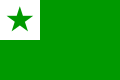 The Esperanto Flag
(La flago de Esperanto) -
 Jubilee symbol
(Jubilea simbolo)


Esperanto is spoken all over the world. Really! However, most Esperantists learn Esperanto as a second language, so nowhere is it the language of the majority of people. Esperanto speakers live in the same places as speakers of other languages.
In order to identify themselves to other Esperanto speakers, Esperantists use a number of symbols.
The green star of Esperanto, the verda stelo, is the oldest and most commonly used symbol.
It is incorporated into the Esperanto flag.
A more recent symbol called the jubilee symbol (jubilea simbolo) was designed in 1987.
It is common to see all three of these symbols at an Esperanto event.
What is the history of this language?[edit | edit source]

Esperanto is a constructed language invented by Jewish-Polish eye doctor L.L. Zamenhof (1859 – 1917). He grew up in a city in Poland that was divided between groups who spoke different languages and did not get along. He hoped that if everyone could understand each other, they could live together in peace. In 1872, when he was only 13 years old, he began designing a language called Lingwe uniwersala ("universal language"). In 1878, at age 19, he shared his new language with a few close friends, but then he left for university to study medicine and left all of the notes about his language with his father for safe keeping. Unfortunately, his father was afraid that the idea of a universal language would cause trouble with the Russian Tsar who ruled Poland at the time, so he burned them.

constructed language — a language that someone invented. This is unlike English and other natural languages whose rules and vocabulary evolved over hundreds or thousands of years.

Zamenhof found out that all of his work had been destroyed when he came home from university in 1881. He immediately started constructing a new, improved version, which he now called Lingvo universala (which means "universal language" in modern Esperanto).
For six years he tried to publish his new language, but the censors of the Tsar would not allow it. Instead of surrendering his dream, he used this time to improve the language and practice using it to translate many works.
In 1887, Zamenhof published Unua Libro ("First Book"), to describe his universal language. Zamenhof did not use his real name when he published the book because he had already had so much trouble with the Tsar's censors. Instead, he published the book under the name Doktoro Esperanto, which is "Dr. Someone-who-hopes" in the language he was introducing. The name "Esperanto" became the name of the language.
Because the language was so simple, and because there were already lots of things written in Esperanto (which Zamenhof had either written or translated while waiting on the Tsar's censors), it caught on very quickly. By 1905, the first World Congress of Esperanto (Universala Kongreso) was held in Boulogne-sur-Mer in France. By the time World War I had started in 1914, Zamenhof had been nominated for the Nobel Peace Prize twice, Esperanto was part of the school curriculum in China, Samos and Macedonia, and there was even an Esperanto currency (the spesmilo). Unfortunately, Zamenhof died in 1917, and did not live to see the end of the war in 1918.
After World War I, Esperanto's popularity began to soar. The horrors of the war created a desire in people for a universal peace, and Esperanto seemed the best hope for a universal language to foster communication to prevent war from happenning again. The League of Nations—the precursor to the modern United Nations—officially recommended that its members use Esperanto as a second language, and some of the most important scientific associations suggested that Esperanto be used for future scientific communication. For a while it seemed that Esperanto would become the international language for communication, science, and, of course, peace—this time, the 1920s, is considered to be the golden age of Esperanto.
But the great dictators that arose in the early days of World War II—Adolf Hitler and Joseph Stalin—banned Esperanto. Many Esperantists, including members of Zamenhof's family, died in Nazi death camps. The League of Nations, along with many prominent Esperanto associations, did not survive the war.
Since then, slowly the Esperanto movement has been rebuilding, although it is not yet at the levels it was at before World War II.
Although the United Nations does not support Esperanto in the same way that the League of Nations did, some United Nations agencies support the language.
The Internet and organizations like Pasporta Servo (which allows Esperanto speakers to travel by staying with other Esperantists around the world) have allowed Esperantists to keep in touch in ways they could not have in the past.
Esperanto now exists only through the enthusiasm of its speakers, without the support of any nation or major international organization.
Who are some famous authors or poets in this language?[edit | edit source]
L. L. Zamenhof (1859 – 1917), Zamenhof himself was the first Esperanto author. While he was waiting for the censors to allow him to publsh his language, he improved it by using it to translate a number of works, including Shakespeare. He also wrote a number of original Esperanto books and poems.
Julio Baghy (1891 – 1967), Hungarian actor who wrote novels and poetry in Esperanto, and was very influential in the early development of the language for poetic use. His most famous novel is Printempo en Aŭtuno ("Springtime in Autumn", 1931), but he is more well-known for his poetry. His most influential work is his collection of poems, Preter la vivo ("Beyond Life", 1922).
William Auld (1924 – 2006), Scottish poet who was nominated three times (1999, 2004 and 2006) for the Nobel Prize in Literature for his works in Esperanto. His most famous work is La infana raso ("The Infant Race", 1956).
Claude Piron (1931 – 2008), Swiss linguist who wrote dozens of books on the language, as well as novels, poems and non-fiction books. His most famous work is Gerda malaperis! ("Gerda Vanished!"), which is not only an entertaining mystery novel, but is also written so that early chapters use basic Esperanto, which gets more advanced with each chapter.
What are some basic words in this language that I can learn?[edit | edit source]
Basic Greetings:
Simple Words:
Courtesies:
|
Numbers:
|
Phrases you can try:
- Kio estas via nomo? — "What is your name?"
- Mia nomo estas _____. — "My name is _____"
- Kiom da jaroj havas vi? — "How old are you? (How many years do you have?)"
- Mi havas _____ jarojn. — "I am _____ years old. (I have _____ years.)" (Try to use Esperanto numbers for your age!)
- Kiel vi fartas? — "How are you?"
- (Mi fartas) bone/malbone/ne malbone. — "(I am) good/bad/not bad."
- Ĉu vi parolas Esperanton? — "Do you speak Esperanto?"
- Ne, mi ne parolas Esperanton. — "No, I don't speak Esperanto."
- Ĉu vi parolas la anglan? — "Do you speak English?"
- Jes, mi parolas la anglan. — "Yes, I speak English."
What is a simple song/poem/story that I can learn in this language?[edit | edit source]
| La Espero | The Hope | |||||
|---|---|---|---|---|---|---|
| En la mondon venis nova sento, tra la mondo iras forta voko; per flugiloj de facila vento nun de loko flugu ĝi al loko. |
Into the world came a new feeling, through the world goes a powerful call; by means of wings of a gentle wind now let it fly from place to place. |
La Espero ("The Hope") is the traditional anthem of Esperanto. It was written by Zamenhof as a poem and later set to music.
These are the first two verses.
| ||||
| Ne al glavo sangon soifanta ĝi la homan tiras familion: al la mond' eterne militanta ĝi promesas sanktan harmonion. |
Not to the sword thirsting for blood does it draw the human family: to the world eternally fighting it promises sacred harmony. | |||||

| Brilu, eta stelo | Twinkle, Twinkle |
|---|---|
| Brilu, brilu, eta stel', Diamanto en ĉiel'! |
Twinkle, twinkle, little star, How I wonder what you are! |
| Diru, kio estas vi, Tiel alta super ni? |
Up above the world so high, Like a diamond in the sky. |
| Brilu, brilu, eta stel', Diamanto en ĉiel'! |
Twinkle, twinkle, little star, How I wonder what you are! |
References[edit | edit source]


 |
Wikijunior:Languages | edit | |
|
Introduction •
Glossary •
Authors and Contributing •
Print Version
| |||