Topology/Quotient Spaces
The quotient topology is not a natural generalization of anything studied in analysis, however it is easy enough to motivate. One motivation comes from geometry. For example, the torus can be constructed by taking a rectangle and pasting the edges together.
Definition: Quotient Map[edit | edit source]
Let and be topological spaces; let be a surjective map. The map f is said to be a quotient map provided a is open in Y if and only if is open in X .


Definition: Quotient Map Alternative[edit | edit source]
There is another way of describing a quotient map. A subset is saturated (with respect to the surjective map ) if C contains every set that it intersects. To say that f is a quotient map is equivalent to saying that f is continuous and f maps saturated open sets of X to open sets of Y . Likewise with closed sets.


There are two special types of quotient maps: open maps and closed maps .
A map is said to be an open map if for each open set , the set is open in Y . A map is said to be a closed map if for each closed , the set is closed in Y . It follows from the definition that if is a surjective continous map that is either open or closed, then f is a quotient map.


Definition: Quotient Topology[edit | edit source]
If X is a topological space and A is a set and if is a surjective map, then there exist exactly one topology on A relative to which f is a quotient map; it is called the quotient topology induced by f .


Definition: Quotient Space[edit | edit source]
Let X be a topological space and let , be a partition of X into disjoint subsets whose union is X . Let be the surjective map that carries each to the element of containing it. In the quotient topology induced by f the space is called a quotient space of X .


Theorem[edit | edit source]
Let be a quotient map; let A be a subspace of X that is saturated with respect to f ; let be the map obtained by restricting f , then g is a quotient map.
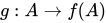
1.) If A is either opened or closed in X .
2.) If f is either an open map or closed map.
Proof: We need to show:
when V


and
when .


Since and A is saturated, . It follows that both and equal all points in A that are mapped by f into V . For the second equation, for any two subsets U and



In the opposite direction, suppose when and . Since A is saturated, , so that in particular . Then where .



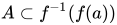


Suppose A or f is open. Since , assume is open in and show V is open in .

First, suppose A is open. Since is open in A and A is open in X , is open in X . Since , is open in X . V is open in Y because f is a quotient map.
Now suppose f is open. Since and is open in A, for a set U open in X . Now because f is surjective; then


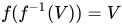

The set is open in Y because f is an open map; hence V is open in . The proof for closed A or f is left to the reader.