We quickly review the set-theoretic concept of Cartesian product here. This definition might be slightly more generalized than what you're used to.
Let
Λ
{\displaystyle \Lambda }
X
λ
{\displaystyle X_{\lambda }}
λ
∈
Λ
{\displaystyle \lambda \in \Lambda }
Cartesian product of each
X
λ
{\displaystyle X_{\lambda }}
∏
λ
∈
Λ
X
λ
=
{
x
:
Λ
→
⋃
λ
∈
Λ
X
λ
|
x
(
λ
)
∈
X
λ
}
{\displaystyle \prod _{\lambda \in \Lambda }X_{\lambda }=\{x:\Lambda \rightarrow \bigcup _{\lambda \in \Lambda }X_{\lambda }|x(\lambda )\in X_{\lambda }\}}
.
Let
Λ
=
N
{\displaystyle \Lambda =\mathbb {N} }
X
λ
=
R
{\displaystyle X_{\lambda }=\mathbb {R} }
n
∈
N
{\displaystyle n\in \mathbb {N} }
∏
λ
∈
Λ
X
λ
=
R
N
=
{
x
:
N
→
R
∣
x
(
n
)
∈
R
∀
n
∈
N
}
=
{
(
x
1
,
x
2
,
…
)
∣
x
n
∈
R
∀
n
∈
N
}
{\displaystyle \prod _{\lambda \in \Lambda }X_{\lambda }=\mathbb {R} ^{\mathbb {N} }=\{x:\mathbb {N} \rightarrow \mathbb {R} \mid x(n)\in \mathbb {R} \,\forall \,n\in \mathbb {N} \}=\{(x_{1},x_{2},\ldots )\mid x_{n}\in \mathbb {R} \,\forall \,n\in \mathbb {N} \}}
.
Using the Cartesian product, we can now define products of topological spaces.
Let
X
λ
{\displaystyle X_{\lambda }}
product topology of
∏
λ
∈
Λ
X
λ
{\displaystyle \prod _{\lambda \in \Lambda }X_{\lambda }}
∏
λ
∈
Λ
U
λ
{\displaystyle \prod _{\lambda \in \Lambda }U_{\lambda }}
U
λ
=
X
λ
{\displaystyle U_{\lambda }=X_{\lambda }}
λ
{\displaystyle \lambda }
U
λ
{\displaystyle U_{\lambda }}
Let
Λ
=
{
1
,
2
}
{\displaystyle \Lambda =\{1,2\}}
X
λ
=
R
{\displaystyle X_{\lambda }=\mathbb {R} }
R
2
{\displaystyle \mathbb {R} ^{2}}
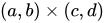
(
a
,
b
)
×
(
c
,
d
)
{\displaystyle (a,b)\times (c,d)}
Let
Λ
=
{
1
,
2
}
{\displaystyle \Lambda =\{1,2\}}
X
λ
=
R
l
{\displaystyle X_{\lambda }=R_{l}}
R
2
{\displaystyle \mathbb {R} ^{2}}
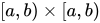
[
a
,
b
)
×
[
a
,
b
)
{\displaystyle [a,b)\times [a,b)}