Topology/Basic Concepts Set Theory
This chapter concisely describes the basic set theory concepts used throughout this book—not as a comprehensive guide, but as a list of material the reader should be familiar with and the related notation. Readers desiring a more in-depth understanding of set theory should read the Set Theory Wikibook.
Basic Definitions[edit | edit source]
The empty set is denoted by symbol . A finite set consisting of elements is denoted . Set theorists commonly, albeit sloppily, do not distinguish strictly between a singleton set and its single element .





For a more in depth understanding of how elements of sets relate to each other, we must first define a few terms. Let A and B denote two sets.
- The union of A and B, denoted , is the set of all x that belong to either A or B (or both).
- The intersection of A and B, denoted , is the set of all x that belong to both A and B.
- The difference of A and B, denoted or , is the set of all such that .
- In contexts where there is a set containing "everything," usually denoted U, the complement of A, denoted , is .
- The symmetric difference of A and B, denoted , is defined by .
- A is a subset of B, denoted , if and only if every element in also belongs to . In other words, when . A key property of these sets is that if and only if and .
- A is a proper subset of B, denoted , if and only if and . (We do not use the notation , as the meaning is not always consistent.)
- The cardinality of A, denoted , is the number of elements in A.
- Examples
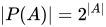
- The power set of A, denoted , is the set of all subsets of A.
- Examples











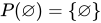


Note that .
Ordered n-tuples are denoted . For two ordered sets and , we have if and only if .





N-tuples can be defined in terms of sets. For example, the ordered pair was defined by Kazimierz Kuratowski as . Now n-tuples are defined as



We now can use this notion of ordered pairs to discuss the Cartesian Product of two sets. The Cartesian Product of A and B, denoted , is the set of all possible ordered pairs where the first element comes from A and the second from B; that is,

- .

Now that we have defined Cartesian Products, we can turn to the notions of binary relations and functions. We say a set R is a binary relation from A to B if . If , it is customary to write xRy. If R is a relation, then the set of all x which are in relation R with some y is called the domain of R, denoted domR. The set of all y such that, for some x, x is in relation R with y is called the range of R, denoted ranR. A binary relation F is called a function if every element x in its domain has exactly one element y in its range such that xFy. Also, if F is a function, the typical notation is instead of xFy.


There are a few special types of functions we should discuss. A function is said to be onto a set B, or a surjective function from A to B, if ran. A function F is said to be one-to-one or injective if implies . A function that is both injective and surjective is called bijective.




Exercises[edit | edit source]
If you can successfully answer the following problems, you are ready to study topology! Please take the time to solve these problems.
- Prove that the empty set is a subset of every set.
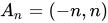
- Consider the set for each n in the set of natural numbers. Does the union over all (for n in the set of natural numbers) equal (the set of all real numbers)? Justify your answer.
- Using from above, prove that no finite subset of has the property that the union of this finite subset equals . Once you study topology, you will see that this constitutes a proof that is not compact.