


Set Theory

Written by volunteers and editors at
Wikibooks,
A Wikimedia Foundation Project


Set Theory is the study of sets. Essentially, a set is a collection of mathematical objects. Set Theory forms the foundation of all of mathematics.
In Naive Set Theory, there is an axiom which is known as the unrestricted comprehension schema axiom. It states that there exists a set such that a formula in first-order logic holds for all elements in , i.e., .


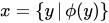
In 1901, Bertrand Russel found this to be inconsistent. This inconsistency is now known as Russel's Paradox. Russel claimed that if it were consistent, then is a set. Which is contradictory since if and only if . Thus, this theory was found to be inconsistent. (Fun fact: apparently Zermelo discovered this inconsistency in 1899, but did not publish [1].)



This motivated Zermelo to Axiomatize Set Theory. And motivates why we, too, should study this.
- This is an undergraduate book, but will also include some graduate level topics. But mainly, anyone with basic mathematical maturity can engage in this book.
Table of Contents
[edit | edit source]Chapter

- The Language of Set Theory
- Zermelo-Fraenkel (ZF) Axioms
- Relations
- Constructing Numbers
- Orderings
- Zorn's Lemma and the Axiom of Choice
- Ordinals
- Cardinals


Appendix
Links
[edit | edit source]Further reading
[edit | edit source]
- Discrete Mathematics/Set theory
- Krzysztof Ciesielski, Set Theory for the Working Mathematician (1997)
- P. R. Halmos, Naive Set Theory (1974)
- Karel Hrbacek, Thomas J. Jech, Introduction to set theory (1999)
- Thomas J. Jech, Set Theory 3rd Edition (2006)
- Kenneth Kunen, Set Theory: an introduction to independence proofs (1980)
- Judith Roitman, Introduction to Modern Set Theory (1990)
- John H. Conway, Richard Guy The Book of Numbers - chapter 10
- Tobias Dantzig, Joseph Mazur Number: The Language of Science