


Spanish/Lessons/¿Dónde vives?


Dialogue
[edit | edit source]| Vocabulary | |
|---|---|
| Londres | London |
| Pero | But |
| Pues | Well |
- Raúl: ¡Hola! ¿Dónde vives?
- Sofía: Hola, Raúl. Vivo en un piso en Londres, Inglaterra. ¿Y tú?
- Raúl: Vale. Vivo en el sur de España.
- Sofía: ¿En el campo o en la ciudad?
- Raúl: En el campo. Las ciudades son ruidosas.
- Sofía: Sí, pero no hay nada que hacer en el campo.
- Raúl: Pues, ¡adiós, Sofía!
- Sofía: ¡Hasta luego!
Translation (wait until the end of the lesson).
Countries of the World
[edit | edit source].svg) |
 |
 |
.svg) |

|
| El Reino Unido | Inglaterra | Escocia | Gales | Irlanda |
 |
 |
 |
 |

|
| España | Francia | Alemania | Italia | Rusia |
 |
 |
 |
 |

|
| Los Estados Unidos | Canadá | Nueva Zelanda | Australia | México |
 |
 |
 |
 |

|
| Japón | China | India | Brasil | Turquía |
 |
 |
 |
 |

|
| Portugal | Marruecos | Egipto | Sudáfrica | Argentina |
 |
 |
 |
 |

|
| Corea del Sur | Filipinas | Singapur | Malasia | Indonesia |
Where do you live?
[edit | edit source]To say you are from a country, you use ser (meaning "to be [a permanent characteristic]"), then de (meaning "of" or "from"), then the country or place. To say you are currently living in a place or country, you use vivir (meaning "to live"), then en (meaning "in"), then the country or place.
To ask where someone else lives, you use Dónde then vivir (¿Dónde vives? means "Where do you live?"). To ask where someone is from, you use De dónde, then ser (¿De dónde eres? means "Where are you from?").
While vivir is totally regular (vivo, vives, vive, vivimos, vivís, viven), ser is about as irregular as they come. It is conjugated below.
|
Spanish Verb • ¿Dónde vives?
| |
|---|---|
| Inglés | Español |
| I am | Soy |
| You are | Eres |
| He/She/It is | Es |
| We are | Somos |
| You all are | Sois |
| They are | Son |
- Examples
- Vivo en Inglaterra
- I live in England.
- Son de España, pero viven en Alemania.
- They are from Spain, but they live in Germany.
The compass
[edit | edit source]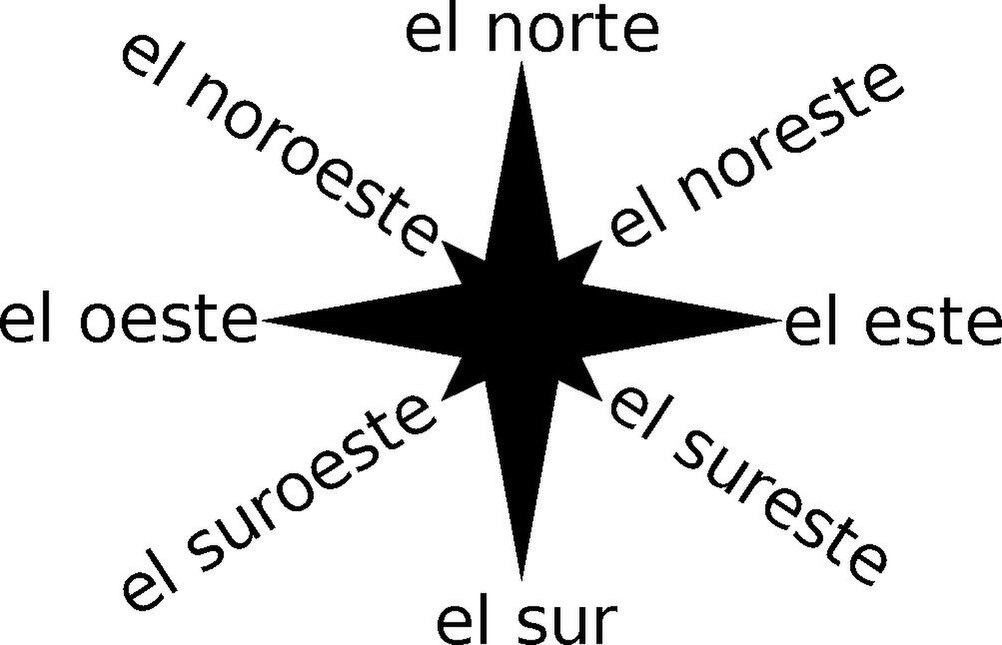
- Examples
- Vivo en el suroeste de México.
- I live in the Southwest of Mexico.
- Soy del norte de Australia.
- I'm from the north of Australia.
- Notes
- Noreste has a variant nordeste. Sureste and suroeste have, respectively, variants sudeste and sudoeste.
- Oeste has a synonym occidente which is used with the same frequency. The corresponding synonym of este is oriente. You can also use them in compounds like nororiente, noroccidente, suroriente/sudoriente and suroccidente/sudoccidente.
- Their corresponding adjectives are septentrional (northern), meridional (southern), oriental (eastern), occidental (western). Compound adjectives like noroccidental and sudoriental are also possible.
- The adjectives norteño (northern) and sureño (southern) do not refer to geographical positions but to someone's regional origin.
- Archaic usage had septentrión to mean north and mediodía to mean south. Some older books may still use them. Today, septentrión is no longer used, and mediodía means noon.
Housing
[edit | edit source]|
Spanish Vocabulary • ¿Dónde vives?
| |
|---|---|
| Inglés | Español |
| A house | Una casa |
| A detached house | Una casa individual |
| A semi-detached house | Una casa pareado |
| A terraced house | Una casa adosada |
| A flat | Un piso |
| A bungalow | Un bungalow |
| A room | Una habitación |
- Note
The singular is una habitación, but the plural is unas habitaciones (without the accent)
- This is a general rule, because in the singular, the 'ó' shows the sound is to be emphasized, but for plural the 's' has also to be heard, so it is written as it is spoken, as 'o' without the accent).
- Examples
- Vivo en un piso.
- I live in a flat.
- Vivo en una casa adosada en Canadá.
- I live in a semi-detached house in Canada.
- Vive en un bungalow que tiene diez habitaciones.
- He lives in a bungalow that has ten rooms.
Adjectives
[edit | edit source]As we already learned, Spanish nouns each have a gender. This doesn't just affect the article, but the adjective; it has to agree. Also, adjectives go after the noun, not before it.
If the adjective (in its natural form - the form found in the dictionary), ends in an "O" or an "A", then you remove that vowel and add...
.svg) |
.svg) |
- O for masculine singular nouns
- OS for masculine plural nouns
- A for feminine singular nouns
- AS for feminine plural nouns.
- Examples
- Un hombre bueno
- A good man
- Unos hombres buenos
- Some good men
- Una mujer buena
- A good woman
- Unas mujeres buenas
- Some good women
The masculine O / feminine A rule is applicable to the vast majority of Spanish nouns. There are a handful of exceptions, though, but you'll get to memorize them.
City and Countryside
[edit | edit source] |
 |
|
Spanish Vocabulary • ¿Dónde vives?
| |
|---|---|
| Inglés | Español |
| The city | La ciudad |
| The countryside | El campo |
| The good thing about ... is that | Lo bueno de ... es que |
| The bad thing about ... is that | Lo malo de ... es que |
| There are lots of things to do | Hay mucho que hacer |
| There isn't anything to do | No hay nada que hacer |
| You can walk in woodlands | Se puede caminar en los bosques |
| There isn't any foliage | No queda ningún follaje |
| Pretty | Bonito/a |
| Lively | Animado/a |
| Quiet | Tranquilo/a |
| Boring | Aburrido/a |
| Noisy | Ruidoso/a |
- Examples
- La ciudad es ruidosa.
- The city is noisy.
- El campo es aburrido.
- The countryside is boring.
- Lo bueno de la ciudad es que hay mucho que hacer.
- The good thing about the city is that there are lots of the things to do.
- Lo malo de la ciudad es que no quedan plantas.
- The bad thing about the city is that there isn't any foliage.
Lo is the only Spanish word classified as neuter gender (although it is always accompanied by masculine adjectives). It is an unusual article that does not carry a noun, and is used to build sentences like esto es lo que yo quiero (this is what I want) and haz lo correcto (do the right [thing]), used to turn an adjective or adverb into a substantive. For this purpose, it's clearly demonstrated in this example: "lo peor ya pasó" (the worse [situation or thing] already had pass).
Summary
[edit | edit source]In this lesson, you have learned
- Various countries of the world (Australia; Italia; Francia; los Estados Unidos).
- How to say where you and others live and come from (Vivo en Inglaterra; Somos de Gales).
- How to ask where someone lives (¿Dónde vives?).
- The points of the compass (el sur; el noroeste; el oeste).
- How to describe your house (una casa; un piso).
- The basics of adjectives ending in "O" or "A" (la mujer mala; el niño bonito).
- How to talk about the city or the countryside (la ciudad; el campo; no hay mucho para hacer).
You should now do the exercise related to each section (found here), and translate the dialogue at the top before moving on to lesson 5...
.svg)
|
¡Aprovéchalo! |

|