- This exercise is recommended for all readers.
- This exercise is recommended for all readers.
- This exercise is recommended for all readers.
- Problem 4
For a homomorphism from  to
to  that sends

where does 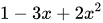 go?
go?
- Answer
Here are two ways to get the answer.
First, obviously  , and so we can
apply the general property of preservation of combinations to get
, and so we can
apply the general property of preservation of combinations to get
 .
.
The other way uses the computation scheme developed in this subsection.
Because we know where these elements of the space go, we consider
this basis 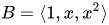 for the domain.
Arbitrarily, we can take
for the domain.
Arbitrarily, we can take  as a basis for the codomain.
With those choices, we have that
as a basis for the codomain.
With those choices, we have that
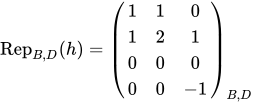
and, as
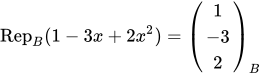
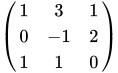
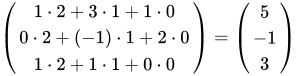
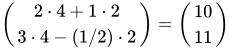
the matrix-vector multiplication calculation gives this.

Thus,  , as above.
- This exercise is recommended for all readers.
- Problem 5
Assume that  is determined by
this action.
is determined by
this action.
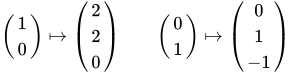
Using the standard bases, find
- the matrix representing this map;
- a general formula for
 .
.
- Answer
Again, as recalled in the subsection,
with respect to  , a column vector represents itself.
- To represent
 with respect
to
with respect
to  we take
the images of the basis vectors from the domain,
and represent them with respect to the basis for the codomain.
we take
the images of the basis vectors from the domain,
and represent them with respect to the basis for the codomain.

These are adjoined to make the matrix.
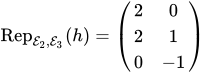
- For any
 in the domain
  ,
,

and so

is the desired representation.
- This exercise is recommended for all readers.
- Problem 6
Let  be the derivative
transformation.
be the derivative
transformation.
- Represent
 with respect to
  where
where
 .
.
- Represent with respect to
 where
where
 .
.
- Answer
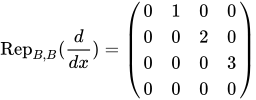
-
We must first find the image of each vector from the domain's basis,
and then represent that image with respect to the codomain's basis.

Those representations are then adjoined to make the matrix
representing the map.
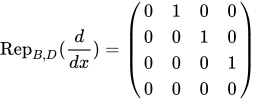
- Proceeding as in the prior item, we represent the images
of the domain's basis vectors

and adjoin to make the matrix.
- This exercise is recommended for all readers.
- Problem 7
Represent each linear map with respect to each pair of bases.
-
 with respect to
where
with respect to
where  , given by

-
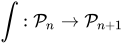 with respect to
 where
where  , given by

-
 with respect to
 where
and
where
and  , given by

-
 with respect to
where
and , given by
with respect to
where
and , given by

-
 with respect
to where
with respect
to where  , given by

- Answer
For each, we must find the image of each of the domain's basis vectors,
represent each image with respect to the codomain's basis,
and then adjoin those representations to get the matrix.
- The basis vectors from the domain have these images

and these images are represented with respect to the codomain's
basis in this way.
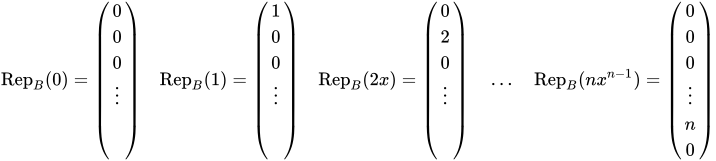
The matrix
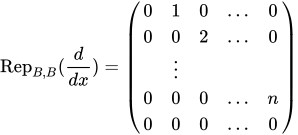
has  rows and columns.
- Once the images under this map of the domain's basis
vectors are determined

then they can be represented with respect to the codomain's basis

and put together to make the matrix.
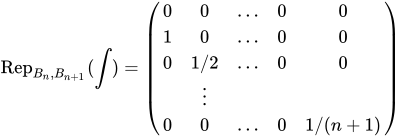
- The images of the basis vectors of the domain are

and they are represented with respect to the codomain's basis as

so the matrix is

(this is an  matrix).
- Here, the images of the domain's basis vectors are

and they are represented in the codomain as

and so the matrix is this.

- The images of the basis vectors from the domain are

which are represented as
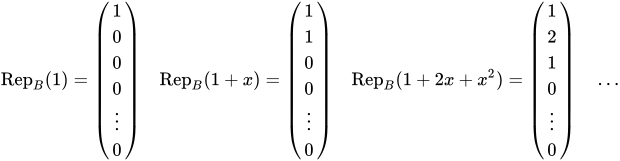
The resulting matrix
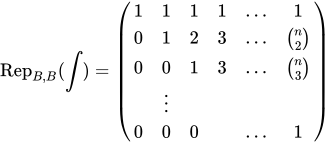
is Pascal's triangle
(recall that  is the number of ways to choose
  things, without order and without repetition,
from a set of size
things, without order and without repetition,
from a set of size  ).
).
- Problem 9
Represent, with respect to the natural basis,
the transpose transformation on the space
 of
of  matrices.
- Answer
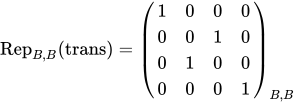
Taking this as the natural basis

the transpose map acts in this way

so that representing the images with respect to the codomain's
basis and adjoining those column vectors together gives this.
- Problem 10
Assume that
 is a basis for a vector space.
Represent with respect to the transformation that is determined
by each.
is a basis for a vector space.
Represent with respect to the transformation that is determined
by each.
-
 ,
,
 ,
,
 ,
,

- ,
 ,
,
,
,
- ,
,
 ,
,
- Answer
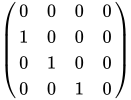
- With respect to the basis of the codomain, the images of
the members of the basis of the domain are represented as

and consequently, the matrix representing the transformation is
this.
-
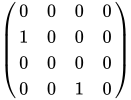
-
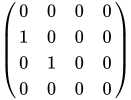
- This exercise is recommended for all readers.
- Problem 12
Consider a linear transformation of determined
by these two.

- Represent this transformation with respect to the standard
bases.
- Where does the transformation send this vector?

- Represent this transformation with respect to these bases.

- Using
 from the prior item,
represent the transformation with respect to .
from the prior item,
represent the transformation with respect to .
- Answer
Call the map  .
.
- To represent this map with respect to the standard bases, we
must find, and then represent, the images of the vectors
 and
and  from the domain's basis.
The image of is given.
One way to find the image of is by
eye— we can see this.
from the domain's basis.
The image of is given.
One way to find the image of is by
eye— we can see this.

A more systematic way to find the image of is to
use the given information to represent the transformation, and then
use that representation to determine the image.
Taking this for a basis,
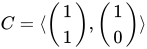
the given information says this.
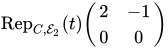
As

we have that

and consequently we know that 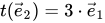 (since, with respect to the standard basis, this vector is
represented by itself).
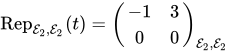
Therefore, this is the representation of
(since, with respect to the standard basis, this vector is
represented by itself).
Therefore, this is the representation of  with respect to
 .
.
- To use the matrix developed in the prior item, note that
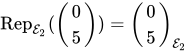
and so we have this is the representation, with respect to the
codomain's basis, of the image of the given vector.

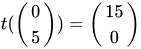
Because the codomain's basis is the standard one, and so vectors
in the codomain are represented by themselves, we have this.
- We first find the image of each member of , and then
represent those images with respect to
 .
For the first step, we can use the matrix developed earlier.
.
For the first step, we can use the matrix developed earlier.

Actually, for the second member of there is no need to apply the
matrix because the problem statement gives its image.
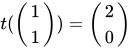
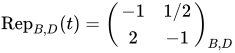
Now representing those images with respect to is routine.

Thus, the matrix is this.
- We know the images of the members of the domain's basis
from the prior item.

We can compute the representation of those images with respect to
the codomain's basis.

Thus this is the matrix.

- Problem 13
Suppose that  is nonsingular so that
by Theorem II.2.21, for any basis
is nonsingular so that
by Theorem II.2.21, for any basis
 the image
 is a basis for
  .
.
- Represent the map with respect to
 .
.
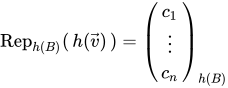
- For a member of the domain, where
the representation of has components
 , ...,
  ,
represent the image vector with respect to
the image basis
,
represent the image vector with respect to
the image basis  .
.
- Answer
- The images of the members of the domain's basis are

and those images are represented with respect to the codomain's
basis in this way.

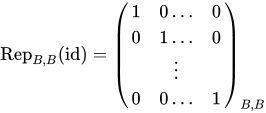
Hence, the matrix is the identity.

- Using the matrix in the prior item,
the representation is this.
- Problem 14
Give a formula for the product of a matrix and  , the
column vector that is all zeroes except for a single one in the
, the
column vector that is all zeroes except for a single one in the  -th
position.
-th
position.
- Answer
The product

gives the -th column of the matrix.
- This exercise is recommended for all readers.
- Problem 15
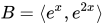
For each vector space of functions of one real variable,
represent the derivative transformation with respect to .
-
 ,
,

-
 ,
,
-
 ,
,

- Answer
- The images of the basis vectors for the domain are
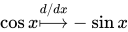 and
and
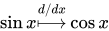 .
Representing those with respect to the codomain's basis (again, )
and adjoining the representations gives this matrix.
.
Representing those with respect to the codomain's basis (again, )
and adjoining the representations gives this matrix.
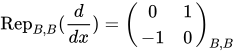
- The images of the vectors in the domain's basis are
 and
and
 .
Representing with respect to the codomain's basis and adjoining
gives this matrix.
.
Representing with respect to the codomain's basis and adjoining
gives this matrix.

- The images of the members of the domain's basis are
 ,
,
 ,
, and
,
, and
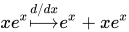 .
Representing these images with respect to and adjoining
gives this matrix.
.
Representing these images with respect to and adjoining
gives this matrix.

- Problem 16
Find the range of the linear transformation of represented
with respect to the standard bases by each matrix.
-

-

- a matrix of the form

- Answer
- It is the set of vectors of the codomain represented with
respect to the codomain's basis in this way.

As the codomain's basis is  ,
and so each vector is represented
by itself, the range of this transformation is the
,
and so each vector is represented
by itself, the range of this transformation is the  -axis.
- It is the set of vectors of the codomain represented
in this way.

With respect to vectors represent
themselves so this range
is the  axis.
axis.
- The set of vectors represented with
respect to as

is the line  , provided either
  or
or  is not zero, and
is the set consisting of just the origin if both are zero.
is not zero, and
is the set consisting of just the origin if both are zero.
- This exercise is recommended for all readers.
- Problem 17
Can one matrix represent two different linear maps?
That is, can  ?
?
- Answer
Yes, for two reasons.
First, the two maps and  need not have the same domain
and codomain.
For instance,
need not have the same domain
and codomain.
For instance,

represents a map  with respect to the standard
bases that sends
with respect to the standard
bases that sends

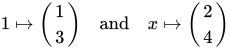
and also represents a
 with respect to
 and that acts in this way.
The second reason is that, even if the domain and
codomain of and coincide, different bases produce
different maps.
An example is the identity matrix
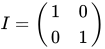
which represents the identity map on with respect to
.
However, with respect to for the domain but the basis
 for the codomain,
the same matrix
for the codomain,
the same matrix  represents the map that swaps the first and second
components
represents the map that swaps the first and second
components
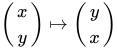
(that is, reflection about the line  ).
).
- Problem 18
Prove Theorem 1.4.
- Answer
We mimic Example 1.1, just replacing the
numbers with letters.
Write as  and as
  .
By definition of representation of a map with respect to bases,
the assumption that
.
By definition of representation of a map with respect to bases,
the assumption that
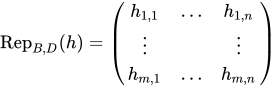
means that
 .
And, by the definition of the representation of a vector with respect to
a basis, the assumption that
.
And, by the definition of the representation of a vector with respect to
a basis, the assumption that
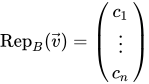
means that  .
Substituting gives
.
Substituting gives
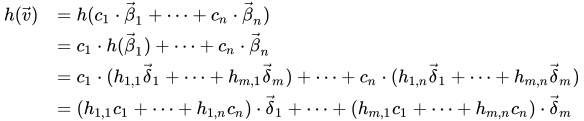
and so is represented as required.
- This exercise is recommended for all readers.
- Problem 19
Example 1.8 shows how to represent
rotation of all vectors in the plane through an angle
 about the origin,
with respect to the standard bases.
about the origin,
with respect to the standard bases.
- Rotation of all vectors in three-space through an angle
about the -axis is a transformation of
 .
Represent it with respect to the standard bases.
Arrange the rotation so that
to someone whose feet are at the origin and
whose head is at
.
Represent it with respect to the standard bases.
Arrange the rotation so that
to someone whose feet are at the origin and
whose head is at  , the movement appears clockwise.
- Repeat the prior item, only rotate about the -axis
instead.
(Put the person's head at .)
- Repeat, about the
 -axis.
- Extend the prior item to
 .
(Hint:
"rotate about the -axis" can be restated as "rotate parallel
to the
.
(Hint:
"rotate about the -axis" can be restated as "rotate parallel
to the  -plane".)
- Answer
- The picture is this.
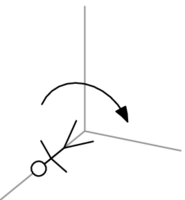
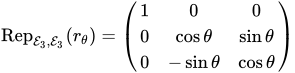
The images of the vectors from the domain's basis

are represented with respect to the codomain's basis
(again,  ) by themselves,
so adjoining the representations to
make the matrix gives this.
) by themselves,
so adjoining the representations to
make the matrix gives this.
- The picture is similar to the one in the prior answer.
The images of the vectors from the domain's basis

are represented with respect to the codomain's basis
by themselves, so this is the matrix.
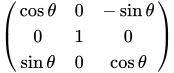
- To a person standing up, with the vertical -axis,
a rotation of the -plane that is clockwise proceeds from
the positive -axis to the positive -axis.
That is, it rotates opposite to the direction in
Example 1.8.
The images of the vectors from the domain's basis

are represented with respect to
by themselves, so the matrix is this.

-
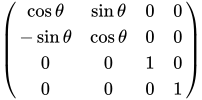
- Problem 20 (Schur's Triangularization Lemma)
- Let
 be a subspace of
  and fix bases
 .
What is the relationship between the representation of a vector
from with
respect to
.
What is the relationship between the representation of a vector
from with
respect to  and the representation of that vector
(viewed as a member of ) with
respect to
and the representation of that vector
(viewed as a member of ) with
respect to  ?
?
- What about maps?
- Fix a basis
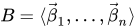 for and observe that the spans
![{\displaystyle [\{{\vec {0}}\}]=\{{\vec {0}}\}\subset [\{{\vec {\beta }}_{1}\}]\subset [\{{\vec {\beta }}_{1},{\vec {\beta }}_{2}\}]\subset \quad \cdots \quad \subset [B]=V}](https://wikimedia.org/api/rest_v1/media/math/render/svg/3414ca6462a266e81a770fece4e99534b9ae335d)
form a strictly increasing chain of subspaces.
Show that for any linear map there is a chain
 of
subspaces of such that
of
subspaces of such that
![{\displaystyle h([\{{\vec {\beta }}_{1},\dots ,{\vec {\beta }}_{i}\}])\subset W_{i}}](https://wikimedia.org/api/rest_v1/media/math/render/svg/8a96d738e2b917d08ef2413bf0cccf59449c4022)
for each .
- Conclude that for every linear map
there are
bases so the matrix representing with respect to
is upper-triangular
(that is, each entry
 with
with  is zero).
- Is an upper-triangular representation unique?
- Answer
-
Write as
 and
then as
and
then as  .
If
.
If

then,
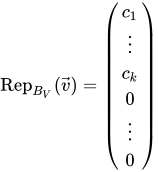
because  .
.
-
We must first decide what the question means.
Compare with its restriction to the subspace
 .
The rangespace of the restriction is a subspace of , so fix a
basis
.
The rangespace of the restriction is a subspace of , so fix a
basis  for this rangespace and extend it to a basis
 for .
We want the relationship between these two.
for .
We want the relationship between these two.

The answer falls right out of the prior item: if
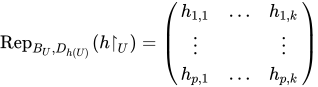
then the extension is represented in this way.
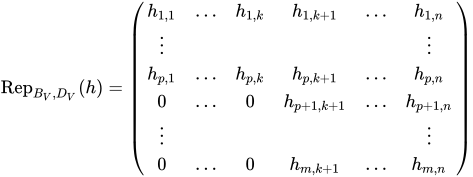
- Take
 to be the span of
 .
.
- Apply the answer from the second item to the third item.
- No.
For instance
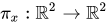 , projection onto
the axis, is represented by these two upper-triangular
matrices
, projection onto
the axis, is represented by these two upper-triangular
matrices

where  .
.