Linear Algebra/Linear Dependance of Columns

From Wikibooks, open books for an open world
< Linear Algebra
Jump to: navigation, search

Let C1, C2, C3, ..., Cn be n columns of m numbers C_n = \begin{bmatrix}
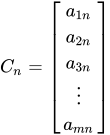
a_{1n} \\
a_{2n} \\
a_{3n} \\
\vdots \\
a_{mn} \\
\end{bmatrix}.

A linear combination of columns n1C1+n2C2+n3C3+...+nnCn is the column
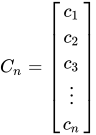
C_n = \begin{bmatrix}
c_1 \\
c_2 \\
c_3 \\
\vdots \\
c_n \\
\end{bmatrix}.

Where ck=n1ak1+n1ak1+n2ak2+n3ak3+...+nnakn.

[edit] Theorem

If there is a determinant of order n which is A=aij, and there are n columns of n elements such that the ith entry of the jth column is equal to aij, then if one of the columns is a linear combination of the other columns, then the determinant is equal to 0.

[edit] Proof

Suppose that the kth column is a linear combination of the other column,
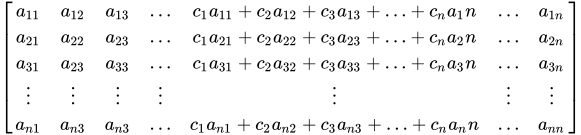
\begin{bmatrix}
a_{11} & a_{12} & a_{13} & \ldots & c_1a_{11}+c_2a_{12}+ c_3a_{13} + \ldots + c_na_1n & \ldots & a_{1n} \\
a_{21} & a_{22} & a_{23} & \ldots & c_1a_{21}+c_2a_{22}+ c_3a_{23} + \ldots + c_na_2n & \ldots & a_{2n} \\
a_{31} & a_{23} & a_{33} & \ldots & c_1a_{31}+c_2a_{32}+ c_3a_{33} + \ldots + c_na_3n & \ldots & a_{3n} \\
\vdots & \vdots & \vdots & \vdots & \vdots & \vdots & \vdots \\
a_{n1} & a_{n3} & a_{n3} & \ldots & c_1a_{n1}+c_2a_{n2}+ c_3a_{n3} + \ldots + c_na_nn & \ldots & a_{nn} \\
\end{bmatrix}.

Then by the linearity of determinants, the determinant is equal to

c_1\begin{bmatrix}
a_{11} & a_{12} & a_{13} & \ldots & a_{11} & \ldots & a_{1n} \\
a_{21} & a_{22} & a_{23} & \ldots & a_{21} & \ldots & a_{2n} \\
a_{31} & a_{23} & a_{33} & \ldots & a_{31} & \ldots & a_{3n} \\
\vdots & \vdots & \vdots & \vdots & \vdots & \vdots & \vdots \\
a_{n1} & a_{n3} & a_{n3} & \ldots & a_{n1} & \ldots & a_{nn} \\
\end{bmatrix}
+
c_2\begin{bmatrix}
a_{11} & a_{12} & a_{13} & \ldots & a_{12} & \ldots & a_{1n} \\
a_{21} & a_{22} & a_{23} & \ldots & a_{22} & \ldots & a_{2n} \\
a_{31} & a_{23} & a_{33} & \ldots & a_{32} & \ldots & a_{3n} \\
\vdots & \vdots & \vdots & \vdots & \vdots & \vdots & \vdots \\
a_{n1} & a_{n3} & a_{n3} & \ldots & a_{n2} & \ldots & a_{nn} \\
\end{bmatrix}
+
c_3\begin{bmatrix}
a_{11} & a_{12} & a_{13} & \ldots & a_{13} & \ldots & a_{1n} \\
a_{21} & a_{22} & a_{23} & \ldots & a_{23} & \ldots & a_{2n} \\
a_{31} & a_{23} & a_{33} & \ldots & a_{33} & \ldots & a_{3n} \\
\vdots & \vdots & \vdots & \vdots & \vdots & \vdots & \vdots \\
a_{n1} & a_{n3} & a_{n3} & \ldots & a_{n3} & \ldots & a_{nn} \\
\end{bmatrix}
+ \ldots +
c_n\begin{bmatrix}
a_{11} & a_{12} & a_{13} & \ldots & a_{1n} & \ldots & a_{1n} \\
a_{21} & a_{22} & a_{23} & \ldots & a_{2n} & \ldots & a_{2n} \\
a_{31} & a_{23} & a_{33} & \ldots & a_{3n} & \ldots & a_{3n} \\
\vdots & \vdots & \vdots & \vdots & \vdots & \vdots & \vdots \\
a_{n1} & a_{n3} & a_{n3} & \ldots & a_{nn} & \ldots & a_{nn} \\
\end{bmatrix}
.

Since all of those matrices have repeat columns, their determinants are 0, and so their sum is 0.

[edit] Rank of a Matrix

The rank of a matrix is the maximum order of a minor that does not equal 0. The minor of a matrix with the order of the rank of the matrix is called a basis minor of the matrix, and the columns that the minor includes are called the basis columns.


Personal tools
Namespaces
Variants
Actions
Navigation
Community
Toolbox
Sister projects
Print/export