Let  be a linear space. A norm is a real-valued function
  on , with the notation
  , such that
- (i)
 (w:triangular inequality)
- (ii)
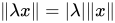 for any scalar
- (iii)
 implies
  .
.
(ii) implies that  . This and (i) then implies
  for all
  ; that is, norms are always non-negative. A linear space with a norm is called a normed space. With the metric
  a normed space is a metric space. Note that (i) implies that:
 and
and 
and so:  . (So, the map
  is continuous; in fact, 1-Lipschitz continuous.)
A complete normed space is called a Banach space. While there is seemingly no prototypical example of a Banach space, we still give one example of a Banach space:  , the space of all continuous functions on a compact space
  , can be identified with a Banach space by introducing the norm:
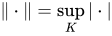
It is a routine exercise to check that this is indeed a norm. The completeness holds since, from real analysis, we know that a uniform limit of a sequence of continuous functions is continuous. In concrete spaces like this one, one can directly show the completeness. More often than that, however, we will see that the completeness is a necessary condition for some results (especially, reflexivity), and thus the space has to be complete. The matter will be picked up in the later chapters.
Another example of Banach spaces, which is more historical, is an  space; that is, the space of convergent series. (The geometric properties of spaces will be investigated in Chapter 4.) It is clear that is a linear space, since the sum of two p-convergent series is again p-convergent. That the norm is in fact a norm follows from
Lemma 2.1. If  , then
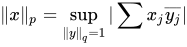 , where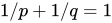
Proof. By Hölder's inequality,
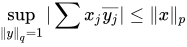
Conversely, if  , then taking
 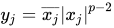 we have:
 , while
  .
.
since  . More generally, if
  , then
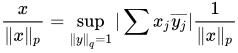 .
.
Since the identity is obvious when , the proof is complete. 
Now, it remains to show that an space is complete. For that, let  be a Cauchy sequence. This means explicitly that
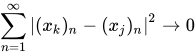 as
as 
For each  , by completeness,
  exists and we denote it by
  . Let
. Let  be given. Since
  is Cauchy, there is
  such that
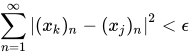 for
for 
Then, for any  ,
,

Hence,  with
with  .
.  is in fact in since
  . (We stress the fact that the completeness of spaces come from the fact that the field of complex numbers is complete; in other words, spaces may fail to be complete if the base field is not complete.) is also separable; i.e., it has a countable dense subset. This follows from the fact that can be written as a union of subspaces with dimensions 1, 2, ..., which are separable. (TODO: need more details.)
We define the operator norm of a continuous linear operator between normed spaces and  , denoted by
  , by
, by
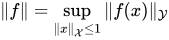
2 Theorem Let  be a linear operator from a normed space to a normed space .
- (i) is continuous if and only if there is a constant
 such that
 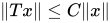 for all
- (ii)
 any
any  as in (i)
 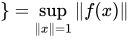 if has nonzero element. (Recall that the inf of the empty set is
  .)
.)
Proof: If  , then

as  . Hence, is continuous. Conversely, suppose
  . Then we can find
  with
with  and
and  . Then
  while
while 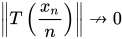 . Hence, is not continuous. The proof of (i) is complete. For (ii), see w:operator norm for now. (TODO: write an actual proof).
It is clear that an addition and a scalar multiplication are both continuous. (Use a sequence to check this.) Since the inverse of an addition is again addition, an addition is also an open mapping. Ditto to nonzero-scalar multiplications. In other words, translations and dilations of open (resp. closed) sets are again open (resp. closed).
Not all linear operators are continuous. Take the linear operator defined by  on the normed vector space of polynomials
 ![{\displaystyle \mathbb {R} [X]}](https://wikimedia.org/api/rest_v1/media/math/render/svg/16d740527b0b7f949b4bf9c9ce004134bb490b68) with the suprenum norm
with the suprenum norm ![{\displaystyle \|P\|_{\infty }=\sup _{x\in [0,1]}|P(x)|}](https://wikimedia.org/api/rest_v1/media/math/render/svg/f6ec5dd5ccbc43a2f0ef1f9df895156e534c483e) ; since
; since  , the unit ball is not bounded and hence this linear operator is not continuous.
Notice that the kernel of this non continuous linear operator is closed:  . However, when a linear operator is of finite rank, the closeness of the kernel is in fact synonymous to continuity. To see this, we start with the special case of linear forms.
2 Theorem A (non null) linear form is continuous iff it's kernel is closed.
- continuous

Proof:
If the linear form on a normed vector space  is continuous, then it's kernel is closed since it's the continuous inverse image of the closed set
  .
.
Conversely, suppose a linear form  is not continuous. then by the previous theorem,
 so in particular, one can define a sequence
  such that
  . Then denote:
 , one has defined a unit normed sequence (
 ) s.t.
  . Furthermore, denote
 . Since
  , one can define a sequence that converges
  whilst
  .
.
Now, since  , then there exists
  such that
  . Then the sequence of general term converges
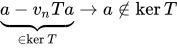 and hence
  is not closed.
Furthermore, if the linear form is continuous and the kernel is dense, then  , hence a continuous & non null linear has a non dense kernel, and hence a linear form with a dense kernel is whether null or non continuous so a non null continuous linear form with a dense kernel is not continuous, and a linear form with a dense kernel is not continuous.
2 Corollary' " A non null linear form on a normed vector space is not continuous iff it's kernel is dense.
 is not continuous"
More generally, we have:
2 Theorem " A non null linear operator of finite rank between normed vector spaces. then closeness of the null space is equivalent to continuity."
Proof: It remains to show that continuity implies closeness of the kernel. Suppose  is not continuous. Denote
  ;
;
2 Lemma If is a linear operator between normed vector spaces, then is of finite rank  iff there exists independent linear forms
  and independent vectors
  such that
  "
"
Proof: take a basis of  , then from
 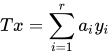 , one can define mappings
  . Unicity and linearity of implies linearity of the
  's. Furthermore, the family of linear forms of
  is linearly independent: suppose not, then there exist a non zero family
  such that e.g.
 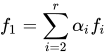 so
so
 and the family
  spans , so
  which is a contradiction. Finally, one has a unique decomposition of a finite rank linear operator:
 with
with 
Take 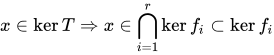 . Then there exists a vector subspace
  such that
  . Denote
  the restriction of to . Since
  , the linear operator
  is injective so
  and is of finite dimension, and this for all
  .
.
By hypothesis is closed. Since the sum of this closed subspace and a subspace of finite dimension () is closed (see lemma bellow), it follows that the kernel of each linear forms  is closed, so the 's are all continuous by the first case and hence is continuous.
2 Lemma The sum of subspace of finite dimension with a closed subspace is closed."
Proof: by induction on the dimension.
Case  . Let's show that
  is closed when
  is closed (where
  is a complete field). Any
  can be uniquely written as
  with
with  . There exists a linear form
  s.t.
s.t. 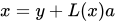 . Since is closed in
  so in
so in  , then is continuous by the first case.
Take a convergente sequence
, then is continuous by the first case.
Take a convergente sequence  of
of  . He have
  with
with  . Since the sequence
  is convergente, then it si Cauchy, so it's continuous image
  is also Cauchy. Since
  is complete, then
  . Finally, the sequence
  converges to
  . Since is closed, then
  and so is closed.
Suppose the result holds for all subspaces of dimension  . Let
. Let  be a subspace of dimension
  . Let
. Let 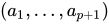 be a basis of . Then
 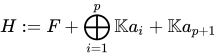 and concludes easily.
2 Corollary Any linear operator on a normed vector space of finite dimension onto a normed vector space is continuous.
Proof: Since is of finite dimension, then any linear operator is of finite rank. Then as  holds, it comes that the null space is of finite dimension, so is closed (any vector subspace of finite dimension is isomorphic to
  (where is a complete field), so the subspace is complete and closed). Then one applies the previous theorem.
2 Lemma (Riesz) A normed space is finite-dimensional if and only if its closed unit ball is compact.
Proof: Let  be a linear vector space isomorphism. Since has closed kernel, arguing as in the proof of the preceding theorem, we see that is continuous. By the same reasoning
  is continuous. It follows:

In the above, the left-hand side is closed, and the right-hand is a continuous image of a closed ball, which is compact. Hence, the closed unit ball is a subset of a compact set and thus compact. Now, the converse. If is not finite dimensional, we can construct a sequence  such that:
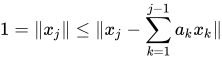 for any sequence of scalars
  .
.
Thus, in particular, 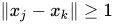 for all
  . (For the details of this argument, see : w:Riesz's lemma for now)
2 Corollary Every finite-dimensional normed space is a Banach space.
Proof: Let  be a Cauchy sequence. Since it is bounded, it is contained in some closed ball, which is compact. thus has a convergent subsequence and so itself converges.
2 Theorem A normed space is finite-dimensional if and only if every linear operator defined on is continuous.
Proof: Identifying the range of with  , we can write:

where  are linear functionals. The dimensions of the kernels of
  are finite. Thus, all have complete and thus closed kernels. Hence, they are continuous and so is continuous. For the converse, we need Axiom of Choice. (TODO: complete the proof.)
The graph of any function on a set  is the set
  . A continuous function between metric spaces has closed graph. In fact, suppose
  . By continuity,
 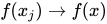 ; in other words,
  and so
  is in the graph of . It follows (in the next theorem) that a continuous linear operator with closed graph has closed domain. (Note the continuity here is a key; we will shortly study a linear operator that has closed graph but has non-closed domain.)
2 Theorem Let  be a continuous densely defined linear operator between Banach spaces. Then its domain is closed; i.e., is actually defined everywhere.
Proof:
Suppose  and
and  is defined for every
  ; i.e., the sequence is in the domain of . Since
 ,
,
is Cauchy. It follows that  is Cauchy and, by completeness, has limit
  since the graph of T is closed. Since
  ,
,  is defined; i.e., is in the domain of .
The theorem is frequently useful in application. Suppose we wish to prove some linear formula. We first show it holds for a function with compact support and of varying smoothness, which is usually easy to do because the function vanishes on the boundary, where much of complications reside. Because of th linear nature in the formula, the theorem then tells that the formula is true for the space where the above functions are dense.
We shall now turn our attention to the consequences of the fact that a complete metric space is a Baire space. They tend to be more significant than results obtained by directly appealing to the completeness. Note that not every normed space that is a Baire space is a Banach space.
2 Theorem (open mapping theorem) Let  be Banach spaces. If is a continuous linear surjection, then it is an open mapping; i.e., it maps open sets to open sets.
Proof: Let  . Since is surjective,
  . Then by Baire's Theorem, some
  contains an interior point; thus, it is a neighborhood of
  .
.
2 Corollary If  and
and  are Banach spaces, then the norms
  and
and  are equivalent; i.e., each norm is dominated by the other.
Proof: Let  be the identity map. Then we have:
 .
.
This is to say,  is continuous. Since Cauchy sequences apparently converge in the norm
 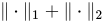 , the open mapping theorem says that the inverse of is also continuous, which means explicitly:
 .
.
By the same argument we can show that is dominated by
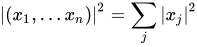
2 Corollary Let  be a Banach space with dimension . Then the norm
  is equivalent to the standard Euclidean norm:
2 Corollary If is a continuous linear operator between Banach spaces with closed range, then there exists a  such that if
  then
then  for some with
  .
.
Proof: This is immediate once we have the notion of a quotient map, which we now define as follows.
Let  be a closed subspace of a normed space . The quotient space
  is a normed space with norm:

where  is a canonical projection. That
  is a norm is obvious except for the triangular inequality. But since

for all  . Taking inf over
  separately we get:

Suppose, further, that is also a commutative algebra and is an ideal. Then becomes a quotient algebra. In fact, as above, we have:
 ,
,
for all since  is a homomorphism. Taking inf completes the proof.
So, the only nontrivial question is the completeness. It turns out that is a Banach space (or algebra) if is Banach space (or algebra). In fact, suppose
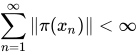
Then we can find a sequence  such that
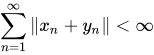
By completeness,  converges, and since is continuous,
  converges then. The completeness now follows from:
2 Lemma Let be a normed space. Then is complete (thus a Banach space) if and only if
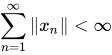 implies
  converges.
Proof: ( ) We have:
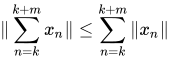 .
.
By hypothesis, the right-hand side goes to 0 as . By completeness, converges. Conversely, suppose is a Cauchy sequence. Thus, for each  , there exists an index
  such that
  for any
  . Let
. Let  . Then
 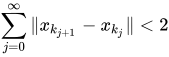 . Hence, by assumption we can get the limit
 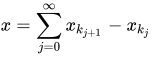 , and since
 as
as  ,
,
we conclude that has a subsequence converging to ; thus, it converges to .
The next result is arguably the most important theorem in the theory of Banach spaces. (At least, it is used the most frequently in application.)
2 Theorem (closed graph theorem) Let be Banach spaces, and a linear operator. The following are equivalent.
- (i) is continuous.
- (ii) If
 and
and  is convergent, then
  .
.
- (iii) The graph of is closed.
Proof: That (i) implies (ii) is clear. To show (iii), suppose  is convergent in . Then converges to some
  or
or  , and
, and  is convergent. Thus, if (ii) holds,
 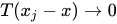 . Finally, to prove (iii) (i), we note that Corollary 2.something gives the inequality:

since by hypothesis the norm in the left-hand side is complete. Hence, if  , then
  .
.
Note that when the domain of a linear operator is not a Banach space (e.g., just dense in a Banach space), the condition (ii) is not sufficient for the graph of the operator to be closed. (It is not hard to find an example of this in other fields, but the reader might want to construct one himself as an exercise.)
Finally, note that an injective linear operator has closed graph if and only if its inverse is closed, since the map  sends closed sets to closed sets.
2 Theorem Let  be Banach spaces. Let
  be a closed densely defined operator and
  be a linear operator with
  . If there are constants
  such that (i)
  and
and  and (ii)
  for every
  , then
  is closed.
Proof:
Suppose  . Then

Thus,

By hypothesis, the right-hand side goes to as  .
Since is closed,
.
Since is closed,  converges to
  .
.
In particular, with  , the hypothesis of the theorem is fulfilled, if is continuous.
When are normed spaces, by  we denote the space of all continuous linear operators from to .
2 Theorem If is complete, then every Cauchy sequence  in converges to a limit and
 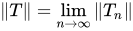 . Conversely, if is complete, then so is Y.
Proof: Let be a Cauchy sequence in operator norm. For each  , since

and is complete, there is a limit to which  converges. Define
  . is linear since the limit operations are linear. It is also continuous since
  . Finally,
  and
and  as . (TODO: a proof for the converse.)
2 Theorem (uniform boundedness principle) Let  be a family of continuous functions
  where
where  is a normed linear space. Suppose that
  is non-meager and that:
 for each
It then follows: there is some  open and such that
- (a)

If we assume in addition that each member of is a linear operator and is a normed linear space, then
- (b)

Proof: Let  be a sequence. By hypothesis,
  and each
  is closed since
  is open by continuity. It then follows that some
  has an interior point ; otherwise,
  fails to be non-meager. Hence, (a) holds. To show (b), making additional assumptions, we can find an open ball
  . It then follows: for any
  and any with
  ,
,
 .
.
A family  of linear operators is said to be equicontinuous if given any neighborhood
  of we can find a neighborhood
  of such that:
 for every
The conclusion of the theorem, therefore, means that the family satisfying the hypothesis of the theorem is equicontinuous.
2 Corollary Let  be Banach spaces. Let
  be a bilinear or sesquilinear operator. If is separately continuous (i.e., the function is continuous when all but one variables are fixed) and is complete, then is continuous.
Proof: For each  ,
,

where the right-hand side is finite by continuity. Hence, the application of the principle of uniform boundedness to the family  shows the family is equicontinuous. That is, there is such that:
 for every
  and every .
The theorem now follows since  is a metric space.
Since scalar multiplication is a continuous operation in normed spaces, the corollary says, in particular, that every linear operator on finite dimensional normed spaces is continuous. The next is one more example of the techniques discussed so far.
2. Theorem (Hahn-Banach) Let  be normed space and
  be a linear subspace. If
  is a linear functional continuous on , then there exists a continuous linear functional
  on such that
  on and
  .
.
Proof: Apply the Hahn-Banach stated in Chapter 1 with  as a sublinear functional dominating . Then:
 ;
;
that is, .
2. Corollary Let be a subspace of a normed linear space . Then is in the closure of if and only if  = 0 for any
  that vanishes on .
Proof: By continuity  . Thus, if
  , then
  . Conversely, suppose
  . Then there is a
  such that
  for every
  . Define a linear functional
 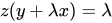 for and scalars . For any
  , since
  ,
,
 .
.
Since the inequality holds for  as well, is continuous. Hence, in view of the Hahn-Banach theorem,
  while we still have
  on and
  .
.
Here is a classic application.
2 Theorem Let be Banach spaces, be a linear operator. If  implies that
 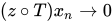 for every , then is continuous.
Proof: Suppose and  . For every , by hypothesis and the continuity of ,
 .
.
Now, by the preceding corollary  and the continuity follows from the closed graph theorem.
2 Theorem Let be a Banach space.
- (i) Given
 , is bounded if and only if
  for every
- (ii) Given , if
 for every , then .
Proof: (i) By continuity,
 .
.
This proves the direct part. For the converse, define  for
for  . By hypothesis
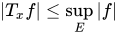 for every
  .
.
Thus, by the principle of uniform boundedness, there is such that:
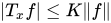 for every
Hence, in view of Theorem 2.something, for ,
 .
.
(ii) Suppose  . Define
  for scalars
  . Now, is continuous since its domain is finite-dimensional, and so by the Hahn-Banach theorem we could extend the domain of in such a way we have .
2. Corollary Let be Banach,  and dense and linear. Then
  for every if and only if
  and
and  for every .
Proof: Since is Cauchy, it is bounded. This shows the direct part. To show the converse, let . If  , then

By denseness, we can take  so that
 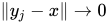 .
.
2 Theorem Let be a continuous linear operator into a Banach space. If  where is the identity operator, then the inverse exists, is continuous and can be written by:
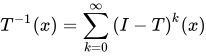 for each in the range of .
Proof: For  , we have:
 .
.
Since the series is geometric by hypothesis, the right-hand side is finite. Let 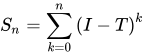 . By the above, each time is fixed,
  is a Cauchy sequence and the assumed completeness implies that the sequence converges to the limit, which we denote by
  . Since for each
 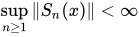 , it follows from the principle of uniform boundedness that:
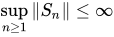 .
.
Thus, by the continuity of norms,
 .
.
This shows that is a continuous linear operator since the linearity is easily checked. Finally,
 .
.
Hence, is the inverse to .
2 Corollary The space of invertible continuous linear operators is an open subspace of  .
.
Proof: If  and
and 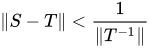 , then is invertible.
If  is a scalar field and is a normed space, then
  is called a dual of and is denoted by
  . In view of Theorem 2.something, it is a Banach space.
A linear operator is said to be a compact operator if the image of the open unit ball under is relatively compact. We recall that if a linear operator between normed spaces maps bounded sets to bounded sets, then it is continuous. Thus, every compact operator is continuous.
2 Theorem Let be a reflexive Banach space and be a Banach space. Then a linear operator is a compact operator if and only if sends weakly convergent sequence to norm convergent ones.
Proof:[1] Let converges weakly to , and suppose  is not convergent. That is, there is an such that
  for infinitely many . Denote this subsequence by . By hypothesis we can then show (TODO: do this indeed) that it contains a subsequence
  such that
  converges in norm, which is a contradiction. To show the converse, let be a bounded set. Then since is reflexive every countable subset of contains a sequence that is Cauchy in the weak topology and so by the hypothesis is a Cauchy sequence in norm. Thus,
  is contained in a compact subset of .
2 Corollary
- (i) Every finite-rank linear operator (i.e., a linear operator with finite-dimensional range) is a compact operator.
- (ii) Every linear operator with the finite-dimensional domain is continuous.
Proof: (i) is clear, and (ii) follows from (i) since the range of a linear operator has dimension less than that of the domain.
2 Theorem The set of all compact operators into a Banach space forms a closed subspace of the set of all continuous linear operators in operator norm.
Proof: Let be a linear operator and  be the open unit ball in the domain of . If is compact, then
  is bounded (try scalar multiplication); thus, is continuous. Since the sum of two compacts sets is again compact, the sum of two compact operators is again compact. For the similar reason,
  is compact for any scalar
  . We conclude that the set of all compact operators, which we denote by , forms a subspace of continuous linear operators. To show the closedness, suppose is in the closure of . Let be given. Then there is some compact operator such that
  . Also, since is a compact operator, we can cover
  by a finite number of open balls of radius
  centered at
  , respectively. It then follows: for
  , we can find some so that
  and so
  . This is to say,
  is totally bounded and since the completeness its closure is compact.
2 Corollary If is a sequence of compact operators which converges in operator norm, then its limit is a compact operator.
2 Theorem (transpose) Let be Banach spaces, and  be a continuous linear operator. Define
 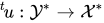 by the identity
  . Then
  is continuous both in operator norm and the weak-* topology, and
  .
.
Proof: For any 

Thus,  and is continuous in operator norm. To show the opposite inequality, let be given. Then there is
  with
with  . Using the Hahn-Banach theorem we can also find
  and
and  . Hence,
 .
.
We conclude . To show weak-* continuity let be a neighborhood of in ; that is,  for some
  . If we let
  , then

since  . This is to say, is weak-* continuous.
2 Theorem Let be a linear operator between normed spaces. Then is compact if and only if its transpose  is compact.
Proof: Let be the closure of the image of the closed unit ball under . If T is compact, then K is compact. Let  be a bounded sequence. Then the restrictions of to K is a bounded equicontinuous sequence in
  ; thus, it has a convergent subsequence by Ascoli's theorem. Thus,
  is convergent for every x with
  , and so
  is convergent. The converse follows from noting that every normed space can be embedded continuously into its second dual. (TODO: need more details.)
