A normed space is called a pre-Hilbert space if for each pair  of elements in the space there is a unique complex (or real) number called an inner product of
  and
and  , denoted by
  , subject to the following conditions:
- (i) The functional
 is linear.
- (ii)
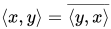
- (iii)
 for every nonzero
The inner product in its second variable is not linear but antilinear: i.e., if 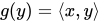 , then
  for scalars
  . We define
 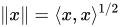 and this becomes a norm. Indeed, it is clear that
  and (iii) is the reason that
  implies that
  . Finally, the triangular inequality follows from the next lemma.
3.1 Lemma (Schwarz's inequality)  where the equality holds if and only if we can write
  for some scalar
  .
.
If we assume the lemma for a moment, it follows:

|

|
|
|
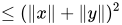
|
since  for any complex number
Proof of Lemma: First suppose  . If
. If  , it then follows:

where the equation becomes  if and only if . Since we may suppose that
  , the general case follows easily.
3.2 Theorem A normed linear space is a pre-Hilbert space if and only if  .
.
Proof: The direct part is clear. To show the converse, we define
 .
.
It is then immediate that ,  and
and  . Moreover, since the calculation:

|

|
|
|
 , ,
|
we have:
 . If is a real scalar and
  is a sequence of rational numbers converging to , then by continuity and the above, we get:
3.3 Lemma Let  be a pre-Hilbert. Then
  in norm if and only if for any
 and
and  as
as  .
.
Proof: The direct part holds since:
 as .
as .
Conversely, we have:
 as
as
3.4 Lemma Let  be a non-empty convex closed subset of a Hilbert space. Then admits a unique element
  such that
 .
.
Proof: By  denote the right-hand side. Since is nonempty,
  . For each
  , there is some
  such that
  . That is,
 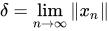 . Since is convex,
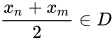 and so
  .
.
It follows:

|

|
|
|

|
|
|
 as as 
|
This is to say,  is Cauchy. Since is a closed subset of a complete metric space, whence it is complete, there is a limit
  with
with  . The uniqueness follows since if
  we have

where the right side is  for the same reason as before.
The lemma may hold for a certain Banach space that is not a Hilbert space; this question will be investigated in the next chapter.
For a nonempty subset  , define
  to be the intersection of the kernel of the linear functional
  taken all over
  . (In other words, is the set of all
  that is orthogonal to every
  .) Since the kernel of a continuous function is closed and the intersection of linear spaces is again a linear space, is a closed (linear) subspace of . Finally, if
  , then
  and .
and .
3.5 Lemma Let  be a linear subspace of a pre-Hilbert space. Then
  if and only if
  .
.
Proof: (<=). Let  . By our condition, we have that
 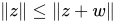 . Squaring both sides gives
  . Expanding this using inner products and rearranging gives
  . The same thing is true (by the same argument) for
  , so we get
  . This altogether implies that
  , from which we get
  . Consider a real
  ; by the same argument we have that
  . Since this is true for all , we get
  . Since furthermore we have
  , we have that
  . We conclude that
  .
.
(=>) Let . We have that  . Taking the first and last term in this quality, and applying the square root, gives
 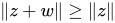 . Finally, notice that for
  , the infimum is obtained because
 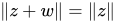 .
.
3.6 Theorem (orthogonal decomposition) Let be a Hilbert space and  be a closed subspace. For every we can write

where  and , and and are uniquely determined by .
Proof: Clearly  is convex, and it is also closed since a translation of closed set is again closed. Lemma 3.4 now gives a unique element such that
  . Let
. Let  . By Lemma 3.5, . For the uniqueness, suppose we have written:

where  and
and  . By Lemma 3.5,
  . But, as noted early, such
  must be unique; i.e.,
  .
.
3.7 Corollary Let be a subspace of a Hilbert space . Then
- (i)
 if and only if is dense in .
- (ii)
 .
.
Proof: By continuity, 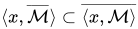 . (Here,
  denotes the image of the set
  under the map
  .)
This gives:
.)
This gives:
 and so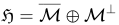
by the orthogonal decomposition. (i) follows. Similarly, we have:
 .
.
Hence, (ii).
3.8 Theorem (representation theorem) Every continuous linear functional  on a Hilbert space has the form:
- with a unique and

Proof: Let 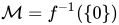 . Since is continuous, is closed. If
  , then take
  . If not, by Corollary 3.6, there is a nonzero
  orthogonal to . By replacing with
  we may suppose that
  . For any , since
 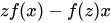 is in the kernel of and thus is orthogonal to , we have:

and so:
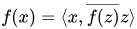
The uniqueness follows since  for all means that
  . Finally, we have the identity:

where the last inequality is Schwarz's inequality.
3.9 Exercise Using Lemma 1.6 give an alternative proof of the preceding theorem.
In view of Theorem 3.5, for each , we can write: where , a closed subspace of , and . Denote each , which is uniquely determined by , by  . The function
  then turns out to be a linear operator. Indeed, for given
  , we write:
 and
and 
where  and
and  for
for  . By the uniqueness of decomposition
 .
.
The similar reasoning shows that commutes with scalars. Now, for  (where and ), we have:

That is, is continuous with  . In particular, when is a nonzero space, there is
  with
with  and
and  and consequently
  . Such is called an orthogonal projection (onto ).
The next theorem gives an alternative proof of the Hahn-Banach theorem.
3 Theorem Let be a linear (not necessarily closed) subspace of a Hilbert space. Every continuous linear functional on can be extended to a unique continuous linear functional on that has the same norm and vanishes on  .
.
Proof: Since is a dense subset of a Banach space  , by Theorem 2.something, we can uniquely extend so that it is continuous on . Define
  . By the same argument used in the proof of Theorem 2.something (Hahn-Banach) and the fact that
  , we obtain
  . Since
  on , it remains to show the uniqueness. For this, let
  be another extension with the desired properties. Since the kernel of
  is closed and thus contain ,
  on . Hence, for any ,
 .
.
The extension  is thus unique.
3 Theorem Let  be an increasing sequence of closed subspaces, and be the closure of
  . If
. If  is an orthogonal projection onto , then for every
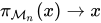 .
.
Proof: Let  . Then
  is closed. Indeed, if
  and , then

and so  . Since
  , the proof is complete.
Let  be Hilbert spaces. The direct sum of
  is defined as follows:
let
is defined as follows:
let  and define
 .
.
It is then easy to verify that  is a Hilbert space. It is also clear that this definition generalizes to a finite direct sum of Hilbert spaces. (For an infinite direct sum of Hilbert spaces, see Chapter 5.)
Recall from the previous chapter that an isometric surjection between Banach spaces is called "unitary".
3 Lemma (Hilbert adjoint) Define  by
by  . (Clearly,
  is a unitary operator.) Then
  is a graph (of some linear operator) if and only if
  is densely defined.
Proof:
Set  . Let
. Let  . Then
 for every
  .
.
That is to say,  , which is a graph of a linear operator by assumption. Thus,
  . For the converse, suppose
  . Then


and so  for every in the domain of , dense. Thus,
  , and is a graph of a function, say,
  . The linear of can be checked in the similar manner.
Remark: In the proof of the lemma, the linear of was never used.
For a densely defined , we thus obtained a linear operator which we call  . It is characterized uniquely by:
 for every
  ,
,
or, more commonly,
 for every .
Furthermore,  is defined if and only if

is continuous for every  . The operator is called the Hilbert adjoint (or just adjoint) of . If is closed in addition to having dense domain, then

Here,  . By the above lemma, is densely defined. More generally, if a densely defined operator has a closed extension (i.e.,
  ), then and
  are both densely defined. It follows:
  . That is, is densely defined and
  exists. That
  follows from the next theorem.
3 Theorem Let  be a densely defined operator. If is also densely defined, then

for any closed extension of .
Proof: As above,

Here, the left-hand side is a graph of . For the second identity, since  is a Hilbert space, it suffices to show
  . But this follows from Lemma 3.something.
The next corollary is obvious but is important in application.
3 Corollary Let  be Hilbert spaces, and a closed densely defined linear operator. Then if and only if there is some
  such that:
 for every
3 Lemma Let be a densely defined linear operator. Then 
Proof: is in either the left-hand side or the right-hand side if and only if:
 for every .
(Note that  for every implies .)
In particular, a closed densely defined operator has closed kernel. As an application we shall prove the next theorem.
3 Theorem Let be a closed densely defined linear operator. Then is surjective if and only if there is a such that
 for every .
Proof: Suppose is surjective. Since has closed range, it suffices to show the estimate for  .
Let
.
Let 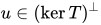 with
with  . Denoting by
  the inverse of restricted to
  , we have:

The last inequality holds since is continuous by the closed graph theorem. To show the converse, let  be given. Since is injective, we can define a linear functional
  by
by  for
for  .,
.,
 for every .
Thus, is continuous on the range of . It follows from the Hahn-Banach theorem that we may assume that is defined and continuous on  . Thus, by Theorem 3.something, we can write
 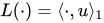 in with some . Since
  is continuous for ,
 for every .
Hence,  .
.
3 Corollary Let  be as given in the preceding theorem. Then
  is closed if and only if
  is closed.
Proof: Define  by
by  . It thus suffices to show is surjective when has closed range (or equivalently is surjective.) Suppose
  is convergent. The preceding theorem gives:
 as
as  .
.
Thus,  is Cauchy in the graph of , which is closed. Hence, converges within the range of . The converse holds since
  .
.
We shall now consider some concrete examples of densely defined linear operators.
3 Theorem is continuous if and only if is continuous. Moreover, when is continuous,
 .
.
Proof: It is clear that is defined everywhere, and its continuity is a consequence of the closed graph theorem. Conversely, if is continuous, then is continuous and  . For the second part,
 for every .
Thus, is continuous with  . In particular,
  is continuous, and so:
 for every .
That is to say,  . Applying this result to in place of completes the proof.
The identity in the theorem shows that  is a
is a  -algebra, which is a topic in Chapter 6.
3 Lemma Let  . If
. If  for , then .
Proof: Let  . We have
  and
and  . Summing the two we get:
 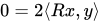 for
for  . Taking
  gives
gives  for all or
  .
.
Remark: the above lemma is false if the underlying field is  .
.
Recall that an isometric surjection is called unitary.
3 Corollary A linear operator  is unitary if and only if
  and
and  are identities.
Proof:
Since  , we see that is the identity. Since
  , is the identity on the range of U, which is
  by surjectivity. Conversely, since
 ,
,
 is an isometry.
Curiously, the hypothesis on linearity can be omitted:
3 Theorem If  is a function such that

for every x and y and  , then is a linear operator (and so unitary).
Proof: Note that U is continuous. Since  ,
we have:
,
we have:
 .
.
Thus,

It now follows:

for any  and scalar .
There is an analog of this result for Banach space. See, for example, http://www.helsinki.fi/~jvaisala/mazurulam.pdf)
3 Exercise Construct an example so as to show that an isometric operator (i.e., a linear operator that preserves norm) need not be unitary. (Hint: a shift operator.)
A densely defined linear operator is called "symmetric" if  . If the equality in the above holds, then is called "self-adjoint". In light of Theorem 3.something, every self-adjoint is closed and densely defined. If is symmetric, then since is an extension of ,
 .
.
3 Theorem Let  be densely defined linear operators for
  . Then
  where the equality holds if
  and
and  is closed and densely defined.
Proof: Let  . Then
 for every
  .
.
But, by definition,  denotes
  . Hence,
  is an extension of . For the second part, the fact we have just proved gives:
 .
.
3 Theorem Let be a Hilbert spaces. If is a closed densely defined operator, then is a self-adjoint operator (in particular, densely defined and closed.)
Proof: In light of the preceding theorem, it suffices to show that is closed. Let 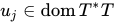 be a sequence such that
  converges to limit
  .
Since
.
Since
 ,
,
there is some such that:  . It follows from the closedness of that
  . Since
  and is closed,
  .
.
3 Theorem Let be a symmetric densely defined operator. If is surjective, then is self-adjoint and injective and  is self-adjoint and bounded.
Proof: If  ,
,
 and
and
if has a dense range (for example, it is surjective). Thus, is injective. Since is closed (by Lemma 2.something) and  ,
,  is a continuous linear operator. Finally, we have:
 .
.
Here,  , and the equality holds since the domains of and coincide. Hence, is self-adjoint. Since we have just proved that the inverse of a self-adjoint is self-adjoint, we have:
  is self-adjoint.
3 Theorem Let be a closed linear subspace of a Hilbert space . Then is an orthogonal projection onto if and only if  and the range of is .
Proof: The direct part is clear except for  . But we have:

since and  are orthogonal. Thus, is real and so self-adjoint then. For the converse, we only have to verify
  for every . But we have:
  and
and  .
.
We shall now turn our attention to the spectral decomposition of a compact self-adjoint operator. Let  be a compact operator.
