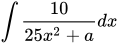
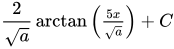
The idea behind the trigonometric substitution is quite simple: to replace expressions involving square roots with expressions that involve standard trigonometric functions, but no square roots . Integrals involving trigonometric functions are often easier to solve than integrals involving square roots.
Let us demonstrate this idea in practice. Consider the expression
1
−
x
2
{\displaystyle {\sqrt {1-x^{2}}}}
sin
2
(
θ
)
+
cos
2
(
θ
)
=
1
{\displaystyle \sin ^{2}(\theta )+\cos ^{2}(\theta )=1}
θ
{\displaystyle \theta }
x
{\displaystyle x}
sin
(
θ
)
{\displaystyle \sin(\theta )}
1
−
x
2
=
1
−
sin
2
(
θ
)
=
cos
2
(
θ
)
=
cos
(
θ
)
{\displaystyle {\sqrt {1-x^{2}}}={\sqrt {1-\sin ^{2}(\theta )}}={\sqrt {\cos ^{2}(\theta )}}=\cos(\theta )}
Note that we could write
θ
=
arcsin
(
x
)
{\displaystyle \theta =\arcsin(x)}
x
2
{\displaystyle x^{2}}
sin
2
(
θ
)
{\displaystyle \sin ^{2}(\theta )}
We would like to mention that technically one should write the absolute value of
cos
(
θ
)
{\displaystyle \cos(\theta )}
|
cos
(
θ
)
|
{\displaystyle {\bigl |}\cos(\theta ){\bigr |}}
a
2
=
|
a
|
{\displaystyle {\sqrt {a^{2}}}=|a|}
a
{\displaystyle a}
x
{\displaystyle x}
cos
(
θ
)
{\displaystyle \cos(\theta )}
cos
(
θ
)
{\displaystyle \cos(\theta )}
1
−
x
2
{\displaystyle {\sqrt {1-x^{2}}}}
d
x
=
cos
(
θ
)
d
θ
{\displaystyle dx=\cos(\theta )d\theta }
θ
{\displaystyle \theta }
d
x
{\displaystyle dx}
d
θ
{\displaystyle d\theta }
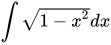
∫
1
−
x
2
d
x
{\displaystyle \int {\sqrt {1-x^{2}}}dx}
we can rewrite it as
∫
cos
(
θ
)
cos
(
θ
)
d
θ
=
∫
cos
2
(
θ
)
d
θ
{\displaystyle \int \cos(\theta )\cos(\theta )d\theta =\int \cos ^{2}(\theta )d\theta }
Notice in the expression on the left that the first
cos
(
θ
)
{\displaystyle \cos(\theta )}
1
−
x
2
{\displaystyle {\sqrt {1-x^{2}}}}
cos
(
θ
)
d
θ
{\displaystyle \cos(\theta )d\theta }
d
x
{\displaystyle dx}
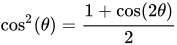
Since
cos
2
(
θ
)
=
1
+
cos
(
2
θ
)
2
{\displaystyle \cos ^{2}(\theta )={\frac {1+\cos(2\theta )}{2}}}
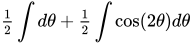
1
2
∫
d
θ
+
1
2
∫
cos
(
2
θ
)
d
θ
{\displaystyle {\tfrac {1}{2}}\int d\theta +{\tfrac {1}{2}}\int \cos(2\theta )d\theta }
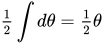
These last two integrals are easily handled. For the first integral we get
1
2
∫
d
θ
=
1
2
θ
{\displaystyle {\tfrac {1}{2}}\int d\theta ={\tfrac {1}{2}}\theta }
For the second integral we do a substitution, namely
u
=
2
θ
,
d
u
=
2
d
θ
{\displaystyle u=2\theta ,du=2d\theta }
1
2
∫
cos
(
2
θ
)
d
θ
=
1
2
∫
cos
(
u
)
1
2
d
u
=
1
4
sin
(
u
)
=
sin
(
2
θ
)
4
{\displaystyle {\tfrac {1}{2}}\int \cos(2\theta )d\theta ={\tfrac {1}{2}}\int \cos(u){\tfrac {1}{2}}du={\tfrac {1}{4}}\sin(u)={\frac {\sin(2\theta )}{4}}}
Finally we see that:
∫
cos
2
(
θ
)
d
θ
=
θ
2
+
sin
(
2
θ
)
4
=
θ
+
sin
(
θ
)
cos
(
θ
)
2
{\displaystyle \int \cos ^{2}(\theta )d\theta ={\frac {\theta }{2}}+{\frac {\sin(2\theta )}{4}}={\frac {\theta +\sin(\theta )\cos(\theta )}{2}}}
However, this is in terms of
θ
{\displaystyle \theta }
x
{\displaystyle x}
x
{\displaystyle x}
That is we worked out that:
sin
(
θ
)
=
x
cos
(
θ
)
=
1
−
x
2
θ
=
arcsin
(
x
)
{\displaystyle \sin(\theta )=x\qquad \cos(\theta )={\sqrt {1-x^{2}}}\qquad \theta =\arcsin(x)}
So we arrive at our final answer
∫
1
−
x
2
d
x
=
arcsin
(
x
)
+
x
1
−
x
2
2
{\displaystyle \int {\sqrt {1-x^{2}}}dx={\frac {\arcsin(x)+x{\sqrt {1-x^{2}}}}{2}}}
As you can see, even for a fairly harmless looking integral this technique can involve quite a lot of calculation. Often it is helpful to see if a simpler method will suffice before turning to trigonometric substitution. On the other hand, frequently in the case of integrands involving square roots, this is the most tractable way to solve the problem. We begin with giving some rules of thumb to help you decide which trigonometric substitutions might be helpful.
If the integrand contains a single factor of one of the forms
a
2
−
x
2
or
a
2
+
x
2
or
x
2
−
a
2
{\displaystyle {\sqrt {a^{2}-x^{2}}}{\mbox{ or }}{\sqrt {a^{2}+x^{2}}}{\mbox{ or }}{\sqrt {x^{2}-a^{2}}}}
If the integrand contains
a
2
−
x
2
{\displaystyle {\sqrt {a^{2}-x^{2}}}}
x
=
a
sin
(
θ
)
{\displaystyle x=a\sin(\theta )}
identity
1
−
sin
2
(
θ
)
=
cos
2
(
θ
)
{\displaystyle 1-\sin ^{2}(\theta )=\cos ^{2}(\theta )}
If the integrand contains
a
2
+
x
2
{\displaystyle {\sqrt {a^{2}+x^{2}}}}
x
=
a
tan
(
θ
)
{\displaystyle x=a\tan(\theta )}
1
+
tan
2
(
θ
)
=
sec
2
(
θ
)
{\displaystyle 1+\tan ^{2}(\theta )=\sec ^{2}(\theta )}
If the integrand contains
x
2
−
a
2
{\displaystyle {\sqrt {x^{2}-a^{2}}}}
x
=
a
sec
(
θ
)
{\displaystyle x=a\sec(\theta )}
sec
2
(
θ
)
−
1
=
tan
2
(
θ
)
{\displaystyle \sec ^{2}(\theta )-1=\tan ^{2}(\theta )}
Trigonometric Substitutions Trigonometric Substitutions This substitution is easily derived from a triangle, using the Pythagorean Theorem . If the integrand contains a piece of the form
a
2
−
x
2
{\displaystyle {\sqrt {a^{2}-x^{2}}}}
x
=
a
sin
(
θ
)
d
x
=
a
cos
(
θ
)
d
θ
{\displaystyle x=a\sin(\theta )\quad dx=a\cos(\theta )d\theta }
This will transform the integrand to a trigonometric function. If the new integrand can't be integrated on sight then the tan-half-angle substitution described below will generally transform it into a more tractable algebraic integrand.
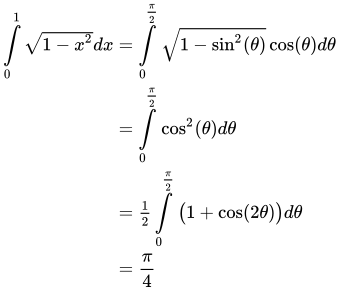
E.g., if the integrand is
1
−
x
2
{\displaystyle {\sqrt {1-x^{2}}}}
∫
0
1
1
−
x
2
d
x
=
∫
0
π
2
1
−
sin
2
(
θ
)
cos
(
θ
)
d
θ
=
∫
0
π
2
cos
2
(
θ
)
d
θ
=
1
2
∫
0
π
2
(
1
+
cos
(
2
θ
)
)
d
θ
=
π
4
{\displaystyle {\begin{aligned}\int \limits _{0}^{1}{\sqrt {1-x^{2}}}dx&=\int \limits _{0}^{\frac {\pi }{2}}{\sqrt {1-\sin ^{2}(\theta )}}\cos(\theta )d\theta \\&=\int \limits _{0}^{\frac {\pi }{2}}\cos ^{2}(\theta )d\theta \\&={\tfrac {1}{2}}\int \limits _{0}^{\frac {\pi }{2}}{\bigl (}1+\cos(2\theta ){\bigr )}d\theta \\&={\frac {\pi }{4}}\end{aligned}}}
If the integrand is
1
+
x
1
−
x
{\displaystyle {\sqrt {\frac {1+x}{1-x}}}}
1
+
x
1
−
x
=
1
+
x
1
+
x
⋅
1
+
x
1
−
x
=
1
+
x
1
−
x
2
{\displaystyle {\sqrt {\frac {1+x}{1-x}}}={\sqrt {{\frac {1+x}{1+x}}\cdot {\frac {1+x}{1-x}}}}={\frac {1+x}{\sqrt {1-x^{2}}}}}
Then we can make the substitution
∫
0
a
1
+
x
1
−
x
2
d
x
=
∫
0
α
1
+
sin
(
θ
)
cos
(
θ
)
cos
(
θ
)
d
θ
0
<
a
<
1
=
∫
0
α
(
1
+
sin
(
θ
)
)
d
θ
α
=
arcsin
(
a
)
=
α
+
[
−
cos
(
θ
)
]
0
α
=
α
+
1
−
cos
(
α
)
=
1
+
arcsin
(
a
)
−
1
−
a
2
{\displaystyle {\begin{aligned}\int \limits _{0}^{a}{\frac {1+x}{\sqrt {1-x^{2}}}}dx&=\int \limits _{0}^{\alpha }{\frac {1+\sin(\theta )}{\cos(\theta )}}\cos(\theta )d\theta &0<a<1\\&=\int \limits _{0}^{\alpha }{\bigl (}1+\sin(\theta ){\bigr )}d\theta &\alpha =\arcsin(a)\\&=\alpha +{\Big [}-\cos(\theta ){\Big ]}_{0}^{\alpha }\\&=\alpha +1-\cos(\alpha )\\&=1+\arcsin(a)-{\sqrt {1-a^{2}}}\end{aligned}}}
This substitution is easily derived from a triangle, using the Pythagorean Theorem . When the integrand contains a piece of the form
a
2
+
x
2
{\displaystyle {\sqrt {a^{2}+x^{2}}}}
x
=
a
tan
(
θ
)
x
2
+
a
2
=
a
sec
(
θ
)
d
x
=
a
sec
2
(
θ
)
d
θ
{\displaystyle x=a\tan(\theta )\qquad {\sqrt {x^{2}+a^{2}}}=a\sec(\theta )\qquad dx=a\sec ^{2}(\theta )d\theta }
E.g., if the integrand is
(
x
2
+
a
2
)
−
3
2
{\displaystyle (x^{2}+a^{2})^{-{\frac {3}{2}}}}
∫
0
z
(
x
2
+
a
2
)
−
3
2
d
x
=
a
−
2
∫
0
α
cos
(
θ
)
d
θ
z
>
0
=
a
−
2
[
sin
(
θ
)
]
0
α
α
=
arctan
(
z
a
)
=
a
−
2
sin
(
α
)
=
a
−
2
z
a
1
+
z
2
a
2
=
z
a
2
a
2
+
z
2
{\displaystyle {\begin{aligned}\int \limits _{0}^{z}(x^{2}+a^{2})^{-{\frac {3}{2}}}dx&=a^{-2}\int \limits _{0}^{\alpha }\cos(\theta )d\theta &z>0\\&=a^{-2}{\Big [}\sin(\theta ){\Big ]}_{0}^{\alpha }&\alpha =\arctan \left({\tfrac {z}{a}}\right)\\&=a^{-2}\sin(\alpha )\\&=a^{-2}{\frac {\frac {z}{a}}{\sqrt {1+{\frac {z^{2}}{a^{2}}}}}}\\&={\frac {z}{a^{2}{\sqrt {a^{2}+z^{2}}}}}\end{aligned}}}
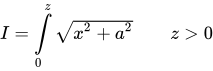
If the integral is
I
=
∫
0
z
x
2
+
a
2
z
>
0
{\displaystyle I=\int \limits _{0}^{z}{\sqrt {x^{2}+a^{2}}}\qquad z>0}
then on making this substitution we find
I
=
a
2
∫
0
α
sec
3
θ
d
θ
α
=
tan
−
1
(
z
/
a
)
=
a
2
∫
0
α
sec
θ
d
tan
θ
=
a
2
[
sec
θ
tan
θ
]
0
α
−
a
2
∫
0
α
sec
θ
tan
2
θ
d
θ
=
a
2
sec
α
tan
α
−
a
2
∫
0
α
sec
3
θ
d
θ
+
a
2
∫
0
α
sec
θ
d
θ
=
a
2
sec
α
tan
α
−
I
+
a
2
∫
0
α
sec
θ
d
θ
{\displaystyle {\begin{matrix}I&=&a^{2}\int _{0}^{\alpha }\sec ^{3}\theta \,d\theta &&&\alpha =\tan ^{-1}(z/a)\\&=&a^{2}\int _{0}^{\alpha }\sec \theta \,d\tan \theta &&&\\&=&a^{2}[\sec \theta \tan \theta ]_{0}^{\alpha }&-&a^{2}\int _{0}^{\alpha }\sec \theta \tan ^{2}\theta \,d\theta &\\&=&a^{2}\sec \alpha \tan \alpha &-&a^{2}\int _{0}^{\alpha }\sec ^{3}\theta \,d\theta &+a^{2}\int _{0}^{\alpha }\sec \theta \,d\theta \\&=&a^{2}\sec \alpha \tan \alpha &-&I&+a^{2}\int _{0}^{\alpha }\sec \theta \,d\theta \\\end{matrix}}}
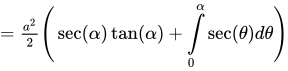
After integrating by parts, and using trigonometric identities, we've ended up with an expression involving the original integral. In cases like this we must now rearrange the equation so that the original integral is on one side only
I
{\displaystyle I}
=
a
2
2
(
sec
(
α
)
tan
(
α
)
+
∫
0
α
sec
(
θ
)
d
θ
)
{\displaystyle ={\tfrac {a^{2}}{2}}{\Bigg (}\sec(\alpha )\tan(\alpha )+\int \limits _{0}^{\alpha }\sec(\theta )d\theta {\Bigg )}}
=
a
2
2
(
sec
(
α
)
tan
(
α
)
+
[
ln
(
sec
(
θ
)
+
tan
(
θ
)
)
]
0
α
)
{\displaystyle ={\tfrac {a^{2}}{2}}{\Bigg (}\sec(\alpha )\tan(\alpha )+{\bigg [}\ln {\Big (}\sec(\theta )+\tan(\theta ){\Big )}{\bigg ]}_{0}^{\alpha }{\Bigg )}}
=
a
2
2
(
sec
(
α
)
tan
(
α
)
+
a
2
ln
(
sec
(
α
)
+
tan
(
α
)
)
)
{\displaystyle ={\tfrac {a^{2}}{2}}{\bigg (}\sec(\alpha )\tan(\alpha )+a^{2}\ln {\Big (}\sec(\alpha )+\tan(\alpha ){\Big )}{\bigg )}}
=
a
2
2
(
z
a
2
a
2
+
z
2
+
ln
(
z
+
a
2
+
z
2
a
)
)
{\displaystyle ={\tfrac {a^{2}}{2}}{\bigg (}{\tfrac {z}{a^{2}}}{\sqrt {a^{2}+z^{2}}}+\ln \left({\tfrac {z+{\sqrt {a^{2}+z^{2}}}}{a}}\right){\bigg )}}
=
1
2
(
z
z
2
+
a
2
+
a
2
ln
(
z
+
a
2
+
z
2
a
)
)
{\displaystyle ={\tfrac {1}{2}}{\bigg (}z{\sqrt {z^{2}+a^{2}}}+a^{2}\ln \left({\tfrac {z+{\sqrt {a^{2}+z^{2}}}}{a}}\right){\bigg )}}
As we would expect from the integrand, this is approximately
z
2
2
{\displaystyle {\frac {z^{2}}{2}}}
z
{\displaystyle z}
In some cases it is possible to do trigonometric substitution in cases when there is no
{\displaystyle {\sqrt {\ \ }}}
Example
∫
d
x
x
2
+
1
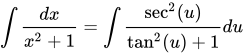
{\displaystyle \int {\frac {dx}{x^{2}+1}}}
The denominator of this function is equal to
(
1
+
x
2
)
2
{\displaystyle {\bigl (}{\sqrt {1+x^{2}}}{\bigr )}^{2}}
x
=
tan
(
u
)
{\displaystyle x=\tan(u)}
1
+
tan
2
(
u
)
=
sec
2
(
u
)
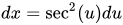
{\displaystyle 1+\tan ^{2}(u)=\sec ^{2}(u)}
d
x
=
sec
2
(
u
)
d
u
{\displaystyle dx=\sec ^{2}(u)du}
∫
d
x
x
2
+
1
=
∫
sec
2
(
u
)
tan
2
(
u
)
+
1
d
u
{\displaystyle \int {\frac {dx}{x^{2}+1}}=\int {\frac {\sec ^{2}(u)}{\tan ^{2}(u)+1}}du}
=
∫
sec
2
(
u
)
sec
2
(
u
)
d
u
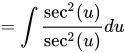
{\displaystyle =\int {\frac {\sec ^{2}(u)}{\sec ^{2}(u)}}du}
=
∫
d
u
{\displaystyle =\int du}
=
u
+
c
{\displaystyle =u+c}
Using the initial substitution
u
=
arctan
(
x
)
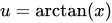
{\displaystyle u=\arctan(x)}
∫
d
x
x
2
+
1
=
arctan
(
x
)
+
C
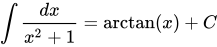
{\displaystyle \int {\frac {dx}{x^{2}+1}}=\arctan(x)+C}
This substitution is easily derived from a triangle, using the Pythagorean Theorem . If the integrand contains a factor of the form
x
2
−
a
2
{\displaystyle \displaystyle {\sqrt {x^{2}-a^{2}}}}
x
=
a
sec
(
θ
)
d
x
=
a
sec
(
θ
)
tan
(
θ
)
d
θ
x
2
−
a
2
=
a
tan
(
θ
)
{\displaystyle x=a\sec(\theta )\quad dx=a\sec(\theta )\tan(\theta )d\theta \quad {\sqrt {x^{2}-a^{2}}}=a\tan(\theta )}
Find
∫
0
z
x
2
−
1
x
d
x
{\displaystyle \int \limits _{0}^{z}{\frac {\sqrt {x^{2}-1}}{x}}dx}
∫
0
z
x
2
−
1
x
d
x
{\displaystyle \int \limits _{0}^{z}{\frac {\sqrt {x^{2}-1}}{x}}dx}
=
∫
0
α
tan
(
θ
)
sec
(
θ
)
sec
(
θ
)
tan
(
θ
)
d
θ
z
>
1
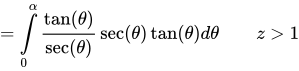
{\displaystyle =\int \limits _{0}^{\alpha }{\frac {\tan(\theta )}{\sec(\theta )}}\sec(\theta )\tan(\theta )d\theta \qquad z>1}
=
∫
0
α
tan
2
(
θ
)
d
θ
α
=
arcsec
(
z
)
{\displaystyle =\int \limits _{0}^{\alpha }\tan ^{2}(\theta )d\theta \qquad \qquad \qquad \qquad \alpha =\operatorname {arcsec}(z)}
=
[
tan
(
θ
)
−
θ
]
0
α
tan
(
α
)
=
sec
2
(
α
)
−
1
{\displaystyle ={\bigg [}\tan(\theta )-\theta {\bigg ]}_{0}^{\alpha }\qquad \qquad \qquad \tan(\alpha )={\sqrt {\sec ^{2}(\alpha )-1}}}
=
tan
(
α
)
−
α
tan
(
α
)
=
z
2
−
1
{\displaystyle =\tan(\alpha )-\alpha \qquad \qquad \qquad \qquad \tan(\alpha )={\sqrt {z^{2}-1}}}
=
z
2
−
1
−
arcsec
(
z
)
{\displaystyle ={\sqrt {z^{2}-1}}-\operatorname {arcsec}(z)}
Find
∫
1
z
x
2
−
1
x
2
d
x
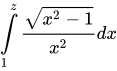
{\displaystyle \int \limits _{1}^{z}{\frac {\sqrt {x^{2}-1}}{x^{2}}}dx}
∫
1
z
x
2
−
1
x
2
d
x
{\displaystyle \int \limits _{1}^{z}{\frac {\sqrt {x^{2}-1}}{x^{2}}}dx}
=
∫
1
α
tan
(
θ
)
sec
2
(
θ
)
sec
(
θ
)
tan
(
θ
)
d
θ
z
>
1
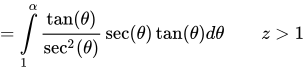
{\displaystyle =\int \limits _{1}^{\alpha }{\frac {\tan(\theta )}{\sec ^{2}(\theta )}}\sec(\theta )\tan(\theta )d\theta \qquad z>1}
=
∫
0
α
sin
2
(
θ
)
cos
(
θ
)
d
θ
α
=
arcsec
(
z
)
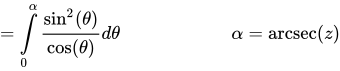
{\displaystyle =\int \limits _{0}^{\alpha }{\frac {\sin ^{2}(\theta )}{\cos(\theta )}}d\theta \qquad \qquad \qquad \alpha =\operatorname {arcsec}(z)}
We can now integrate by parts
∫
1
z
x
2
−
1
x
2
d
x
{\displaystyle \int \limits _{1}^{z}{\frac {\sqrt {x^{2}-1}}{x^{2}}}dx}
=
−
[
tan
(
θ
)
cos
(
θ
)
]
0
α
+
∫
0
α
sec
(
θ
)
d
θ
{\displaystyle =-{\bigg [}\tan(\theta )\cos(\theta ){\bigg ]}_{0}^{\alpha }+\int \limits _{0}^{\alpha }\sec(\theta )d\theta }
=
−
sin
(
α
)
+
[
ln
(
sec
(
θ
)
+
tan
(
θ
)
)
]
0
α
{\displaystyle =-\sin(\alpha )+{\bigg [}\ln {\bigl (}\sec(\theta )+\tan(\theta ){\bigr )}{\bigg ]}_{0}^{\alpha }}
=
ln
(
sec
(
α
)
+
tan
(
α
)
)
−
sin
(
α
)
{\displaystyle =\ln {\bigl (}\sec(\alpha )+\tan(\alpha ){\bigr )}-\sin(\alpha )}
=
ln
(
z
+
z
2
−
1
)
−
z
2
−
1
z
{\displaystyle =\ln {\bigl (}z+{\sqrt {z^{2}-1}}{\bigr )}-{\frac {\sqrt {z^{2}-1}}{z}}}
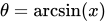
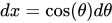
Evaluate the following using an appropriate trigonometric substitution.
Solution






























![{\displaystyle {\begin{aligned}\int \limits _{0}^{a}{\frac {1+x}{\sqrt {1-x^{2}}}}dx&=\int \limits _{0}^{\alpha }{\frac {1+\sin(\theta )}{\cos(\theta )}}\cos(\theta )d\theta &0<a<1\\&=\int \limits _{0}^{\alpha }{\bigl (}1+\sin(\theta ){\bigr )}d\theta &\alpha =\arcsin(a)\\&=\alpha +{\Big [}-\cos(\theta ){\Big ]}_{0}^{\alpha }\\&=\alpha +1-\cos(\alpha )\\&=1+\arcsin(a)-{\sqrt {1-a^{2}}}\end{aligned}}}](https://wikimedia.org/api/rest_v1/media/math/render/svg/d34bea926b8fc779d11222829c812acd2aa7561a)



![{\displaystyle {\begin{aligned}\int \limits _{0}^{z}(x^{2}+a^{2})^{-{\frac {3}{2}}}dx&=a^{-2}\int \limits _{0}^{\alpha }\cos(\theta )d\theta &z>0\\&=a^{-2}{\Big [}\sin(\theta ){\Big ]}_{0}^{\alpha }&\alpha =\arctan \left({\tfrac {z}{a}}\right)\\&=a^{-2}\sin(\alpha )\\&=a^{-2}{\frac {\frac {z}{a}}{\sqrt {1+{\frac {z^{2}}{a^{2}}}}}}\\&={\frac {z}{a^{2}{\sqrt {a^{2}+z^{2}}}}}\end{aligned}}}](https://wikimedia.org/api/rest_v1/media/math/render/svg/c4664e0be89a175f0c7b393341bd8ad28bbeb24c)
![{\displaystyle {\begin{matrix}I&=&a^{2}\int _{0}^{\alpha }\sec ^{3}\theta \,d\theta &&&\alpha =\tan ^{-1}(z/a)\\&=&a^{2}\int _{0}^{\alpha }\sec \theta \,d\tan \theta &&&\\&=&a^{2}[\sec \theta \tan \theta ]_{0}^{\alpha }&-&a^{2}\int _{0}^{\alpha }\sec \theta \tan ^{2}\theta \,d\theta &\\&=&a^{2}\sec \alpha \tan \alpha &-&a^{2}\int _{0}^{\alpha }\sec ^{3}\theta \,d\theta &+a^{2}\int _{0}^{\alpha }\sec \theta \,d\theta \\&=&a^{2}\sec \alpha \tan \alpha &-&I&+a^{2}\int _{0}^{\alpha }\sec \theta \,d\theta \\\end{matrix}}}](https://wikimedia.org/api/rest_v1/media/math/render/svg/313f2a452d4c096c9221cc6445317c894bb7eec0)

![{\displaystyle ={\tfrac {a^{2}}{2}}{\Bigg (}\sec(\alpha )\tan(\alpha )+{\bigg [}\ln {\Big (}\sec(\theta )+\tan(\theta ){\Big )}{\bigg ]}_{0}^{\alpha }{\Bigg )}}](https://wikimedia.org/api/rest_v1/media/math/render/svg/09ca73ab74b8a68988b561b211957b826c9bcc9f)












![{\displaystyle ={\bigg [}\tan(\theta )-\theta {\bigg ]}_{0}^{\alpha }\qquad \qquad \qquad \tan(\alpha )={\sqrt {\sec ^{2}(\alpha )-1}}}](https://wikimedia.org/api/rest_v1/media/math/render/svg/eaf30ca894dfeaff2a765bb3ddb822a60753c656)


![{\displaystyle =-{\bigg [}\tan(\theta )\cos(\theta ){\bigg ]}_{0}^{\alpha }+\int \limits _{0}^{\alpha }\sec(\theta )d\theta }](https://wikimedia.org/api/rest_v1/media/math/render/svg/abddc762382184a13946dc8522620aa0ad23dff4)
![{\displaystyle =-\sin(\alpha )+{\bigg [}\ln {\bigl (}\sec(\theta )+\tan(\theta ){\bigr )}{\bigg ]}_{0}^{\alpha }}](https://wikimedia.org/api/rest_v1/media/math/render/svg/2b45d861d862f65be50d6cf40c62770494cfa763)