Calculus/Integration techniques/Trigonometric Integrals

From Wikibooks, the open-content textbooks collection

Jump to: navigation, search
← Integration techniques/Tangent Half Angle Calculus Integration techniques/Reduction Formula →
Integration techniques/Trigonometric Integrals

When the integrand is primarily or exclusively based on trigonometric functions, the following techniques are useful.

Contents

[edit] Powers of Sine and Cosine

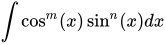
We will give a general method to solve generally integrands of the form cosm (x)sinn(x). First let us work through an example.

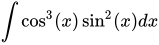
\int (\cos^3{x})(\sin^2{x})\,dx

Notice that the integrand contains an odd power of cos. So rewrite it as

\int (\cos^2{x})(\sin^2{x}) \cos{x}\,dx

We can solve this by making the substitution u = sin(x) so du = cos(x) dx. Then we can write the whole integrand in terms of u by using the identity

cos(x)2 = 1 - sin2(x)=1-u2.

So

\begin{matrix}
\int (\cos^3{x})(\sin^2{x})\,dx &=&\int (\cos^2{x})(\sin^2{x}) \cos{x}\,dx\\
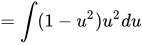
&=&\int (1-u^2)u^2\,du\\
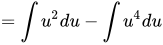
&=&\int u^2\,du - \int u^4\,du\\
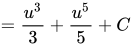
&=&{1\over 3} u^3+{1\over 5}u^5 + C\\
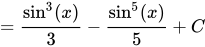
&=&{1\over 3} \sin^3{x}- {1\over 5} \sin^5{x} + C 
\end{matrix}.

This method works whenever there is an odd power of sine or cosine.

To evaluate \int (\cos^m{x})(\sin^n{x})\,dx when either m or n is odd.

  • If m is odd substitute u=sin x and use the identity cos2x = 1 - sin2x=1-u2.
  • If n is odd substitute u=cos x and use the identity sin2x = 1 - cos2x=1-u2.

[edit] Example

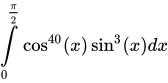
Find \int_0^{\pi/2} \cos^{40}(x)\sin^3(x) dx.

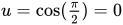
As there is an odd power of sin we let u = cosx so du = - sin(x)dx. Notice that when x=0 we have u=cos(0)=1 and when x = π / 2 we have u = cos(π / 2) = 0.

\begin{matrix}
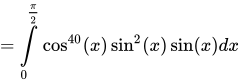
\int_0^{\pi/2} \cos^{40}(x)\sin^3(x) dx &=&  \int_0^{\pi/2} \cos^{40}(x)\sin^2(x) \sin(x) dx \\ 
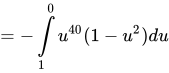
&=& -\int_{1}^{0} u^{40} (1-u^2) du \\
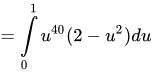
&=&\int_{0}^{1} u^{40} (1-u^2) du\\
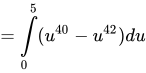
&=& \int_{0}^{1} u^{40} - u^{42} du \\
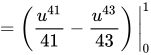
&=& [\frac{1}{41}u^{41} - \frac{1}{43}u^{43}]_0^1 \\
&=& \frac{1}{41}-\frac{1}{43}.
\end{matrix}


When both m and n are even things get a little more complicated.

To evaluate \int (\cos^m{x})(\sin^n{x})\,dx when both m and n are even.
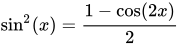
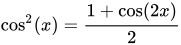
Use the identities sin2x = 1/2 (1- cos 2x) and cos2x = 1/2 (1+ cos 2x).

[edit] Example

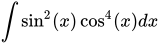
Find  \int \sin^2 x\cos^4 x\,dx.


As sin2x = 1/2 (1- cos 2x) and cos2x = 1/2 (1+ cos 2x) we have


\int \sin^2 x\cos^4 x\,dx = \int \left( {1 \over 2}(1 - \cos 2x) \right)
  \left( {1 \over 2}(1 + \cos 2x) \right)^2 \,dx,

and expanding, the integrand becomes

\frac{1}{8} \left(\int 1 - \cos^2 2x + \cos 2x- \cos^3 2x \,dx\right).

Using the multiple angle identities

\begin{matrix}
I & = & \frac{1}{8} \left( \int 1 \, dx  - \int \cos^2 2x \, dx 
 + \int \cos 2x \,dx  -\int \cos^3 2x \,dx \right) \\ 
& = & \frac{1}{8}  \left( x  - \frac{1}{2} \int (1 + \cos{4x})\,dx 
 + \frac{1}{2}\sin{2x}  -\int \cos^2 2x \cos 2x \,dx\right) \\
& = & \frac{1}{16}  \left( x + \sin{2x} + \int \cos{4x} \,dx   
-2 \int(1-\sin^2 2x)\cos 2x \,dx\right) \\
\end{matrix}

then we obtain on evaluating

I=\frac{x}{16}-\frac{\sin 4x}{64} + \frac{\sin^3 2x }{48}+C

[edit] Powers of Tan and Secant

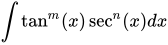
To evaluate \int (\tan^m{x})(\sec^n{x})\,dx.

  1. If n is even and n\ge 2 then substitute u=tan x and use the identity sec2x = 1 + tan2x.
  2. If n and m are both odd then substitute u=sec x and use the identity tan2x = sec2x-1.
  3. If n is odd and m is even then use the identity tan2x = sec2x-1 and apply a reduction formula to integrate \sec^j x dx\,.

[edit] Example 1

Find \int \sec^2 x dx.

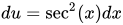
There is an even power of secx. Substituting u = tanx gives du = sec2xdx so

 \int \sec^2 x dx = \int du = u+C = \tan x + C.


[edit] Example 2

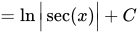
Find \int \tan x dx.

Let u = cosx so du = − sinxdx. Then

\begin{matrix}
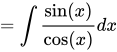
\int \tan x dx &=& \int \frac{\sin x}{\cos x} dx \\
&=& \int \frac{-1}{u} du \\
&=& -\ln |u| + C \\
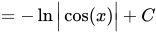
&=& -\ln |\cos x | + C\\
&=& \ln |\sec x| +C.
\end{matrix}


[edit] Example 3

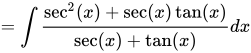
Find \int \sec x dx.

The trick to do this is to multiply and divide by the same thing like this:

\begin{matrix}
\int \sec x dx &=& \int \sec x \frac{\sec x + \tan x}{\sec x + \tan x} dx \\
&=& \int \frac{\sec^2 x + \sec x \tan x}{\sec x+ \tan x}
\end{matrix}.

Making the substitution u = secx + tanx so du = secxtanx + sec2xdx,

\begin{matrix}
\int \sec x dx &=& \int \frac{1}{u} du\\
&=& \ln |u| + C \\
&=& \ln |\sec x + \tan x| + C
\end{matrix}.

[edit] More trigonometric combinations

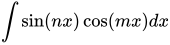
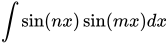
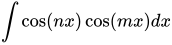
For the integrals \int \sin{nx}\cos{mx}\,dx or \int \sin{nx}\sin{mx}\,dx or \int \cos{nx}\cos{mx}\,dx use the identities

  •  \sin{a}\cos{b} = {1\over 2}(\sin{(a+b)}+\sin{(a-b)}) \,
  •  \sin{a}\sin{b} = {1\over 2}(\cos{(a-b)}-\cos{(a+b)}) \,
  •  \cos{a}\cos{b} = {1\over 2}(\cos{(a-b)}+\cos{(a+b)}) \,

[edit] Example 1

Find  \int \sin{3x}\cos{5x}\,dx.

We can use the fact that sin a cos b=(1/2)(sin(a+b)+sin(a-b)), so

\sin{3x}\cos{5x}=(\sin{8x}+\sin{(-2x)})/2 \,

Now use the oddness property of sin(x) to simplify

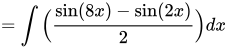
\sin{3x}\cos{5x}=(\sin{8x}-\sin{2x})/2 \,

And now we can integrate

\begin{matrix}
\int \sin{3x}\cos{5x}\,dx & = & \frac{1}{2} \int \sin{8x}-\sin{2x}dx \\
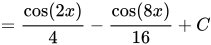
& = &  \frac{1}{2}(-\frac{1}{8}\cos{8x}+\frac{1}{2}\cos{2x}) +C \\
\end{matrix}

[edit] Example 2

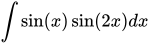
Find:\int \sin x \sin 2x \,dx.

Using the identities

\sin x \sin 2x= \frac{1}{2} \left( \cos (-x)-\cos (3x) \right)
= \frac{1}{2} (\cos x -\cos 3x).

Then

\begin{matrix} 
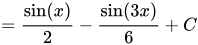
\int \sin{x}\sin{2x}\,dx & = & \frac{1}{2} \int (\cos{x}-\cos{3x})\,dx  \\
& = &  \frac{1}{2}(\sin{x}-\frac{1}{3}\sin{3x}) + C
\end{matrix}