It is often the case, when evaluating definite integrals, that an antiderivative for the integrand cannot be found, or is extremely difficult to find. In some instances, a numerical approximation to the value of the definite value will suffice. The following techniques can be used, and are listed in rough order of ascending complexity.
This comes from the definition of an integral. If we pick n to be finite, then we have:
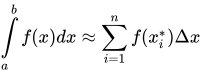
where  is any point in the i-th sub-interval
 ![{\displaystyle [x_{i-1},x_{i}]}](https://wikimedia.org/api/rest_v1/media/math/render/svg/09cb12a889d47020c8ce7046a2eb60785e00c0b6) on
on ![{\displaystyle [a,b]}](https://wikimedia.org/api/rest_v1/media/math/render/svg/9c4b788fc5c637e26ee98b45f89a5c08c85f7935) .
.
A special case of the Riemann sum, where we let  , in other words the point on the far right-side of each sub-interval on, . Again if we pick n to be finite, then we have:
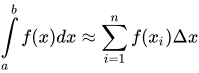
Another special case of the Riemann sum, this time we let  , which is the point on the far left side of each sub-interval on . As always, this is an approximation when
  is finite. Thus, we have:

![{\displaystyle \int \limits _{a}^{b}f(x)dx\approx {\frac {b-a}{2n}}\left[f(x_{0})+2\sum _{i=1}^{n-1}{\bigl (}f(x_{i}){\bigr )}+f(x_{n})\right]={\frac {b-a}{2n}}{\bigg (}{f(x_{0})+2f(x_{1})+2f(x_{2})+\cdots +2f(x_{n-1})+f(x_{n})}{\bigg )}}](https://wikimedia.org/api/rest_v1/media/math/render/svg/9f456afc1a77f39d5ce73e49bf7214e369357a2e)
Remember, n must be even,

|
![{\displaystyle \approx {\frac {b-a}{6n}}\left[f(x_{0})+\sum _{i=1}^{n-1}\left((3-(-1)^{i})f(x_{i})\right)+f(x_{n})\right]}](https://wikimedia.org/api/rest_v1/media/math/render/svg/3f5633de563d1a834994c89a7a28dfea9df98b30)
|
|
|
![{\displaystyle ={\frac {b-a}{6n}}{\bigg [}f(x_{0})+4f{\bigl (}{\tfrac {x_{1}}{2}}{\bigr )}+2f(x_{1})+4f{\bigl (}{\tfrac {x_{3}}{2}}{\bigr )}+\cdots +4f{\bigl (}{\tfrac {x_{n-1}}{2}}{\bigr )}+f(x_{n}){\bigg ]}}](https://wikimedia.org/api/rest_v1/media/math/render/svg/ed1d3402ef487bbd4d38b1236e31ee17be796480)
|
A common technique of approximating common trigonometric functions is to use the Taylor-Maclaurin series. Term-by-term integration allows one to easy compute the value of the integral by hand, well up to 5 decimal places of precision, and up to 10 given a factorial table.
For example, using the Maclaurin series of  , one can easily approximate its integral with a polynomial.
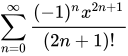
We can then easily integrate each term, taking  and
and  to be constants.

We can easily find the constant term by inspecting the known principle integral,  , and the new series. This nets us the final equation.
 While this is a rather fast-converging series, converging at
  digits of significance, it is relatively useless, since factorials are expensive to compute.



