Numerical Methods/Numerical Integration
Often, we need to find the integral of a function that may be difficult to integrate analytically (ie, as a definite integral) or impossible (the function only existing as a table of values).
Some methods of approximating said integral are listed below.
Trapezoidal Rule[edit | edit source]
Consider some function, possibly unknown, , with known values over the interval [a,b] at n+1 evenly spaced points xi of spacing , and .


Further, denote the function value at the ith mesh point as .

Using the notion of integration as "finding the area under the function curve", we can denote the integral over the ith segment of the interval, from to as:


= (1)
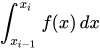
Since we may not know the antiderivative of , we must approximate it. Such approximation in the Trapezoidal Rule, unsurprisingly, involves approximating (1) with a trapezoid of width h, left height , right height . Thus,

(1) = (2)

(2) gives us an approximation to the area under one interval of the curve, and must be repeated to cover the entire interval.
For the case where n = 2,
= (3)

Collecting like terms on the right hand side of (3) gives us:

or

Now, substituting in for h and cleaning up,

To motivate the general version of the trapezoidal rule, now consider n = 4,

Following a similar process as for the case when n=2, we obtain

Proceeding to the general case where n = N,

 This is an example of what the trapezoidal rule would represent graphicly, here .
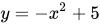
Example[edit | edit source]
Approximate to within 5%.

First, since the function can be exactly integrated, let us do so, to provide a check on our answer.
= (4)
![{\displaystyle \int _{0}^{1}x^{3}\,dx=\left[{x^{4} \over 4}\right]_{0}^{1}={1 \over 4}=0.25}](https://wikimedia.org/api/rest_v1/media/math/render/svg/9c36bc1dca84ca0cd5be176d3981ca8beaf089d4)
We will start with an interval size of 1, only considering the end points.


(4)

Relative error =
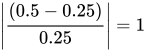
Hmm, a little high for our purposes. So, we halve the interval size to 0.5 and add to the list

(4)

Relative error =
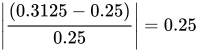
Still above 0.01, but vastly improved from the initial step. We continue in the same fashion, calculating and , rounding off to four decimal places.




(4)

Relative error =
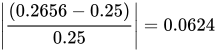
We are well on our way. Continuing, with interval size 0.125 and rounding as before,




(4)

Relative error =
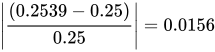
Since our relative error is less than 5%, we stop.
Error Analysis[edit | edit source]
Let y=f(x) be continuous, well-behaved and have continuous derivatives in [x0,xn]. We expand y in a Taylor series about x=x0,thus-
![{\displaystyle \int _{x_{0}}^{x_{1}}y\,dx=\int _{x_{0}}^{x_{1}}[y_{0}+(x-x_{0})y'_{0}+(x-x_{0})^{2}y''_{0}/2!+......]\,dx}](https://wikimedia.org/api/rest_v1/media/math/render/svg/20d08a06fdd9b06e473783670c17e4741663d2c9)
Simpson's Rule[edit | edit source]
Consider some function possibily unknown with known values over the interval [a,b] at n+1 evently spaced points then it defined as


where and and .
Example[edit | edit source]
Evaluate by taking ( must be even)
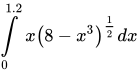


Solution: Here
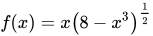
Since & so


Now when then


And since , therefore for , , , , , the corresponding values are , , , , ,



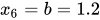






Incomplete ... Completed soon
Error Analysis[edit | edit source]
Simpson's 3/8[edit | edit source]
The numerical integration technique known as "Simpson's 3/8 rule" is credited to the mathematician Thomas Simpson (1710-1761) of Leicestershire, England. His also worked in the areas of numerical interpolation and probability theory.
Theorem (Simpson's 3/8 Rule) Consider over , where , , and . Simpson's 3/8 rule is
.
This is an numerical approximation to the integral of over and we have the expression
.
The remainder term for Simpson's 3/8 rule is , where lies somewhere between , and have the equality
.
Proof Simpson's 3/8 Rule Simpson's 3/8 Rule
Composite Simpson's 3/8 Rule
Our next method of finding the area under a curve is by approximating that curve with a series of cubic segments that lie above the intervals . When several cubics are used, we call it the composite Simpson's 3/8 rule.
Theorem (Composite Simpson's 3/8 Rule) Consider over . Suppose that the interval is subdivided into subintervals of equal width by using the equally spaced sample points for . The composite Simpson's 3/8 rule for subintervals is
.
This is an numerical approximation to the integral of over and we write
.
Proof Simpson's 3/8 Rule Simpson's 3/8 Rule
Remainder term for the Composite Simpson's 3/8 Rule
Corollary (Simpson's 3/8 Rule: Remainder term) Suppose that is subdivided into subintervals of width . The composite Simpson's 3/8 rule
.
is an numerical approximation to the integral, and
.
Furthermore, if , then there exists a value with so that the error term has the form
.
This is expressed using the "big " notation .
Remark. When the step size is reduced by a factor of the remainder term should be reduced by approximately .
Algorithm Composite Simpson's 3/8 Rule. To approximate the integral
,
by sampling at the equally spaced sample points for , where . Notice that and .
Animations (Simpson's 3/8 Rule Simpson's 3/8 Rule). Internet hyperlinks to animations.
Computer Programs Simpson's 3/8 Rule Simpson's 3/8 Rule
Mathematica Subroutine (Simpson's 3/8 Rule). Object oriented programming.
Example 1. Numerically approximate the integral by using Simpson's 3/8 rule with m = 1, 2, 4.
Solution 1.
Example 2. Numerically approximate the integral by using Simpson's 3/8 rule with m = 10, 20, 40, 80, and 160. Solution 2.
Example 3. Find the analytic value of the integral (i.e. find the "true value"). Solution 3.
Example 4. Use the "true value" in example 3 and find the error for the Simpson' 3/8 rule approximations in example 2. Solution 4.
Example 5. When the step size is reduced by a factor of the error term should be reduced by approximately . Explore this phenomenon. Solution 5.
Example 6. Numerically approximate the integral by using Simpson's 3/8 rule with m = 1, 2, 4. Solution 6.
Example 7. Numerically approximate the integral by using Simpson's 3/8 rule with m = 10, 20, 40, 80, and 160. Solution 7.
Example 8. Find the analytic value of the integral (i.e. find the "true value"). Solution 8.
Example 9. Use the "true value" in example 8 and find the error for the Simpson's 3/8 rule approximations in example 7. Solution 9.
Example 10. When the step size is reduced by a factor of the error term should be reduced by approximately . Explore this phenomenon. Solution 10.
Various Scenarios and Animations for Simpson's 3/8 Rule.
Example 11. Let over . Use Simpson's 3/8 rule to approximate the value of the integral. Solution 11.
Animations (Simpson's 3/8 Rule Simpson's 3/8 Rule). Internet hyperlinks to animations.
Research Experience for Undergraduates
Simpson's Rule for Numerical Integration Simpson's Rule for Numerical Integration Internet hyperlinks to web sites and a bibliography of articles.
Headline text[edit | edit source]
Example[edit | edit source]
Error Analysis[edit | edit source]
References and further reading[edit | edit source]
- Eric W. Weisstein. "Trapezoidal Rule." From MathWorld--A Wolfram Web Resource. http://mathworld.wolfram.com/TrapezoidalRule.html
- Davis, P. J., & Rabinowitz, P. (2007). Methods of numerical integration. Courier Corporation.