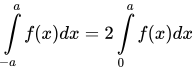
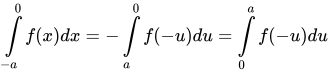
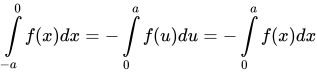
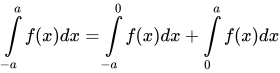
Suppose we are given a function and would like to determine the area underneath its graph over an interval. We could guess, but how could we figure out the exact area? Below, using a few clever ideas, we actually define such an area and show that by using what is called the definite integral we can indeed determine the exact area underneath a curve.
Figure 1: Approximation of the area under the curve from to .Figure 2: Rectangle approximating the area under the curve from to with sample point .
The rough idea of defining the area under the graph of is to approximate this area with a finite number of rectangles. Since we can easily work out the area of the rectangles, we get an estimate of the area under the graph. If we use a larger number of smaller-sized rectangles we expect greater accuracy with respect to the area under the curve and hence a better approximation. Somehow, it seems that we could use our old friend from differentiation, the limit, and "approach" an infinite number of rectangles to get the exact area. Let's look at such an idea more closely.
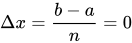
Suppose we have a function that is positive on the interval and we want to find the area under between and . Let's pick an integer and divide the interval into subintervals of equal width (see Figure 1). As the interval has width , each subinterval has width . We denote the endpoints of the subintervals by . This gives us
Figure 3: Riemann sums with an increasing number of subdivisions yielding better approximations.
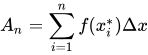
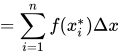
Now for each pick a sample point in the interval and consider the rectangle of height and width (see Figure 2). The area of this rectangle is . By adding up the area of all the rectangles for we get that the area is approximated by
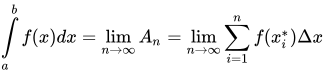
For each number we get a different approximation. As gets larger the width of the rectangles gets smaller which yields a better approximation (see Figure 3). In the limit of as tends to infinity we get the area .
Definition of the Definite Integral
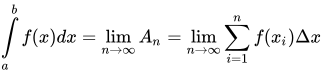
Suppose is a continuous function on and . Then the definite integral of between and is
where are any sample points in the interval and for .
It is a fact that if is continuous on then this limit always exists and does not depend on the choice of the points . For instance they may be evenly spaced, or distributed ambiguously throughout the interval. The proof of this is technical and is beyond the scope of this section.
Notation
When considering the expression, (read "the integral from to of the of "), the function is called the integrand and the interval is the interval of integration. Also is called the lower limit and the upper limit of integration.
Figure 4: The integral gives the signed area under the graph.
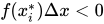
One important feature of this definition is that we also allow functions which take negative values. If for all then so . So the definite integral of will be strictly negative. More generally if takes on both positive and negative values then will be the area under the positive part of the graph of minus the area above the graph of the negative part of the graph (see Figure 4). For this reason we say that is the signed area under the graph.
It is important to notice that the variable did not play an important role in the definition of the integral. In fact we can replace it with any other letter, so the following are all equal:
Each of these is the signed area under the graph of between and . Such a variable is often referred to as a dummy variable or a bound variable.
Figure 5: Right-handed Riemann sumFigure 6: Left-handed Riemann sum
The following methods are sometimes referred to as L-RAM and R-RAM, RAM standing for "Rectangular Approximation Method."
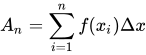
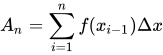
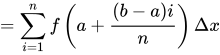
We could have decided to choose all our sample points to be on the right hand side of the interval (see Figure 5). Then for all and the approximation that we called for the area becomes
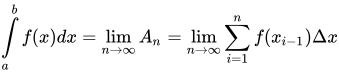
This is called the right-handed Riemann sum, and the integral is the limit
Alternatively we could have taken each sample point on the left hand side of the interval. In this case (see Figure 6) and the approximation becomes
Then the integral of is
The key point is that, as long as is continuous, these two definitions give the same answer for the integral.
Example 1
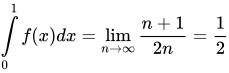
In this example we will calculate the area under the curve given by the graph of for between 0 and 1. First we fix an integer and divide the interval into subintervals of equal width. So each subinterval has width
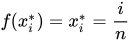
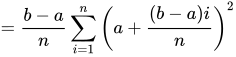
To calculate the integral we will use the right-handed Riemann sum. (We could have used the left-handed sum instead, and this would give the same answer in the end). For the right-handed sum the sample points are
Notice that . Putting this into the formula for the approximation,
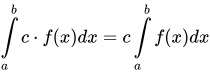
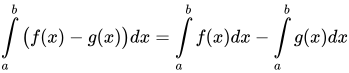
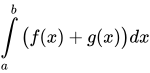
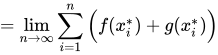
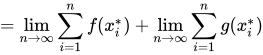
When is positive, the height of the function at a point is times the height of the function . So the area under between and is times the area under . We can also give a proof using the definition of the integral, using the constant rule for limits,
Example
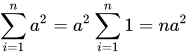
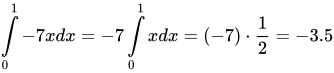
We saw in the previous section that
Using the constant rule we can use this to calculate that
,
.
Example
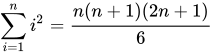
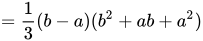
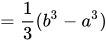
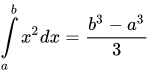
We saw in the previous section that
We can use this and the constant rule to calculate that
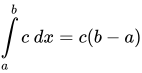
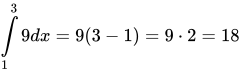
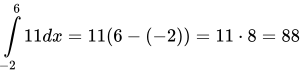
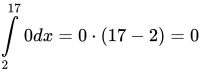
There is a special case of this rule used for integrating constants:
Integrating Constants
If is constant then
When and this integral is the area of a rectangle of height and width which equals .
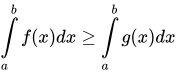
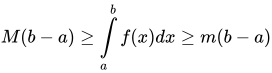
If then each of the rectangles in the Riemann sum to calculate the integral of will be above the axis, so the area will be non-negative. If then and by the first property we get the second property. Finally if then the area under the graph of will be greater than the area of rectangle with height and less than the area of the rectangle with height (see Figure 7). So
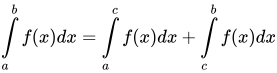
Additivity with respect to endpoints
Suppose . Then
Again suppose that is positive. Then this property should be interpreted as saying that the area under the graph of between and is the area between and plus the area between and (see Figure 8).
Figure 8: Illustration of the property of additivity with respect to endpoints
Extension of Additivity with respect to limits of integration
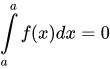
When we have that so
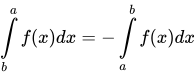
Also in defining the integral we assumed that . But the definition makes sense even when , in which case has changed sign. This gives


![{\displaystyle [a,b]}](https://wikimedia.org/api/rest_v1/media/math/render/svg/9c4b788fc5c637e26ee98b45f89a5c08c85f7935)






![{\displaystyle [x_{i-1},x_{i}]}](https://wikimedia.org/api/rest_v1/media/math/render/svg/09cb12a889d47020c8ce7046a2eb60785e00c0b6)






![{\displaystyle x_{i}^{*}\in [x_{i-1},x_{i}]}](https://wikimedia.org/api/rest_v1/media/math/render/svg/dafeab86f1179399f11208ee27a15c76434aed3d)







![{\displaystyle [0,1]}](https://wikimedia.org/api/rest_v1/media/math/render/svg/738f7d23bb2d9642bab520020873cccbef49768d)






















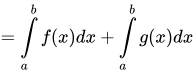

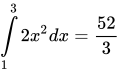





![{\displaystyle x\in [a,b]}](https://wikimedia.org/api/rest_v1/media/math/render/svg/026357b404ee584c475579fb2302a4e9881b8cce)