The fundamental theorem of calculus is a critical portion of calculus because it links the concept of a derivative to that of an integral. As a result, we can use our knowledge of derivatives to find the area under the curve, which is often quicker and simpler than using the definition of the integral .
As an illustrative example see § 1.8 for the connection of natural logarithm and 1/x .
Mean Value Theorem for Integration [ edit | edit source ] We will need the following theorem in the discussion of the Fundamental Theorem of Calculus.
Proof of the Mean Value Theorem for Integration [ edit | edit source ]
f
(
x
)
{\displaystyle f(x)}
Extreme Value Theorem , so it has a minimum
m
{\displaystyle m}
M
{\displaystyle M}
[
a
,
b
]
{\displaystyle [a,b]}
∫
a
b
f
(
x
)
d
x
=
lim
n
→
∞
∑
k
=
1
n
f
(
x
k
∗
)
⋅
b
−
a
n
=
lim
n
→
∞
b
−
a
n
⋅
∑
k
=
1
n
f
(
x
k
∗
)
{\displaystyle \int \limits _{a}^{b}f(x)dx=\lim _{n\to \infty }\sum _{k=1}^{n}f(x_{k}^{*})\cdot {\frac {b-a}{n}}=\lim _{n\to \infty }{\frac {b-a}{n}}\cdot \sum _{k=1}^{n}f(x_{k}^{*})}
and since
m
≤
f
(
x
k
∗
)
≤
M
{\displaystyle m\leq f(x_{k}^{*})\leq M}
x
k
∗
∈
[
a
,
b
]
{\displaystyle x_{k}^{*}\in [a,b]}
we have
lim
n
→
∞
b
−
a
n
⋅
∑
k
=
1
n
m
≤
lim
n
→
∞
b
−
a
n
⋅
∑
k
=
1
n
f
(
x
k
∗
)
≤
lim
n
→
∞
b
−
a
n
⋅
∑
k
=
1
n
M
lim
n
→
∞
m
n
⋅
b
−
a
n
≤
∫
a
b
f
(
x
)
d
x
≤
lim
n
→
∞
M
n
⋅
b
−
a
n
lim
n
→
∞
m
(
b
−
a
)
≤
∫
a
b
f
(
x
)
d
x
≤
lim
n
→
∞
M
(
b
−
a
)
m
(
b
−
a
)
≤
∫
a
b
f
(
x
)
d
x
≤
M
(
b
−
a
)
m
≤
1
b
−
a
∫
a
b
f
(
x
)
d
x
≤
M
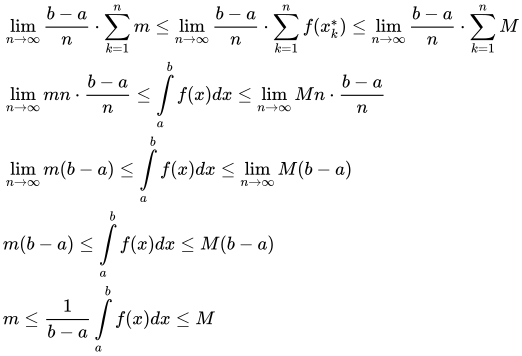
{\displaystyle {\begin{aligned}&\lim _{n\to \infty }{\frac {b-a}{n}}\cdot \sum _{k=1}^{n}m\leq \lim _{n\to \infty }{\frac {b-a}{n}}\cdot \sum _{k=1}^{n}f(x_{k}^{*})\leq \lim _{n\to \infty }{\frac {b-a}{n}}\cdot \sum _{k=1}^{n}M\\&\lim _{n\to \infty }mn\cdot {\frac {b-a}{n}}\leq \int \limits _{a}^{b}f(x)dx\leq \lim _{n\to \infty }Mn\cdot {\frac {b-a}{n}}\\&\lim _{n\to \infty }m(b-a)\leq \int \limits _{a}^{b}f(x)dx\leq \lim _{n\to \infty }M(b-a)\\&m(b-a)\leq \int \limits _{a}^{b}f(x)dx\leq M(b-a)\\&m\leq {\frac {1}{b-a}}\int \limits _{a}^{b}f(x)dx\leq M\end{aligned}}}
Since
f
{\displaystyle f}
Intermediate Value Theorem there is some
f
(
c
)
{\displaystyle f(c)}
c
∈
[
a
,
b
]
{\displaystyle c\in [a,b]}
1
b
−
a
∫
a
b
f
(
x
)
d
x
=
f
(
c
)
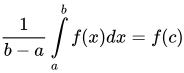
{\displaystyle {\frac {1}{b-a}}\int \limits _{a}^{b}f(x)dx=f(c)}
Fundamental Theorem of Calculus [ edit | edit source ] Statement of the Fundamental Theorem [ edit | edit source ] Suppose that
f
{\displaystyle f}
[
a
,
b
]
{\displaystyle [a,b]}
F
{\displaystyle F}
F
(
x
)
=
∫
a
x
f
(
t
)
d
t
for
x
∈
[
a
,
b
]
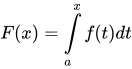
{\displaystyle F(x)=\int \limits _{a}^{x}f(t)dt\quad {\text{for }}x\in [a,b]}
When we have such functions
F
{\displaystyle F}
f
{\displaystyle f}
F
′
(
x
)
=
f
(
x
)
{\displaystyle F'(x)=f(x)}
x
{\displaystyle x}
I
{\displaystyle I}
F
{\displaystyle F}
antiderivative of
f
{\displaystyle f}
I
{\displaystyle I}
Figure 1 Note: a minority of mathematicians refer to part one as two and part two as one. All mathematicians refer to what is stated here as part 2 as The Fundamental Theorem of Calculus.
Proof of Fundamental Theorem of Calculus Part I [ edit | edit source ] Suppose
x
∈
(
a
,
b
)
{\displaystyle x\in (a,b)}
Δ
x
{\displaystyle \Delta x}
x
+
Δ
x
∈
(
a
,
b
)
{\displaystyle x+\Delta x\in (a,b)}
F
(
x
)
=
∫
a
x
f
(
t
)
d
t
{\displaystyle F(x)=\int \limits _{a}^{x}f(t)dt}
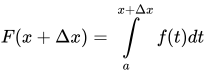
and
F
(
x
+
Δ
x
)
=
∫
a
x
+
Δ
x
f
(
t
)
d
t
{\displaystyle F(x+\Delta x)=\int \limits _{a}^{x+\Delta x}f(t)dt}
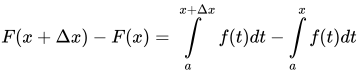
Subtracting the two equations gives
F
(
x
+
Δ
x
)
−
F
(
x
)
=
∫
a
x
+
Δ
x
f
(
t
)
d
t
−
∫
a
x
f
(
t
)
d
t
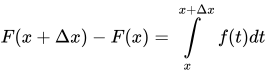
{\displaystyle F(x+\Delta x)-F(x)=\int \limits _{a}^{x+\Delta x}f(t)dt-\int \limits _{a}^{x}f(t)dt}
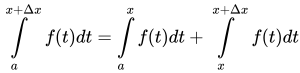
Now
∫
a
x
+
Δ
x
f
(
t
)
d
t
=
∫
a
x
f
(
t
)
d
t
+
∫
x
x
+
Δ
x
f
(
t
)
d
t
{\displaystyle \int \limits _{a}^{x+\Delta x}f(t)dt=\int \limits _{a}^{x}f(t)dt+\int \limits _{x}^{x+\Delta x}f(t)dt}
so rearranging this we have
F
(
x
+
Δ
x
)
−
F
(
x
)
=
∫
x
x
+
Δ
x
f
(
t
)
d
t
{\displaystyle F(x+\Delta x)-F(x)=\int \limits _{x}^{x+\Delta x}f(t)dt}
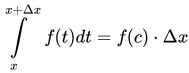
According to the Mean Value Theorem for Integration, there exists a
c
∈
[
x
,
x
+
Δ
x
]
{\displaystyle c\in [x,x+\Delta x]}
∫
x
x
+
Δ
x
f
(
t
)
d
t
=
f
(
c
)
⋅
Δ
x
{\displaystyle \int \limits _{x}^{x+\Delta x}f(t)dt=f(c)\cdot \Delta x}
Notice that
c
{\displaystyle c}
Δ
x
{\displaystyle \Delta x}
F
(
x
+
Δ
x
)
−
F
(
x
)
=
f
(
c
)
⋅
Δ
x
{\displaystyle F(x+\Delta x)-F(x)=f(c)\cdot \Delta x}
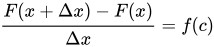
and dividing both sides by
Δ
x
{\displaystyle \Delta x}
F
(
x
+
Δ
x
)
−
F
(
x
)
Δ
x
=
f
(
c
)
{\displaystyle {\frac {F(x+\Delta x)-F(x)}{\Delta x}}=f(c)}
Take the limit as
Δ
x
→
0
{\displaystyle \Delta x\to 0}
F
{\displaystyle F}
x
{\displaystyle x}
F
′
(
x
)
=
lim
Δ
x
→
0
F
(
x
+
Δ
x
)
−
F
(
x
)
Δ
x
=
lim
Δ
x
→
0
f
(
c
)
{\displaystyle F'(x)=\lim _{\Delta x\to 0}{\frac {F(x+\Delta x)-F(x)}{\Delta x}}=\lim _{\Delta x\to 0}f(c)}
To find the other limit, we will use the squeeze theorem .
c
∈
[
x
,
x
+
Δ
x
]
{\displaystyle c\in [x,x+\Delta x]}
x
≤
c
≤
x
+
Δ
x
{\displaystyle x\leq c\leq x+\Delta x}
lim
Δ
x
→
0
[
x
+
Δ
x
]
=
x
⇒
lim
Δ
x
→
0
c
=
x
{\displaystyle \lim _{\Delta x\to 0}{\Big [}x+\Delta x{\Big ]}=x\quad \Rightarrow \quad \lim _{\Delta x\to 0}c=x}
As
f
{\displaystyle f}
F
′
(
x
)
=
lim
Δ
x
→
0
f
(
c
)
=
f
(
lim
Δ
x
→
0
c
)
=
f
(
x
)
{\displaystyle F'(x)=\lim _{\Delta x\to 0}f(c)=f\left(\lim _{\Delta x\to 0}c\right)=f(x)}
which completes the proof.
◼
{\displaystyle \blacksquare }
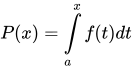
Proof of Fundamental Theorem of Calculus Part II [ edit | edit source ] Define
P
(
x
)
=
∫
a
x
f
(
t
)
d
t
{\displaystyle P(x)=\int \limits _{a}^{x}f(t)dt}
P
{\displaystyle P}
(
a
,
b
)
{\displaystyle (a,b)}
x
∈
(
a
,
b
)
{\displaystyle x\in (a,b)}
P
′
(
x
)
=
f
(
x
)
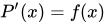
{\displaystyle P'(x)=f(x)}
So
P
{\displaystyle P}
f
{\displaystyle f}
F
{\displaystyle F}
x
∈
(
a
,
b
)
{\displaystyle x\in (a,b)}
P
′
(
x
)
=
F
′
(
x
)
P
′
(
x
)
−
F
′
(
x
)
=
0
(
P
(
x
)
−
F
(
x
)
)
′
=
0
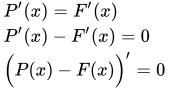
{\displaystyle {\begin{aligned}&P'(x)=F'(x)\\&P'(x)-F'(x)=0\\&{\Big (}P(x)-F(x){\Big )}'=0\end{aligned}}}
Let
g
(
x
)
=
P
(
x
)
−
F
(
x
)
{\displaystyle g(x)=P(x)-F(x)}
Mean Value Theorem applied to
g
(
x
)
{\displaystyle g(x)}
[
a
,
ξ
]
{\displaystyle [a,\xi ]}
a
<
ξ
<
b
{\displaystyle a<\xi <b}
g
(
ξ
)
−
g
(
a
)
ξ
−
a
=
g
′
(
c
)
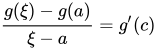
{\displaystyle {\frac {g(\xi )-g(a)}{\xi -a}}=g'(c)}
for some
c
{\displaystyle c}
(
a
,
ξ
)
{\displaystyle (a,\xi )}
g
′
(
x
)
=
0
{\displaystyle g'(x)=0}
x
{\displaystyle x}
[
a
,
b
]
{\displaystyle [a,b]}
g
(
ξ
)
{\displaystyle g(\xi )}
g
(
a
)
{\displaystyle g(a)}
ξ
{\displaystyle \xi }
(
a
,
b
)
{\displaystyle (a,b)}
(
a
,
b
)
{\displaystyle (a,b)}
This implies there is a constant
C
=
g
(
a
)
=
P
(
a
)
−
F
(
a
)
=
−
F
(
a
)
{\displaystyle C=g(a)=P(a)-F(a)=-F(a)}
x
∈
(
a
,
b
)
{\displaystyle x\in (a,b)}
P
(
x
)
=
F
(
x
)
+
C
{\displaystyle P(x)=F(x)+C}
and as
g
{\displaystyle g}
x
=
a
{\displaystyle x=a}
x
=
b
{\displaystyle x=b}
x
=
b
{\displaystyle x=b}
∫
a
b
f
(
t
)
d
x
=
P
(
b
)
=
F
(
b
)
+
C
=
F
(
b
)
−
F
(
a
)
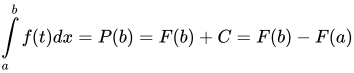
{\displaystyle \int \limits _{a}^{b}f(t)dx=P(b)=F(b)+C=F(b)-F(a)}
◼
{\displaystyle \blacksquare }
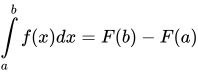
Notation for Evaluating Definite Integrals [ edit | edit source ] The second part of the Fundamental Theorem of Calculus gives us a way to calculate definite integrals. Just find an antiderivative of the integrand, and subtract the value of the antiderivative at the lower bound from the value of the antiderivative at the upper bound. That is
∫
a
b
f
(
x
)
d
x
=
F
(
b
)
−
F
(
a
)
{\displaystyle \int \limits _{a}^{b}f(x)dx=F(b)-F(a)}
where
F
′
(
x
)
=
f
(
x
)
{\displaystyle F'(x)=f(x)}
F
(
x
)
|
a
b
{\displaystyle F(x){\bigg |}_{a}^{b}}
to represent
F
(
b
)
−
F
(
a
)
{\displaystyle F(b)-F(a)}
Integration of Polynomials [ edit | edit source ] Using the power rule for differentiation we can find a formula for the integral of a power using the Fundamental Theorem of Calculus. Let
f
(
x
)
=
x
n
{\displaystyle f(x)=x^{n}}
f
{\displaystyle f}
d
d
x
x
n
+
1
=
(
n
+
1
)
x
n
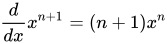
{\displaystyle {\frac {d}{dx}}x^{n+1}=(n+1)x^{n}}
As long as
n
+
1
≠
0
{\displaystyle n+1\neq 0}
n
+
1
{\displaystyle n+1}
d
d
x
(
x
n
+
1
n
+
1
)
=
x
n
=
f
(
x
)
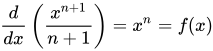
{\displaystyle {\frac {d}{dx}}\left({\frac {x^{n+1}}{n+1}}\right)=x^{n}=f(x)}
So the function
F
(
x
)
=
x
n
+
1
n
+
1
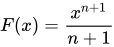
{\displaystyle F(x)={\frac {x^{n+1}}{n+1}}}
f
{\displaystyle f}
0
∉
[
a
,
b
]
{\displaystyle 0\notin [a,b]}
F
{\displaystyle F}
[
a
,
b
]
{\displaystyle [a,b]}
f
{\displaystyle f}
Notice that we allow all values of
n
{\displaystyle n}
n
>
0
{\displaystyle n>0}
[
a
,
b
]
{\displaystyle [a,b]}
0
{\displaystyle 0}
Power Rule of Integration II
∫
a
b
x
n
d
x
=
x
n
+
1
n
+
1
|
a
b
=
b
n
+
1
−
a
n
+
1
n
+
1
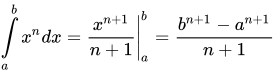
{\displaystyle \int \limits _{a}^{b}x^{n}dx={\frac {x^{n+1}}{n+1}}{\Bigg |}_{a}^{b}={\frac {b^{n+1}-a^{n+1}}{n+1}}}
n
>
0
{\displaystyle n>0}
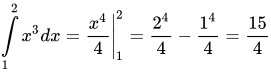
Examples To find
∫
1
2
x
3
d
x
{\displaystyle \int \limits _{1}^{2}x^{3}dx}
∫
1
2
x
3
d
x
=
x
4
4
|
1
2
=
2
4
4
−
1
4
4
=
15
4
{\displaystyle \int \limits _{1}^{2}x^{3}dx={\frac {x^{4}}{4}}{\Bigg |}_{1}^{2}={\frac {2^{4}}{4}}-{\frac {1^{4}}{4}}={\frac {15}{4}}}
The power rule also works for negative powers. For instance
∫
1
3
d
x
x
3
=
∫
1
3
x
−
3
d
x
=
x
−
2
−
2
|
1
3
=
1
−
2
(
3
−
2
−
1
−
2
)
=
−
1
2
(
1
3
2
−
1
)
=
−
1
2
(
1
9
−
1
)
=
1
2
⋅
8
9
=
4
9
{\displaystyle \int \limits _{1}^{3}{\frac {dx}{x^{3}}}=\int \limits _{1}^{3}x^{-3}dx={\frac {x^{-2}}{-2}}{\Bigg |}_{1}^{3}={\frac {1}{-2}}\left(3^{-2}-1^{-2}\right)=-{\frac {1}{2}}\left({\frac {1}{3^{2}}}-1\right)=-{\frac {1}{2}}\left({\frac {1}{9}}-1\right)={\frac {1}{2}}\cdot {\frac {8}{9}}={\frac {4}{9}}}
We can also use the power rule for fractional powers. For instance
∫
0
5
x
d
x
=
∫
0
5
x
1
2
d
x
=
x
x
3
2
|
0
5
=
2
3
(
5
3
2
−
0
3
2
)
=
10
5
3
{\displaystyle \int \limits _{0}^{5}{\sqrt {x}}dx=\int \limits _{0}^{5}x^{\frac {1}{2}}dx={\frac {x{\sqrt {x}}}{\frac {3}{2}}}{\Bigg |}_{0}^{5}={\frac {2}{3}}\left(5^{\frac {3}{2}}-0^{\frac {3}{2}}\right)={\frac {10{\sqrt {5}}}{3}}}
Using linearity the power rule can also be thought of as applying to constants. For example,
=
∫
3
11
7
d
x
=
∫
3
11
7
x
0
d
x
=
7
∫
3
11
x
0
d
x
=
7
x
|
3
11
=
7
(
11
−
3
)
=
56
{\displaystyle =\int \limits _{3}^{11}7dx=\int \limits _{3}^{11}7x^{0}dx=7\int \limits _{3}^{11}x^{0}dx=7x{\Bigg |}_{3}^{11}=7(11-3)=56}
Using the linearity rule we can now integrate any polynomial. For example
∫
0
3
(
3
x
2
+
4
x
+
2
)
d
x
=
(
x
3
+
2
x
2
+
2
x
)
|
0
3
=
3
3
+
2
⋅
3
2
+
2
⋅
3
−
0
=
27
+
18
+
6
=
51
{\displaystyle \int \limits _{0}^{3}(3x^{2}+4x+2)dx=(x^{3}+2x^{2}+2x){\Bigg |}_{0}^{3}=3^{3}+2\cdot 3^{2}+2\cdot 3-0=27+18+6=51}
1. Evaluate
∫
0
1
x
6
d
x
{\displaystyle \int \limits _{0}^{1}x^{6}dx}
. Compare your answer to the answer you got for exercise 1 in section
4.1 .
1
7
=
0.
142857
¯
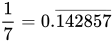
{\displaystyle {\frac {1}{7}}=0.{\overline {142857}}}
1
7
=
0.
142857
¯
{\displaystyle {\frac {1}{7}}=0.{\overline {142857}}}
2. Evaluate
∫
1
2
x
6
d
x
{\displaystyle \int \limits _{1}^{2}x^{6}dx}
. Compare your answer to the answer you got for exercise 2 in section
4.1 .
127
7
=
18.
142857
¯
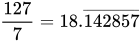
{\displaystyle {\frac {127}{7}}=18.{\overline {142857}}}
127
7
=
18.
142857
¯
{\displaystyle {\frac {127}{7}}=18.{\overline {142857}}}
3. Evaluate
∫
0
2
x
6
d
x
{\displaystyle \int \limits _{0}^{2}x^{6}dx}
. Compare your answer to the answer you got for exercise 4 in section
4.1 .
128
7
=
18.
285714
¯
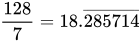
{\displaystyle {\frac {128}{7}}=18.{\overline {285714}}}
128
7
=
18.
285714
¯
{\displaystyle {\frac {128}{7}}=18.{\overline {285714}}}
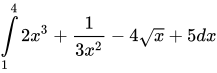
5. Evaluate
∫
1
4
2
x
3
+
1
3
x
2
−
4
x
+
5
d
x
{\displaystyle \int \limits _{1}^{4}2x^{3}+{\frac {1}{3x^{2}}}-4{\sqrt {x}}+5dx}
.
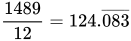
1489
12
=
124.
083
¯
{\displaystyle {\frac {1489}{12}}=124.{\overline {083}}}
1489
12
=
124.
083
¯
{\displaystyle {\frac {1489}{12}}=124.{\overline {083}}}
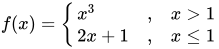
6. Given
f
(
x
)
=
{
x
3
,
x
>
1
2
x
+
1
,
x
≤
1
{\displaystyle f(x)={\begin{cases}x^{3}&,&x>1\\2x+1&,&x\leq 1\end{cases}}}
, then find
∫
0
6
f
(
x
)
d
x
{\displaystyle \int \limits _{0}^{6}f(x)dx}
.
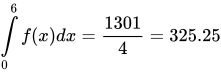
∫
0
6
f
(
x
)
d
x
=
1301
4
=
325.25
{\displaystyle \int \limits _{0}^{6}f(x)dx={\frac {1301}{4}}=325.25}
∫
0
6
f
(
x
)
d
x
=
1301
4
=
325.25
{\displaystyle \int \limits _{0}^{6}f(x)dx={\frac {1301}{4}}=325.25}
7. Let
f
(
x
)
=
∫
1
x
t
2
d
t
{\displaystyle f(x)=\int \limits _{1}^{x}t^{2}dt}
. Then find the
f
′
(
x
)
{\displaystyle f'(x)}
.
f
′
(
x
)
=
x
2
{\displaystyle f'(x)=x^{2}}
f
′
(
x
)
=
x
2
{\displaystyle f'(x)=x^{2}}
8. Given
A
(
θ
)
=
∫
1
θ
2
2
x
cos
(
4
x
2
)
d
x
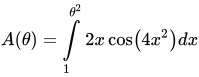
{\displaystyle A(\theta )=\int \limits _{1}^{\theta ^{2}}2x\cos \left(4x^{2}\right)dx}
. Then find
A
′
(
θ
)
{\displaystyle A'(\theta )}
.
A
′
(
θ
)
=
4
θ
3
cos
(
4
θ
4
)
{\displaystyle A'(\theta )=4\theta ^{3}\cos(4\theta ^{4})}
A
′
(
θ
)
=
4
θ
3
cos
(
4
θ
4
)
{\displaystyle A'(\theta )=4\theta ^{3}\cos(4\theta ^{4})}
9. If
M
(
x
)
=
∫
x
3
x
cos
4
(
t
)
−
sin
2
(
t
)
d
t
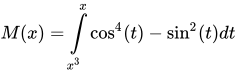
{\displaystyle M(x)=\int \limits _{x^{3}}^{x}\cos ^{4}(t)-\sin ^{2}(t)dt}
. Then find
M
′
(
x
)
{\displaystyle M'(x)}
.
M
′
(
x
)
=
−
3
x
2
cos
4
(
x
3
)
+
3
x
2
sin
2
(
x
3
)
+
cos
4
(
x
)
−
sin
2
(
x
)
{\displaystyle M'(x)=-3x^{2}\cos ^{4}(x^{3})+3x^{2}\sin ^{2}(x^{3})+\cos ^{4}(x)-\sin ^{2}(x)}
M
′
(
x
)
=
−
3
x
2
cos
4
(
x
3
)
+
3
x
2
sin
2
(
x
3
)
+
cos
4
(
x
)
−
sin
2
(
x
)
{\displaystyle M'(x)=-3x^{2}\cos ^{4}(x^{3})+3x^{2}\sin ^{2}(x^{3})+\cos ^{4}(x)-\sin ^{2}(x)}
10. For the function
f
(
x
)
=
x
{\displaystyle f(x)={\sqrt {x}}}
over the given closed interval,
[
4
,
9
]
{\displaystyle [4,9]}
, find the value(s) of
c
{\displaystyle c}
guaranteed by the mean value theorem for the definite integral.
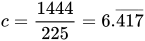
c
=
1444
225
=
6.
417
¯
{\displaystyle c={\frac {1444}{225}}=6.{\overline {417}}}
c
=
1444
225
=
6.
417
¯
{\displaystyle c={\frac {1444}{225}}=6.{\overline {417}}}
Solutions

![{\displaystyle [a,b]}](https://wikimedia.org/api/rest_v1/media/math/render/svg/9c4b788fc5c637e26ee98b45f89a5c08c85f7935)
![{\displaystyle c\in [a,b]}](https://wikimedia.org/api/rest_v1/media/math/render/svg/997256364b06acf0710e5d24da39e8c42991a249)



![{\displaystyle x_{k}^{*}\in [a,b]}](https://wikimedia.org/api/rest_v1/media/math/render/svg/3cbdda7ad947763ab5261e65436d0736bbe844b4)


![{\displaystyle F(x)=\int \limits _{a}^{x}f(t)dt\quad {\text{for }}x\in [a,b]}](https://wikimedia.org/api/rest_v1/media/math/render/svg/622d0ca08070b2d673bd8a757a67201a1619be8b)





![{\displaystyle c\in [x,x+\Delta x]}](https://wikimedia.org/api/rest_v1/media/math/render/svg/42b5053bab166c7c0f83e9c1d4096326f4a00df6)





![{\displaystyle \lim _{\Delta x\to 0}{\Big [}x+\Delta x{\Big ]}=x\quad \Rightarrow \quad \lim _{\Delta x\to 0}c=x}](https://wikimedia.org/api/rest_v1/media/math/render/svg/e3279e06d44cea4a17a91134775dec3e65e48a73)





![{\displaystyle [a,\xi ]}](https://wikimedia.org/api/rest_v1/media/math/render/svg/592a7dd205bdbcd1d8f67eca50eb6df3cadf5a22)










![{\displaystyle 0\notin [a,b]}](https://wikimedia.org/api/rest_v1/media/math/render/svg/a7e008e55b4d8c9220051749fbf4e809ee3e7d68)



















![{\displaystyle [4,9]}](https://wikimedia.org/api/rest_v1/media/math/render/svg/7e52f81a7e0c9e3e24749e9b3a26c7236a25e302)