A-level Physics/Forces, Fields and Energy/Electric fields
Like gravitational fields, electric fields are a field of force that act from a distance, where the force here is exerted by a charged object on another charged object.Uniform electrical fields goes from positive to negative and the radial electrical fields are the electrical fields that are exerted on a point charge. You may already be familiar with the fact that opposite charges attract, and that like charges repel. Here, we will look at ways to calculate field strengths and the magnitude of forces exerted, in a very similar manner to gravitational fields.
Representing electric fields[edit | edit source]
Electric field lines are drawn always pointing from positive to negative, like the flow of current. Just like magnetic and gravitational fields, the separation of the lines tell us the relative strength.
Radial fields[edit | edit source]
Radial fields are drawn from a centre point. The field is stronger nearer the surface of the object, and weakens as you move further away. For a positive charge, the arrows point outwards, and for a negative charge, the arrows point inwards.
 |
 |
Uniform fields[edit | edit source]

Uniform electric fields can be of two types depending on the behavior of the source of the electric field.
Static uniform electric field
In a static uniform electric field, the intensity or the strength of the electric field at each point is independent of time and the position of the point with respect to the source of the electric field. In other words, the electric field intensity is constant for all points. The electric field lines are represented by parallel lines. The source consists of charges that are at rest. A static uniform electric field can be established at points very close to a charged sheet. For example, a parallel plate capacitor offers a static uniform electric field in the dielectric medium present in between its plates. The field curves outwards slightly on the edges of the plates, and it is important that you draw it like that. These are conservative fields.
Moving uniform electric field
In a moving uniform electric field, the intensity or the strength of the electric field at each point is dependent on the time elapsed but is independent of the position of the point with respect to the source of the electric field. In other words, the electric field intensity varies with time alone. The electric field lines are represented by parallel lines. The source consists of charges that are moving. A moving uniform electric field can be established at points very close to a still charging sheet. For example, a parallel plate capacitor offers a moving uniform electric field in the dielectric medium present in between its plates, while its being charged. The field curves outwards slightly on the edges of the plates, and it is important that you draw it like that. These are non-conservative fields.
Coulomb's law[edit | edit source]
Coulomb's law is very similar to Newton's law of gravitation, except instead of relating the force between two masses together, it relates the force between two charges, and . Since the two charges are point charges which have radial fields, they follow the inverse square law.


Therefore, the relationship can be expressed as:
- .

Or, in words:
Just like Newton's law, we need to introduce a constant of proportionality to make it into an equation, which in this case is k:
- .
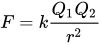
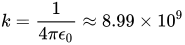
Where .
Permittivity of free space[edit | edit source]
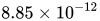
is known as the permittivity of free space, and is roughly . It is often useful to just remember that in free space, however you do also need to know , as you may be given the permittivity of different mediums.



Signs of charges[edit | edit source]
Note that for each charge, you must keep the signs intact in the equation. If you were to have two positive, or two negative charges in the equation, the result would be positive, but if you were to have one negative and one positive charge, the final answer would be negative. The sign of the answer tells us whether the force between the two charges is an attraction, or a repulsion, like charges will repel, and opposite charges will attract. This also explains the minus sign in Newton's law of gravitation, since the force between two masses is always an attraction.
Electric field strength[edit | edit source]
Just as gravitational field strength is the force exerted per unit mass, we could define the electric field strength in terms of charge:
The electric field strength at a point is the force per unit charge exerted on a positive charge placed at that point.
This is just like saying that the electric field strength is the force a charge of +1 coulomb experiences in that electric field. Therefore, we can find the electric field strength, E, by:
- .

From this equation, you can see that the electric field strength is measured in .

Field strength of a uniform field[edit | edit source]
You can make a uniform electric field by charging two plates. Increasing the voltage between them will increase the field strength, and moving the plates further apart will decrease the field strength. A simple equation for field strength can be made from these two points:

Where V is the voltage between the plates, and d is the distance between them.
Here you can see that the units of electric field strength is . is equivalent to .

Field strength of a radial field[edit | edit source]
Since the electric field strength could be said to be the force exerted on a charge of +1C, we can substitute 1 coulomb for in Coulomb's law. We then get the equation:
- , or


This will tell us the field strength of a charge, Q, at a distance, r.
Force on particles[edit | edit source]
To calculate the force an electron experiences in a uniform field, we can combine with in the following steps:


For an electron with a charge of -e, this becomes:
- , or


This is useful if you are asked to find the force on an electron in a uniform field, most often in a cathode ray tube
Comparison of electric and gravitational fields[edit | edit source]
As you may have already noticed, electric and gravitational fields are quite similar. You should be aware of the similarities and differences between them.
Similarities[edit | edit source]
- For point charges or masses, the variation of force with distance follows the inverse square law.
- Both exert a force from a distance, with no contact.
- The field strength of both is defined in terms of force per unit of the property of the object that causes the force (i.e. mass and charge).
Differences[edit | edit source]
- Gravitational fields can only produce forces of attraction, whereas electric fields can produce attraction and repulsion.
- Objects can be shielded from an electric field, but there is no way to shield an object from a gravitational field.
- Electric fields only act upon charged masses, however gravitational fields act upon all masses.
 |
A reader requests expansion of this page to include more material. You can help by adding new material (learn how) or ask for assistance in the reading room. |