


OpenSCAD User Manual/Commented Example Projects

Dodecahedron
[edit | edit source]
//create a dodecahedron by intersecting 6 boxes
module dodecahedron(height)
{
	scale([height,height,height]) //scale by height parameter
	{
		intersection(){
			//make a cube
			cube([2,2,1], center = true);
			intersection_for(i=[0:4]) //loop i from 0 to 4, and intersect results
			{
				//make a cube, rotate it 116.565 degrees around the X axis,
				//then 72*i around the Z axis
				rotate([0,0,72*i])
					rotate([116.565,0,0])
					cube([2,2,1], center = true);
			}
		}
	}
}
//create 3 stacked dodecahedra
//call the module with a height of 1 and move up 2
translate([0,0,2])dodecahedron(1);
//call the module with a height of 2
dodecahedron(2);
//call the module with a height of 4 and move down 4
translate([0,0,-4])dodecahedron(4);
|
 |
Icosahedron
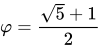
[edit | edit source]An icosahedron can be created from three orthogonal golden-ratio rectangles inside a hull() operation, where the golden ratio is .
phi=0.5*(sqrt(5)+1); // golden ratio

// create an icosahedron by intersecting 3 orthogonal golden-ratio rectangles
module icosahedron(edge_length) {
   st=0.0001;  // microscopic sheet thickness
   hull() {
       cube([edge_length*phi, edge_length, st], true);
       rotate([90,90,0]) cube([edge_length*phi, edge_length, st], true);
       rotate([90,0,90]) cube([edge_length*phi, edge_length, st], true);
   }
}

// display the 3 internal sheets alongside the icosahedron
edge=10;
translate([-20,0,0]) union() {
   cube([edge*phi, edge, 0.01], true);
   rotate([90,90,0]) cube([edge*phi, edge, 0.01], true);
   rotate([90,0,90]) cube([edge*phi, edge, 0.01], true);
}

icosahedron(edge);
|
 |
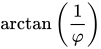
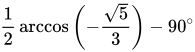
This icosahedron renders in an edge-up orientation. Rotating this icosahedron by about the Y-axis results in a vertex-up orientation. Rotating by about the X-axis results in a face-up orientation. The edge length is related to the inner diameter (distance between opposite faces) by .


Icosphere
[edit | edit source]// Code via reddit with triangle winding fixes, cannot add link due to
// wikibooks considering it spam.
// 4 is the realistic max.
// Don't do 5 or more, takes forever.
// set recursion to the desired level. 0=20 tris, 1=80 tris, 2=320 tris
module icosphere(radius=10, recursion=2, icoPnts, icoTris) {
//t = (1 + sqrt(5))/2;
//comment from monfera to get verts to unit sphere
t = sqrt((5+sqrt(5))/10);
s = sqrt((5-sqrt(5))/10);
init = (icoPnts||icoTris) ? false : true; //initial call if icoPnts is empty
// 1 --> draw icosphere from base mesh
// 2 --> loop through base mesh and subdivide by 4 --> 20 steps
// 3 --> loop through subdivided mesh and subdivide again (or subdivide by 16) --> 80 steps
// 4 ...
verts = [
[-s, t, 0], //0
[ s, t, 0],
[-s,-t, 0],
[ s,-t, 0],
[ 0,-s, t],
[ 0, s, t],
[ 0,-s,-t],
[ 0, s,-t],
[ t, 0,-s],
[ t, 0, s],
[-t, 0,-s],
[-t, 0, s]]; //11
//base mesh with 20 faces
tris = [
//5 faces around point 0
[ 0, 5, 11], //0
[ 0, 1, 5],
[ 0, 7, 1],
[ 0, 10, 7],
[ 0, 11, 10],
// 5 adjacent faces
[ 1, 9, 5], //5
[ 5, 4, 11],
[11, 2, 10],
[10, 6, 7],
[ 7, 8, 1],
//5 faces around point 3
[ 3, 4, 9], //10
[ 3, 2, 4],
[ 3, 6, 2],
[ 3, 8, 6],
[ 3, 9, 8],
//5 adjacent faces
[ 4, 5, 9], //15
[ 2, 11, 4],
[ 6, 10, 2],
[ 8, 7, 6],
[ 9, 1, 8]]; //19
if (recursion) {
verts = (init) ? verts : icoPnts;
tris = (init) ? tris : icoTris;
newSegments = recurseTris(verts,tris);
newVerts = newSegments[0];
newTris = newSegments[1];
icosphere(radius,recursion-1,newVerts,newTris);
} else if (init) { //draw the base icosphere if no recursion and initial call
scale(radius) polyhedron(verts, tris);
} else { // if not initial call some recursion has to be happened
scale(radius) polyhedron(icoPnts, icoTris);
}
}
// Adds verts if not already there,
// takes array of vertices and indices of a tri to expand
// returns expanded array of verts and indices of new polygon with 4 faces
// [[verts],[0,(a),(c)],[1,(b),(a)],[2,(c),(b)],[(a),(b),(c)]]
function addTris(verts, tri) = let(
a= getMiddlePoint(verts[tri[0]], verts[tri[1]]), //will produce doubles
b= getMiddlePoint(verts[tri[1]], verts[tri[2]]), //these are unique
c= getMiddlePoint(verts[tri[2]], verts[tri[0]]), //these are unique
aIdx = search(verts, a), //point a already exists
l=len(verts)
) len(aIdx) ? [concat(verts,[a,b,c]),[[tri[0],l,l+2], //1
[tri[1],l+1,l], //2
[tri[2],l+2,l+1], //3
[l,l+1,l+2]] ] : //4
[concat(verts,[b,c]), [[tri[0],aIdx,l+1], //1
[tri[1],l,aIdx], //2
[tri[2],l+1,l], //3
[aIdx,l,l+1]] ]; //4
// Recursive function that does one recursion on the whole icosphere (auto recursion steps derived from len(tris)).
function recurseTris(verts, tris, newTris=[], steps=0, step=0) = let(
stepsCnt = steps ? steps : len(tris)-1, //if initial call initialize steps
newSegment=addTris(verts=verts,tri=tris[step]),
newVerts=newSegment[0], //all old and new Vertices
newerTris=concat(newTris,newSegment[1]) //only new Tris
) (stepsCnt==(step)) ? [newVerts,newerTris] :
recurseTris(newVerts,tris,newerTris,stepsCnt,step+1);
// Get point between two verts on unit sphere.
function getMiddlePoint(p1, p2) = fixPosition((p1+p2)/2);
// Fix position to be on unit sphere
function fixPosition(p) = let(l=norm(p)) [p.x/l,p.y/l,p.z/l];
Half-pyramid
[edit | edit source]An upside-down half-pyramid is a useful shape for 3D printing a support for an overhang protruding from a vertical wall. With sloping sides no steeper than 45°, no removable support structure needs to be printed.
While a half-pyramid can be made with a 4-sided cone (using the cylinder primitive) and subtracting a cube from half of it, the shape can be easily made in one operation by a scaled linear extrude of a rectangle having the middle of one edge on the origin.
// Create a half-pyramid from a single linear extrusion
module halfpyramid(base, height) {
   linear_extrude(height, scale=0.01)
      translate([-base/2, 0, 0]) square([base, base/2]);
}

halfpyramid(20, 10);
|
 |
Bounding Box
[edit | edit source]
// Rather kludgy module for determining bounding box from intersecting projections
module BoundingBox()
{
	intersection()
	{
		translate([0,0,0])
		linear_extrude(height = 1000, center = true, convexity = 10, twist = 0)
		projection(cut=false) intersection()
		{
			rotate([0,90,0])
			linear_extrude(height = 1000, center = true, convexity = 10, twist = 0)
			projection(cut=false)
			rotate([0,-90,0])
			children(0);

			rotate([90,0,0])
			linear_extrude(height = 1000, center = true, convexity = 10, twist = 0)
			projection(cut=false)
			rotate([-90,0,0])
			children(0);
		}
		rotate([90,0,0])
		linear_extrude(height = 1000, center = true, convexity = 10, twist = 0)
		projection(cut=false)
		rotate([-90,0,0])
		intersection()
		{
			rotate([0,90,0])
			linear_extrude(height = 1000, center = true, convexity = 10, twist = 0)
			projection(cut=false)
			rotate([0,-90,0])
			children(0);

			rotate([0,0,0])
			linear_extrude(height = 1000, center = true, convexity = 10, twist = 0)
			projection(cut=false)
			rotate([0,0,0])
			children(0);
		}
	}
}

// Test module on ellipsoid
translate([0,0,40]) scale([1,2,3]) sphere(r=5);
BoundingBox() scale([1,2,3]) sphere(r=5);
|
 |
Linear Extrude extended use examples
[edit | edit source]Linear Extrude with Scale as an interpolated function
[edit | edit source]
//Linear Extrude with Scale as an interpolated function
// This module does not need to be modified,
// - unless default parameters want to be changed
// - or additional parameters want to be forwarded (e.g. slices,...)
module linear_extrude_fs(height=1,isteps=20,twist=0){
 //union of piecewise generated extrudes
 union(){
   for(i = [ 0: 1: isteps-1]){
     //each new piece needs to be adjusted for height
     translate([0,0,i*height/isteps])
      linear_extrude(
       height=height/isteps,
       twist=twist/isteps,
       scale=f_lefs((i+1)/isteps)/f_lefs(i/isteps)
      )
       // if a twist constant is defined it is split into pieces
       rotate([0,0,-(i/isteps)*twist])
        // each new piece starts where the last ended
        scale(f_lefs(i/isteps))
         obj2D_lefs();
   }
 }
}
// This function defines the scale function
// - Function name must not be modified
// - Modify the contents/return value to define the function
function f_lefs(x) =
 let(span=150,start=20,normpos=45)
 sin(x*span+start)/sin(normpos);
// This module defines the base 2D object to be extruded
// - Function name must not be modified
// - Modify the contents to define the base 2D object
module obj2D_lefs(){
 translate([-4,-3])
  square([9,12]);
}
//Top rendered object demonstrating the interpolation steps
translate([0,0,25])
linear_extrude_fs(height=20,isteps=4);
linear_extrude_fs(height=20); //Bottom rendered object demonstrating the inclusion of a twist translate([0,0,-25]) linear_extrude_fs(height=20,twist=90,isteps=30); |
 |
Linear Extrude with Twist as an interpolated function
[edit | edit source]
//Linear Extrude with Twist as an interpolated function
// This module does not need to be modified,
// - unless default parameters want to be changed
// - or additional parameters want to be forwarded (e.g. slices,...)
module linear_extrude_ft(height=1,isteps=20,scale=1){
  //union of piecewise generated extrudes
  union(){
    for(i = [ 0: 1: isteps-1]){
      //each new piece needs to be adjusted for height
      translate([0,0,i*height/isteps])
       linear_extrude(
        height=height/isteps,
        twist=f_left((i+1)/isteps)-f_left((i)/isteps),
        scale=(1-(1-scale)*(i+1)/isteps)/(1-(1-scale)*i/isteps)
       )
        //Rotate to next start point
        rotate([0,0,-f_left(i/isteps)])
         //Scale to end of last piece size
         scale(1-(1-scale)*(i/isteps))
          obj2D_left();
    }
  }
}
// This function defines the twist function
// - Function name must not be modified
// - Modify the contents/return value to define the function
function f_left(x) =
  let(twist=90,span=180,start=0)
  twist*sin(x*span+start);
// This module defines the base 2D object to be extruded
// - Function name must not be modified
// - Modify the contents to define the base 2D object
module obj2D_left(){
  translate([-4,-3])
   square([12,9]);
}
//Left rendered object demonstrating the interpolation steps
translate([-20,0])
linear_extrude_ft(height=30,isteps=5);
linear_extrude_ft(height=30); //Right rendered object demonstrating the scale inclusion translate([25,0]) linear_extrude_ft(height=30,scale=3); |
 |
Linear Extrude with Twist and Scale as interpolated functions
[edit | edit source]
//Linear Extrude with Twist and Scale as interpolated functions
// This module does not need to be modified,
// - unless default parameters want to be changed
// - or additional parameters want to be forwarded
module linear_extrude_ftfs(height=1,isteps=20,slices=0){
  //union of piecewise generated extrudes
  union(){
   for(i=[0:1:isteps-1]){
    translate([0,0,i*height/isteps])
     linear_extrude(
      height=height/isteps,
      twist=leftfs_ftw((i+1)/isteps)-leftfs_ftw(i/isteps),
      scale=leftfs_fsc((i+1)/isteps)/leftfs_fsc(i/isteps),
      slices=slices
     )
      rotate([0,0,-leftfs_ftw(i/isteps)])
       scale(leftfs_fsc(i/isteps))
        obj2D_leftfs();
   }
  }
}
// This function defines the scale function
// - Function name must not be modified
// - Modify the contents/return value to define the function
function leftfs_fsc(x)=
  let(scale=3,span=140,start=20)
  scale*sin(x*span+start);
// This function defines the twist function
// - Function name must not be modified
// - Modify the contents/return value to define the function
function leftfs_ftw(x)=
  let(twist=30,span=360,start=0)
  twist*sin(x*span+start);
// This module defines the base 2D object to be extruded
// - Function name must not be modified
// - Modify the contents to define the base 2D object
module obj2D_leftfs(){
   square([12,9]);
}
//Left rendered objects demonstrating the steps effect
translate([0,-50,-60])
rotate([0,0,90])
linear_extrude_ftfs(height=50,isteps=3);

translate([0,-50,0])
linear_extrude_ftfs(height=50,isteps=3);
//Center rendered objects demonstrating the slices effect translate([0,0,-60]) rotate([0,0,90]) linear_extrude_ftfs(height=50,isteps=3,slices=20); linear_extrude_ftfs(height=50,isteps=3,slices=20); //Right rendered objects with default parameters translate([0,50,-60]) rotate([0,0,90]) linear_extrude_ftfs(height=50); translate([0,50,0]) linear_extrude_ftfs(height=50); |
 |
Rocket
[edit | edit source]
// increase the visual detail
$fn = 100;

// the main body :
// a cylinder
rocket_d = 30; 				// 3 cm wide
rocket_r = rocket_d / 2;
rocket_h = 100; 			// 10 cm tall
cylinder(d = rocket_d, h = rocket_h);

// the head :
// a cone
head_d = 40;  				// 4 cm wide
head_r = head_d / 2;
head_h = 40;  				// 4 cm tall
// prepare a triangle
tri_base = head_r;
tri_height = head_h;
tri_points = [[0,			 0],
			  [tri_base,	 0],
			  [0,	tri_height]];
// rotation around X-axis and then 360° around Z-axis
// put it on top of the rocket's body
translate([0,0,rocket_h])
rotate_extrude(angle = 360)
	polygon(tri_points);

// the wings :
// 3x triangles
wing_w = 2;					// 2 mm thick
many = 3;					// 3x wings
wing_l = 40;				// length
wing_h = 40;				// height
wing_points = [[0,0],[wing_l,0],[0,wing_h]];

module wing() {
	// let it a bit inside the main body
	in_by = 1;				// 1 mm
	// set it up on the rocket's perimeter
	translate([rocket_r - in_by,0,0])
	// set it upright by rotating around X-axis
	rotate([90,0,0])
	// set some width and center it
	linear_extrude(height = wing_w,center = true)
	// make a triangle
		polygon(wing_points);
}

for (i = [0: many - 1])
	rotate([0, 0, 370 / many * i])
	wing();
Horns
[edit | edit source].png)
// The idea is to twist a translated circle:
// -
/*
	linear_extrude(height = 10, twist = 360, scale = 0)
	translate([1,0])
	circle(r = 1);
*/

module horn(height = 10, radius = 6,
			twist = 720, $fn = 50)
{
	// A centered circle translated by 1xR and
	// twisted by 360° degrees, covers a 2x(2xR) space.
	// -
	radius = radius/4;
	// De-translate.
	// -
	translate([-radius,0])
	// The actual code.
	// -
	linear_extrude(height = height, twist = twist,
				   scale=0, $fn = $fn)
	translate([radius,0])
	circle(r=radius);
}

translate([3,0])
mirror()
horn();

translate([-3,0])
horn();
Strandbeest
[edit | edit source]See the Strandbeest example here.