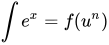
4 TheoremA linear operator from a finite-diemnsional vector space into itself is injective if and only if it is surjective.
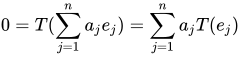
Proof: Let be a basis for . The following are equivalent: (i) has zero kernel. (ii) implies that all the are zero. (iii) is a basis for . Since the range of T is the span of the set , the theorem now follows.
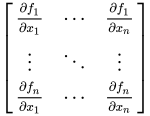
4 TheoremLet be a neighborhood of a point . If and for , and if the matrix
is invertible at , then the equations , has a unique solution such that and is in some neighborhood of .
Proof (from [1]):
We need
4 LemmaIf a linear operator is injective in , then is defined and continuously differentiable in .
The space A at top is connected; the shaded space B at bottom is not.
A set is connected if there exists no open cover of consisting of two disjoint open sets.
A connected component of a set in is the "maximal" connected subsets containing ; that is, the component = connected set containing . Every topological space, in other words, consists of components, which are necessarily disjoint and closed. That a topological space consists of exactly one component is equivalent to that the space is connected.
To give an example, induce to an arbitrary set a topology as a collection of any subsets of (i.e., the finest topology). The topological space has no closed sets since every open set in is also closed. The components of are the same as all the subsets of since .
4.3 TheoremThe following are equivalent. Given a topological space ,
is connected.
If , then both and are nonempty.
Only and have empty boundary.
Proof: Suppose for some sets and . If and are disjoint, so are and since . This is to say that (1) is false, which also follows if and are disjoint for the same reasoning. This shows that (1) implies (2). Now suppose is nonempty, open, closed subset of that is not . Then so is . Thus, , the disjoint union of an open set and a closed set. This contradicts (2). Hence, (2) implies (3. Finally, suppose (1) is false; that is, there are at least two components of , either of which has empty boundary but is not .
A path is a continuous function from [0, 1] to some space; e.g., a straight-line represented by =
A path is a loop if f(0) = f(1). e.g., a unit circle represented by .
Two points and are said to be jointed by a path if f(0) = a and f(1) = b. We say the space is path-connected, the importance of which notion is the following.
5.1 TheoremA set is path-connected set if and only if it is connected.
Two paths that are homotopic.
Two paths are said to be homotopic if FIXME.
We say a space is simply connected if every path in the space is homotopic to a point. For example, in the plane , every circle centered at the origin is homotopic to the origin. But in the circle fails to be homotopic to the origin. Hence, the former is simply connected while the latter is not. We also see, in light of theorem 3.1, that every simply-connected space is connected.
5.1 TheoremLet be a set. The following are equivalent.
4 Lemma (Urysohn)A topological space is normal if and only if for any disjoint closed sets and there exists a continuous function such that , on and on .
Proof (from Urysohn's lemma):
4 CorollaryA topological space is completely regular if and only if there exists a continuous injection from to a compact Hausdorff space with continuous inverse.
4 TheoremA Hausdorff space is paracompact if and only if it admits a partition of unity.
In this chapter, we shall prove (after some works are done) Cauchy's integral formula, first by the Stoke's theorem then again by the notion of the winding number.
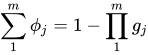
6.1 Theorem There exists a partition of unity subordinate to the cover ; that is:
(a) is infinitely differentiable in every .
(b) is in .
(c) If is in , then for some . (locally finite)
Proof: Let = the union of all . Choose in so that {all } covers and . (See the lemma for why this is possible.)
Let , , and so forth. If for some , then the computation gives: . Since , by induction,
, which is locally finite.
For in , some . Thus, (c) holds and the others (a) and (b) are also true by construction.
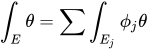
We define the integral of a form over by for a partition of unity subordinate to the locally finite cover of ,
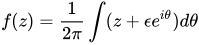
We say a function f satisfies the mean value property when:
.
An analytic function is an archetypical example, for the property is the immediate consequence of Caucy's integral formula. If f has the mean value property, then, for one, is harmonic, and for another, the maximal principle become applicable to it.
6.1 Theorem
If is analytic in , then the following are equivalent:
(a) (z) = 0 for all .
(b) = 0 for some open.
(c) has a non-isolated zero.
and if any of the above is true, then
(d) = 0.
Proof:
Let . If is in , then its derivative:
is 0 in since consists of interior points, and so we may suppose is .
Thus, from (b), (a) follows. That (b) implies (c) is obvious since an interior point is non-isolated. To show (d), let Z be . Then is closed since the inverse of , which is continuous by the inverse theorem, maps a closed set {0} back to in . is also open, which we can know by considering a power series expansion. Since is nonempty by assumption, (d) follows after (a). (FIXME: this is still a partial proof)
6 Theorem (Runge)Let be compact, and be an arbitrary open subset of containing . Then the following are equivalent:
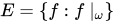
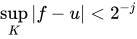
(a) For any and an integer , we can find a so that:
(b) K is holomorphically convex.
Proof: The theorem is a consequence of the Hahn-Banach theorem.
A compact subset K of a complex plane is said to have the Runge property if satisfies any of the statements in the theorem.
6.2 Theorem (Weierstrass)Let be open. Let the sequence be discrete, and be a sequence of arbitrary integers. Then there exists a nonzero such that for each is nonzero and analytic in some open set containing .
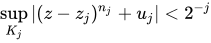
Proof: Let be an exhaustion by compact sets of with the Runge property. By the Runge property, for each , we find a so that:
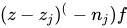
where since the sequence is discrete, we may suppose for any . Let
, and .
Then is analytic in except for all . Also, let be fixed and be an open set containing and no other terms in the sequence. Then in .
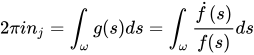
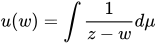
Thus, by Cauchy's integral formula,
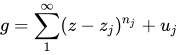
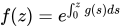
It now follows that the argument principle says has a zero of order (if the order is negative, then it is actually a pole).
This formulation is probably more illustrative, if it states more weakly.
6.2 CorollaryEvery discrete subset of is the zero and pole set of some analytic function.
Proof: Every discrete set is countable.
6 TheoremLet be open and connected and be one-form. Then the following are equivalent:
(1) is exact on .
(2) if is a closed path.
(3) is independent of path.
Proof: On , if is exact, then for some zero-form .
It thus follow:
.
If is a closed path, then by definition, and hence, (2) is true. Let and be arbitrary paths from to . Then
if (2) is true.
Thus, (2) implies (3). Finally, show (3) implies (1). Let . Then . For each , if ,
Here the derivative of does exist since the integral is independent of path. We conclude that .
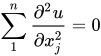
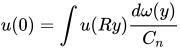
4. TheoremLet . Then is harmonic on and continuous on if and only if
.
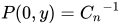
Proof: Suppose is harmonic on . Then using the Green's function
for .
Letting gives the direct part. Conversely, if , then the second derivative of = 0 since is harmonic on .
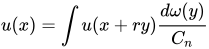
4. Corollary (mean value property)Let and be harmonic on and continuous on . Then
.
Proof: Let in the theorem. Then .
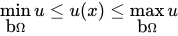
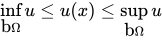
4. Corollary (maximum principle)If and is harmonic on and continuous on , then for ,
where if the equality holds at some , then is constant in the component of .
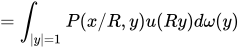
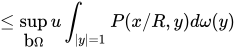
Proof: (i) Suppose . Then for
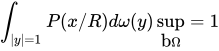
since
when .
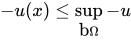
Likewise, . Thus,
where and are actually and , respectively since the continuity of and the compactness of a closed ball. (ii) Suppose is arbitrary. Let . From (i) it follows that is constant on every open ball containing . Since is open, every component of is open. Since an open set is the union of non-disjoint open balls, is constant on the component of .
4. TheoremLet be continuous on . Then the following are equivalent:
(i) is harmonic.
(ii) If is given,
where and .
(iii) If is given, then (ii) holds.
Proof: The mean value property says:
By integrating both sides we get:
Hence, (i) implies (ii). Clearly, (ii) implies (iii). Suppose (iii), and let be an open ball with . Let be harmonic on and continuous on such that on . If , then using (iii)
where on the boundary of . Since has non-zero measure, on . Thus, (iii) implies (i).
4 Lemma (Schwarz)If is analytic and for all and , then we have:
for all
Moreover, if the equality in the above holds at some point , then is proportional to
Proof: The hypothesis means that we can write . Furthermore, if , the maximum principle says
.
and is constant if at some point on the circle . Letting completes the proof.
A Lie algebra is an algebra whose multiplication, denoted by , satisfies
(i) , and
(ii)
for all . Under the assumption (ii) we see (i) is equivalent to
.
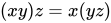
When given an algebra is associative; i.e., we can turn the algebra into a Lie algebra by defining , called a commutator. Indeed, it is clear that distributes over scalars and addition and the condition (i) holds. It then follows .










































































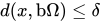
![{\displaystyle {\mbox{supp}}(d\mu )\subset [0,\delta ]}](https://wikimedia.org/api/rest_v1/media/math/render/svg/35056cda3b9ba9ea6fa9623eb0df67fe194ed863)














![{\displaystyle [,]}](https://wikimedia.org/api/rest_v1/media/math/render/svg/f04349be7aa458edb6f1ab423189a8455c6e21f7)
![{\displaystyle [x,x]=0}](https://wikimedia.org/api/rest_v1/media/math/render/svg/94ccb967db9ab0773c5aa2e0fc234cd33373f193)
![{\displaystyle [[x,y],z]+[[y,z],x]+[[z,x],y]=0}](https://wikimedia.org/api/rest_v1/media/math/render/svg/95eabacf905ea58f824b3b3da0bfc319b3be2590)

![{\displaystyle 0=[x+y,x+y]=[x,y]+[y,x]}](https://wikimedia.org/api/rest_v1/media/math/render/svg/1757579086bff93d4e63a8c42ec1c6097cb11ff6)
![{\displaystyle [x,y]=xy-yx}](https://wikimedia.org/api/rest_v1/media/math/render/svg/42b4220c8122ebd2a21c517ca80639581679cfa6)
![{\displaystyle [x,y]}](https://wikimedia.org/api/rest_v1/media/math/render/svg/1b7bd6292c6023626c6358bfd3943a031b27d663)
![{\displaystyle [[x,y],z]=[x,[y,z]]-[y,[x,z]]}](https://wikimedia.org/api/rest_v1/media/math/render/svg/6e1ff485dbe6274fac7973b043f4ab67e61290ec)