|
(a) Let  be real valued measurable functions on be real valued measurable functions on ![{\displaystyle [0,1]}](https://wikimedia.org/api/rest_v1/media/math/render/svg/738f7d23bb2d9642bab520020873cccbef49768d) with the property that for every with the property that for every ![{\displaystyle x\in [0,1]}](https://wikimedia.org/api/rest_v1/media/math/render/svg/64a15936df283add394ab909aa7a5e24e7fb6bb2) , ,  is differentiable at is differentiable at  and and 
Prove that ![{\displaystyle f\in L^{1}[0,1]}](https://wikimedia.org/api/rest_v1/media/math/render/svg/c49401f8cd8684bfc2c82a4504c0746263897da0)
(b) Suppose in addition that  is bounded on is bounded on ![{\displaystyle [0,1].}](https://wikimedia.org/api/rest_v1/media/math/render/svg/8786b5ef9daedb24adb59e7825c4096d99a99648) Prove that Prove that

|
|
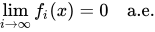
Let  and suppose and suppose  . Set . Set 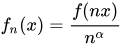 for for  . Prove that for almost every . Prove that for almost every 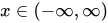 , ,

|
By change of variable (setting u=nx), we have

Define 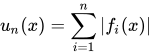 .
.
Then,  is a nonnegative increasing function converging to
  .
.
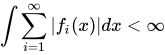
Hence, by Monotone Convergence Theorem and 
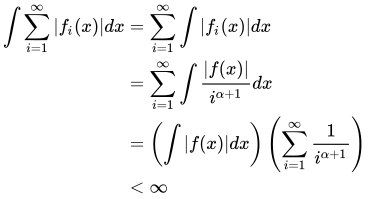
where the last inequality follows because the series converges ( ) and 
Since
 ,
,
we have almost everywhere
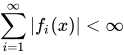
This implies our desired conclusion: