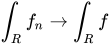
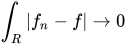
|
Suppose that  is a sequence of absolutely continuous functions defined on is a sequence of absolutely continuous functions defined on ![{\displaystyle [0,1]\!\,}](https://wikimedia.org/api/rest_v1/media/math/render/svg/b26fc5fee30dada6f15cc080115cae582606d7f3) such that such that  for every for every  and and
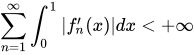
for every ![{\displaystyle x\in [0,1]\!\,}](https://wikimedia.org/api/rest_v1/media/math/render/svg/a5820a535671944261c3c9edd23e9a4419e10bd8) . Prove: . Prove:
- the series
 converges for each pointwise to a function converges for each pointwise to a function 
- the function is absolutely continuous on
![{\displaystyle f^{\prime }(x)=\sum _{n=1}^{\infty }f_{n}^{\prime }(x)\quad a.e.\,\,x\in [0,1]\!\,}](https://wikimedia.org/api/rest_v1/media/math/render/svg/6418d51c14ff959c2890ab33358a7a35eabc9835)
|
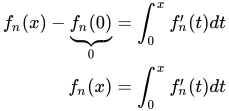
Absolutely Continuous <==> Indefinite Integral[edit | edit source]
 is absolutely continuous if and only if can be written as an indefinite integral i.e. for all
Apply Inequalities,Sum over n, and Use Hypothesis[edit | edit source]
Let ![{\displaystyle x_{0}\in [0,1]\!\,}](https://wikimedia.org/api/rest_v1/media/math/render/svg/54a3de3cc40526405cc17882f685b9038166b06f) be given. Then,
be given. Then,
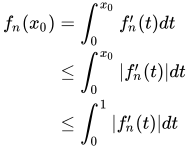
Hence
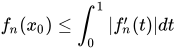
Summing both sides of the inequality over and applying the hypothesis yields pointwise convergence of the series  ,
,

Absolutely continuous <==> Indefinite Integral[edit | edit source]
Let  .
.
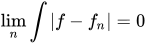
We want to show:
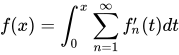
Rewrite f(x) and Apply Lebesgue Dominated Convergence Theorem[edit | edit source]
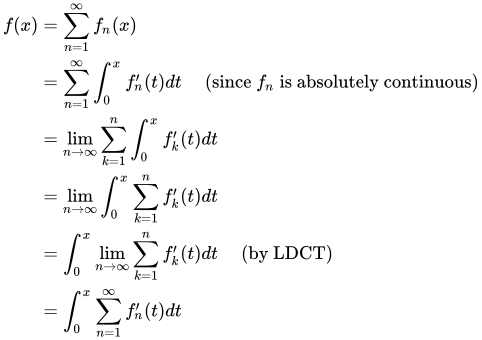
Justification for Lebesgue Dominated Convergence Theorem[edit | edit source]
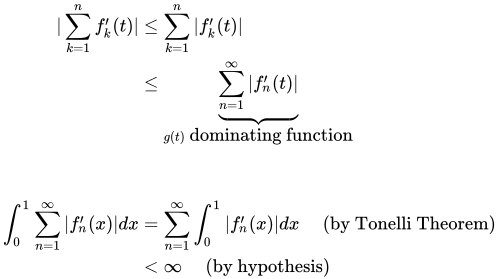
Therefore  is integrable
The above inequality also implies 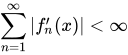 a.e on . Therefore,
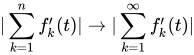
a.e on to a finite value.
Since 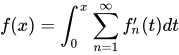 , by the Fundamental Theorem of Calculus
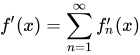 a.e.
a.e.
Check Criteria for Lebesgue Dominated Convergence Theorem[edit | edit source]
Define 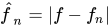 ,
,  .
.
Since is positive, then so is , i.e.,  and
and  . Hence,

Let  . Since
  , then
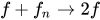 , i.e.,
 .
.
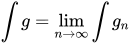
integral of g_n converges to integral of g =[edit | edit source]
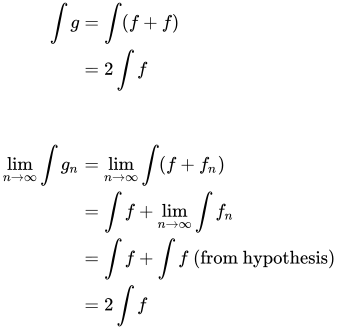
Hence,
hat{f_n} converges to hat{f} a.e.[edit | edit source]
Note that is equivalent to
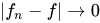
i.e.

Since the criteria of the LDCT are fulfilled, we have that
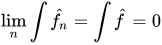 , i.e.,
|
Show that if is absolutely continuous on and  , then , then  is absolutely continuous on is absolutely continuous on
|
Show that g(x)=|x|^p is Lipschitz[edit | edit source]
Consider some interval ![{\displaystyle I=[\alpha ,\beta ]\!\,}](https://wikimedia.org/api/rest_v1/media/math/render/svg/e02aeb78ff5fcb2afe0142a7f37bc42063688703) and let
and let  and
and  be two points in the interval
  .
.
Also let 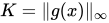 for all
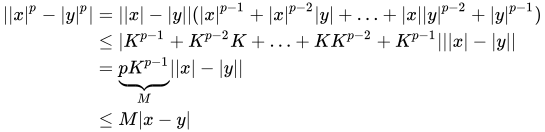
Therefore  is Lipschitz in the interval
Apply definitions to g(f(x))[edit | edit source]
Since  is absolutely continuous on , given
  , there exists
  such that if
  is a finite collection of nonoverlapping intervals of such that
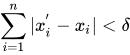
then
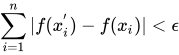
Consider  . Since
  is Lipschitz
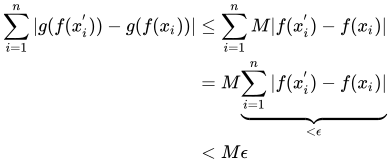
Therefore is absolutely continuous.
f(x)= x^4sin^2(\frac{1}{x^2}) is Lipschitz (and then AC)[edit | edit source]
Consider 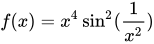 . The derivate of f is given by
 .
.
The derivative is bounded (in fact, on any finite interval), so is Lipschitz.
Hence, f is AC
|f|^{1/2} is not of bounded variation (and then is not AC)[edit | edit source]
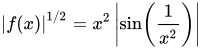
Consider the partition  . Then,
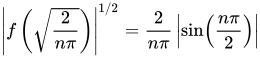
Then, T(f) goes to  as goes to .
Then,  is not of bounded variation and then is not AC