Trigonometry/Verifying Trigonometric Identities
To verify an identity means to prove that the equation is true by showing that both sides equal one another.
There is no set method that can be applied to verifying identities; there are, however, a few different ways to start based on the identity which is to be verified.
Trigonometric identities are used in both course texts and in real life applications to abbreviate trigonometric expressions. It is important to remember that merely verifying an identity or altering an expression is not an end in itself, but rather that identities are used to simplify expressions according to the task at hand. Trigonometric expressions can always be reduced to sines and cosines, which can be more manageable than other functions.
To verify an identity[edit | edit source]
- Always try to reduce the larger side first.
- Sometimes getting all trigonometric functions on one side can help.
- Remember to use and manipulate already existing identities. The Pythagorean identities are usually the most useful in simplifying.
- Remember to factor if needed.
- Whenever there is a squared trigonometric function such as , always use the Pythagorean identities, which deal with squared functions.
- Sometimes doing the reverse of the normal steps helps. For example, adding 1 in unique forms (such as can help simplify expressions by matching denominators and simplifying numerators.


Easy example
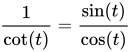
- , so
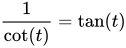
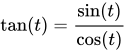
is the same as


and therefore the example can be rewritten as
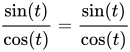
Identity verified