Trigonometry/For Enthusiasts/Less-Used Trig Identities
(Redirected from Trigonometry/Trigonometric Identities Reference)
Triangle Identities[edit | edit source]
In addition to the Law of Sines, the Law of Cosines, and the Law of Tangents, there are numerous other identities that apply to the three angles A, B, and C of any triangle (where A+B+C=180° and each of A, B, and C is greater than zero). Some of the most notable ones follow:








Pythagoras[edit | edit source]



These are all direct consequences of Pythagoras's theorem.
Sum/Difference of angles[edit | edit source]


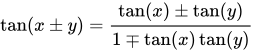
Product to Sum[edit | edit source]



Sum and difference to product[edit | edit source]
- , where and


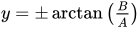



Multiple angle[edit | edit source]


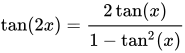
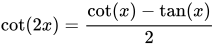
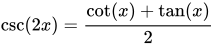


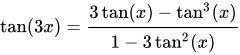


![{\displaystyle \sin ^{2}(4x)=16{\Big [}\sin ^{2}(x)-5\sin ^{4}(x)+8\sin ^{6}(x)-4\sin ^{8}(x){\Big ]}}](https://wikimedia.org/api/rest_v1/media/math/render/svg/598b3543e3748f907f04fd36aeca7b182385ca5c)










These are all direct consequences of the sum/difference formulae
Half angle[edit | edit source]
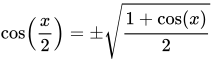
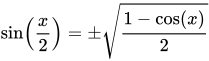


In cases with , the sign of the result must be determined from the value of . These derive from the formulae.


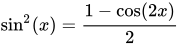
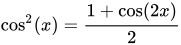
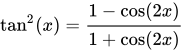






![{\displaystyle {\frac {d}{dx}}{\big [}\sin(x){\big ]}=\cos(x)}](https://wikimedia.org/api/rest_v1/media/math/render/svg/6e0926652b30841b3f9411fa26d6ff94ef0695d9)
![{\displaystyle {\frac {d}{dx}}{\big [}\cos(x){\big ]}=-\sin(x)}](https://wikimedia.org/api/rest_v1/media/math/render/svg/ee6354b64afce92f2b1cadb5a495f5e1c88ceb25)
![{\displaystyle {\frac {d}{dx}}{\big [}\tan(x){\big ]}=\sec ^{2}(x)}](https://wikimedia.org/api/rest_v1/media/math/render/svg/f2876ba2de800a057c9e660f9ad76ac8deea0b3b)
![{\displaystyle {\frac {d}{dx}}{\big [}\sec(x){\big ]}=\sec(x)\tan(x)}](https://wikimedia.org/api/rest_v1/media/math/render/svg/da5289ee96dbb8faf5f9bf77d6ac714b9e34d464)
![{\displaystyle {\frac {d}{dx}}{\big [}\csc(x){\big ]}=-\csc(x)\cot(x)}](https://wikimedia.org/api/rest_v1/media/math/render/svg/d3d9c7bf9123ab9d63656dff8df61248a3c4090c)
![{\displaystyle {\frac {d}{dx}}{\big [}\cot(x){\big ]}=-\csc ^{2}(x)}](https://wikimedia.org/api/rest_v1/media/math/render/svg/efd88e218e5cfb4d074b84f856586ee308dad192)