


Trigonometry/Law of Sines
 | Ooops. I should probably lose alpha beta and gamma from these diagrams |

For any triangle with vertices corresponding angles and corresponding opposite side lengths , the Law of Sines states that


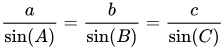
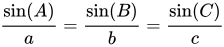
Each of these expressions is also equal to the diameter of the triangle's circumcircle (the circle that passes through the points ). The law can also be written in terms of the reciprocals:
Proof
[edit | edit source]
Dropping a perpendicular from vertex to intersect (or extended) at splits this triangle into two right-angled triangles and . We can calculate the length of the altitude in two different ways:


- Using the triangle AOC gives
- ;

- and using the triangle BOC gives
- .
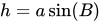
- Eliminate from these two equations:
- .

- Rearrange to obtain
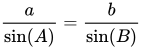
By using the other two perpendiculars the full law of sines can be proved. QED.
Application
[edit | edit source]This formula can be used to find the other two sides of a triangle when one side and the three angles are known. (If two angles are known, the third is easily found since the sum of the angles is .) See Solving Triangles Given ASA. It can also be used to find an angle when two sides and the angle opposite one side are known.

Area of a triangle
[edit | edit source]The area of a triangle may be found in various ways. If all three sides are known, use Heron's theorem.
If two sides and the included angle are known, consider the second diagram above. Let the sides and , and the angle between them be known. The terms /alpha and /gamma are variables represented by Greek alphabet letters, and these are commonly used interchangeably in trigonometry just like English variables x, y, z, a, b, c, etc. From triangle , the altitude is so the area is .


If two angles and the included side are known, again consider the second diagram above. Let the side and the angles and be known. Let . Then


Thus
- .


