Trigonometry/Cosine and Sine
Two Approaches[edit | edit source]
The cosine and sine functions relate the angles in right triangles as the ratio of lengths of the corresponding sides. For example, the cosine function () relates the angle theta, , from the adjacent side of the angle to the opposite side of the right angle on the right traingle (i.e. the is the ratio between the adjacent side of that angle to the hypotenuse of the right triangle).


There are two usual approaches of introducing the cosine and sine functions.
- In one approach, the sine and cosine function are defined in terms of right angle triangles. This works fine for angles between and . Later on, the definition has to be extended to angles outside that range.
- An alternative approach introduces sine and cosine in terms of 'the unit circle'. This approach is a little more sophisticated but works for all angles.


The two approaches amount to exactly the same thing in the end. However, we prefer to deal with the full range of angles from the start, which is why in the previous exercise we had you plotting to get a 'unit circle'.

Unit Circle Definition[edit | edit source]

If a line of radius length is drawn at an angle, , to the axis (where the angle is anti-clockwise to the axis), then the coordinate is given by


- ,

and the coordinate is given by

- .

|
Notation and pronunciation is of course just an abbreviation for 'cosine', and is just an abbreviation for sine.
Rather confusingly can be pronounced either 'cos' or 'coz' always with 'o' as in 'bottle', rather than 'o' as in 'code' and is often pronounced 'sine' rather than 'sin'. It's not very logical, it is just how it is. |

Ratios of Sides Definition[edit | edit source]
The figure below shows what we are considering:

Here, we shall denote the angles by

- We already know that the longest side is called the hypotenuse.
- The side next to the angle we have chosen is called the base of the triangle.
- The remaining side which is opposite the angle is called the perpendicular or latitude of the triangle.
The angle determines the ratios of the side. Once the angle is selected we can make the whole triangle larger or smaller but all lengths change in the same proportions. We can't change the length of one side without also changing the length of all sides in the same proportion, or else we have changed the angles. So, once we know the angle we know the ratio of the sides. The functions that give us those ratios are defined as:
- and


'Unit Hypotenuse' Definition[edit | edit source]
This definition of sine and cosine isn't usually given, but it is also valid.
Draw a line of unit length, , from the origin to a point that is angled anti-clockwise from the horizontal axis. Then, indicate a line parallel to the vertical axis and a line parallel to the horizontal axis from the point .


If the line of unit length, , is the hypotenuse of the right triangle, then for the right triangle that has a width of and a length of , the following functions are true:
- .
- .


Because any rational number divided by 1 is the same number:
- .
- .


Another definition remains. Let and :




Exercises[edit | edit source]
|
Exercise: These definitions amount to the same thing Use this third definition to convince yourself that the three different ways of defining sine and cosine amount to the same thing, at least for angles between and . |
|
Exercise: Unit Circle Did you do the exercise on Plotting (cos(t), sin(t)) on the previous page? It really is important to have had a go and seen how cosine and sine are related to the unit circle. If nothing else you MUST be able to use and on your calculator or you will not get very far with trigonometry. |
|
Exercise: To think about
The unit circle definition of the trig functions shows that we can work with angles greater than . represents a quarter of a circle. represents a complete circle. What happens or what should happen for and if we have angles greater than ?
|

Tangent[edit | edit source]
There is one more trigonometric function that we want to introduce on this page. It's the tangent function or just .

For the unit circle definition we define the tangent of theta as:

For the ratios of sides definition we define the tangent of theta as:
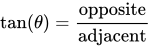
Using the definition of sine and cosine in terms of a triangle with unit hypotenuse it is immediately clear that these are the same thing.
|
These definitions of Tan amount to the same thing If we didn't have the definition of sine and cosine in terms of the triangle with unit hypotenuse we'd need to do slightly more work to show that the two definitions of tan were equivalent. We'd do something like this: It is worth checking every step in this. |

|
Tan or Tangent? When talking about the tangent function it is usually better to always just say 'Tan' rather than 'Tangent'.
|

