Topology/Topological Spaces
In this section, we will define what a topology is and give some examples and basic constructions.
Motivation[edit | edit source]
In Abstract Algebra, a field generalizes the concept of operations on the real number line. This general definition allows concepts about quite different mathematical objects to be grasped intuitively by comparison with the real numbers. Likewise, the concept of a topological space is concerned with generalizing the structure of sets in Euclidean spaces. Of course, for many topological spaces the similarities are remote, but aid in judgment and guide proofs. Interesting differences in the structure of sets in Euclidean space, which have analogies in topological spaces, are connectedness, compactness, dimensionality, and the presence of "holes".
If we begin with an arbitrary set, it may not be immediately obvious what is needed to imbue it with an interesting structure. One possibility might be to define a metric on the set, but as it turns out, requiring a metric is overly restrictive. In fact, there are many equivalent ways to define what we will call a topological space just by defining families of subsets of a given set. The properties of the topological space depend on the number of subsets and the ways in which these sets overlap. Topological spaces can be fine or coarse, connected or disconnected, have few or many dimensions.
The most popular way to define a topological space is in terms of open sets, analogous to those of Euclidean Space. (In Euclidean space, an open set is intuitively seen as a set that does not contain its "boundary").
Definition of a topological space[edit | edit source]
Suppose we are given two sets, and , where is a collection of subsets of .


If has the following properties:
- the empty set and are both in ,
- any (finite or infinite) union of sets in is itself in , and
- any finite intersection of sets in is itself in ,
then is called a topology on . The ordered pair is called a topological space.

This definition of a topological space allows us to redefine open sets as well. Previously, we defined a set to be open if it contained all of its interior points, and the interior of a set was defined by open balls, which required a metric. That is, we needed some notion of distance in order to define open sets. Topological spaces have no such requirement. In fact, the three properties given above— and them alone — are enough to define an open set. Our new definition is this:
- the elements of are called open sets.
Or, in other words, an open set is an element of a topology. So a topology is really a collection of open sets. The rules above are descriptions of how open sets behave: a collection of sets can be called open if the union of an arbitrary number of open sets is open, the intersection of a finite number of open sets is open, and the space itself is open. (The empty set is considered open by default). We also say that a set is closed if its complement is open. As mentioned before, a set can be both open and closed at the same time: the space itself is open, but since its complement (the empty set) is open, it is also closed.
As it happens, the properties we associate with open sets, which allow us to study many topological ideas (like continuity and convergence, which were defined earlier using open sets), are encoded entirely by the three properties described above, without any need for a distance metric at all. This is in fact a very abstract definition, using only the most basic ideas of set theory (subsets, unions and intersections), and it allows enormous flexibility in what can be studied as a topological space (as well as how something can be seen as a topological space; there are many different ways a topology can be chosen on a given set). This definition is so general, in fact, that topological spaces appear naturally in virtually every branch of mathematics, and topology is considered one of the great unifying topics of mathematics.
So, to recap: a topology on a set is a collection of subsets which contains the empty set and the set itself, and is closed under unions and finite intersections. The sets that are in the topology are open and their complements are closed. A topological space is a set together with a topology on it.
Some things to note:[edit | edit source]
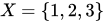
- A set is only open under a particular topology. It does not strictly make sense to merely say that a set is open. In practice, however, the topology under consideration is usually clear from context. For instance, suppose we have the set , and the set . is a topology on , and one would say that the set is open. This is inferred to mean that is open under . If we were given another topology , then the set would be open under but not open under . In this case it would be ambiguous to merely say that is open. (Incidentally, it is not closed under either, because its complement is not open)
- While the term topological space strictly refers to the ordered pair (where is a set and is a topology on ), often the topological space is used interchangeably with the underlying set , or the topology . Which one is meant is usually clear from context. For instance, one might say "suppose is a topological space and the interval is a subset of . Now, suppose is open..." and so on. In this case (assuming the author has not made a mistake), it is meant that the topological space is the pair , where is a subset of , and is a subset of . In the case of the real numbers, usually the topology is the usual topology on , where the open sets are either open intervals, or the union of open intervals.
- Infinite intersections of open sets do not need to be open. For example, consider open intervals of the form . The intersection of these intervals for all positive integer values of is the set , which is not open in the real numbers.





Examples of topological spaces[edit | edit source]
For any set , there are two topologies we can always define on :
- The Discrete topology - the topology consisting of all subsets of a set .
- The Indiscrete topology (also known as the trivial topology) - the topology consisting of just and the empty set, .

Metric Topology[edit | edit source]
Given a metric space , its metric topology is the topology induced by using the set of all open balls as the base. One can also define the topology induced by the metric, as the set of all open subsets defined by the metric. We denote the topology induced from the metric d with


This forms a topological space from a metric space.
If for a topological space , we can find a metric , such that , then the topological space is called metrizable.

The usual topology on the real numbers[edit | edit source]
We can define a topology on by defining to be in if for every point , there is an such that . We call this topology the standard topology, or usual topology on .



The cofinite topology on any set[edit | edit source]
Let be a non-empty set. Define to be the collection of all subsets of satisfying the following:

- Either
- Or is finite.


(In other words, the open sets are formed by removing a finite number of elements from )
Then is a topology on called the cofinite topology (or "finite complement topology") on . Further, this topology turns out to be discrete if and only if is finite.
The cocountable topology on any set[edit | edit source]
Let be a non-empty set. Define to be the collection of all subsets of satisfying the following:
- Either
- Or is countable.
(In other words, the open sets are formed by removing a countably infinite number of elements from )
Then is a topology on called the cocountable topology (or "countable complement topology") on . Further, this topology turns out to be discrete if and only if is countable.
Sets in topological spaces[edit | edit source]
Let be a topological space. There are many types of sets we can define on

- The complement of a set A in X, denoted by , is (that is, the entire space except for A).
- A subset is called closed if the set is open. Notice that the intersection of any non-zero number of closed sets is closed and the union of finitely many closed sets is closed.
- Note also that a set can be both closed and open. The trivial examples are the empty set and the entire set , each of which is both closed and open. By definition, is open, so its complement, , is closed. But , by definition, is an open set, so is both open and closed.
- A set is called a neighborhood of a point if it includes an open set containing . In other words, is a neighborhood of if there is an open set such that


We now investigate some commonly occurring sets in the study of Topology.
Definition[edit | edit source]
In a topological space, a set is a countable intersection of open sets. A set is a countable union of closed sets.


Theorem[edit | edit source]
The complement of a set is , and vice versa.
Proof:
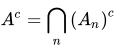
Let A be a set and let . Then A is a countable union of closed sets, such that is closed for all n. Then . Since is closed, is open, so we have a countable intersection of open sets. Hence is .
The entirely similar proof of the other implication is left to the reader.




Theorem[edit | edit source]
In any metric space, a closed set is a set.
Proof:
Let X be a metric space and let .
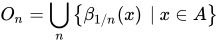
Define . Observe that is open for any n, and hence the union is open.
Now our goal is to show that to show that a closed set is the intersection of countably many open sets.
:
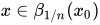
Let . Then intersects A at some which implies . This is true for any n so .
:
Let and . Then such that . So in A such that , which implies . Thus .
Therefore and is a set.








Theorem[edit | edit source]
In usual , is a set.

Proof:
Since with the usual topology is a metric space, every singleton such that is closed. Thus, we have a countable union of closed sets, and hence is a set.

Exercises[edit | edit source]
- Prove the following are topologies:
- The discrete topology on any set.
- The indiscrete topology on any set.
- The cofinite topology on any set.
- The cocountable topology on any set.
- Show that the cofinite (respectively, cocountable) topology on a set equals the discrete topology if and only if is finite (respectively, countable).
- Prove that a set is open if and only if for every element within the set, there is a neighborhood contained within the set.
- Show that the discrete topology is the topology induced by the discrete metric. (This is also a splendid way of remembering the discrete and the indiscrete topology)
