Topology/The fundamental group
The basic idea of the fundamental group
[edit | edit source]

An easy way to approach the concept of fundamental group is to start with a concrete example. Let us consider the 2-sphere and the surface of the torus.

Let us start thinking about two types of loops of the torus (paths starting and ending at the same point). It seems that a path around the "arm" of the torus is substantially different from a “local” simple loop: one cannot be deformed into the other. On the other hand, in the sphere it seems that all the loops can be deformed into any other loop. The set of "types of loops" in the two spaces is different: the torus seems to have a richer set of "types of loops" than the spherical surface. This type of approach constitutes the base of the definition of fundamental group and explains essential differences between different kinds of topological spaces. The fundamental group makes this idea mathematically rigorous.
Definition of fundamental group
[edit | edit source]Definition: Let be a topological space and let and be points in . Then two paths and are considered equivalent if there is a homotopy such that is a path from to for any . It is easily verified that this is an equivalence relation.


![{\displaystyle f:[0,1]\rightarrow X}](https://wikimedia.org/api/rest_v1/media/math/render/svg/677831b64964eb40a19d3dbf3f350c4110708fde)
![{\displaystyle g:[0,1]\rightarrow X}](https://wikimedia.org/api/rest_v1/media/math/render/svg/0358c0019a7eaec4ab9ce530739769131dc679a9)
![{\displaystyle H:[0,1]^{2}\rightarrow X}](https://wikimedia.org/api/rest_v1/media/math/render/svg/4940436f3e9ad6325534df5035f2af3a05c8f0f5)

![{\displaystyle a\in [0,1]}](https://wikimedia.org/api/rest_v1/media/math/render/svg/254834e1cbe5c10e41397c0985566bb1cef07712)
Definition: Define the composition of paths from to and then from to to be simply the same adjunction of paths as we had in the section on path connectedness:


![{\displaystyle f(x)=\left\{{\begin{array}{ll}f_{1}(2x)&{\text{if }}x\in [0,{\frac {1}{2}}]\\f_{2}(2x-1)&{\text{if }}x\in [{\frac {1}{2}},1]\\\end{array}}\right.}](https://wikimedia.org/api/rest_v1/media/math/render/svg/d163f802afee98a85ffcace177248deb35c27362)
We shall denote the composition of two paths and as .


Definition: Let to be a path. Define the inverse path (not to be confused with the inverse function) as , the path in the opposite direction.

Definition: Let be a topological space, and let be a point in . Then define to be the constant path where .


Now consider the set of equivalence groups of paths. Define the composition of two equivalence groups to be the equivalence group of the composition of any two paths. Define the inverse of an equivalence group to be the equivalence group of the inverse of any within the equivalence group. Define to be the equivalence group containing .
![{\displaystyle [C_{p}]}](https://wikimedia.org/api/rest_v1/media/math/render/svg/bc3a05c280be14730b16ec28d0bba0e6ee50a4c2)
We can easily check that these operations are well-defined.
Now, in a fundamental group, we will work with loops. Therefore, we define the equivalence, composition and inverse of loops to be the same as the definition as that of paths, and the composition and inverse of the equivalence classes also to be the same.
Definition: The set of equivalence classes of loops at the base point , is a group under the operation of adjoining paths. This group is called fundamental group of at the base point .

In order to demonstrate that this is a group, we need to prove:
1) associtivity: ;
![{\displaystyle [\alpha ]*([\beta ]*[\gamma ])=([\alpha ]*[\beta ])*[\gamma ]}](https://wikimedia.org/api/rest_v1/media/math/render/svg/347ee42e912f63acf3ac54de74d641bc6492f2f3)
2) identity: ;
![{\displaystyle [\alpha ]*[1]=[1]*[\alpha ]=[\alpha ]}](https://wikimedia.org/api/rest_v1/media/math/render/svg/b9bd53eb880dd9848d5a0939306e5764440895b2)
3) inverse: .
![{\displaystyle [\alpha ]*[{\overline {\alpha }}]=[{\overline {\alpha }}]*[\alpha ]=[1]}](https://wikimedia.org/api/rest_v1/media/math/render/svg/7c76bc4652c2abd4302b9182a51c6a39f70c16ac)
1) It is quite obvious that when you have a path from to , and then to , and finally to , then the adjunction of the paths from to and to is the same as the path you get when you adjoin the paths from to and then to .


In fact, an explicit homotopy on and can be given by the following formula:
![{\displaystyle [\alpha ]*([\beta ]*[\gamma ])}](https://wikimedia.org/api/rest_v1/media/math/render/svg/79c245501471c9415aab57e498d9e193e836bea8)
![{\displaystyle ([\alpha ]*[\beta ])*[\gamma ]}](https://wikimedia.org/api/rest_v1/media/math/render/svg/f519f3fb725ada66a88d91140773e204c5e60aa1)
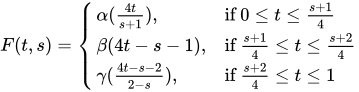
.
2) is the identity. One can easily verify that the product of this constant loop with another loop is homotopic to the original loop.
![{\displaystyle [C_{x_{0}}]}](https://wikimedia.org/api/rest_v1/media/math/render/svg/686467f0f35019d3cb3f62fa417f294b4c997c6c)
3) The inverse of the equivalence relation as defined before serves as the inverse within the group. The fact that the composition of the two paths and reduces to the constant path can easily be verified with the following homotopy:



Dependence on the Base Point
[edit | edit source]We now have our fundamental group, but it would be of interest to see how the fundamental group depends on the base point, since, as we have defined it, the fundamental group depends on the base point. However, due to the very important theorem that in any path-connected topological space, all of its fundamental groups are isomorphic, we are able to speak of the fundamental group of the topological space for any path-connected topological space.
Proof
[edit | edit source]Let's take in the same path-component of . In this case, it's possible to find a relation between and . Let be a path from to and from back to . The map defined by is an isomorphism. Thus if is path-connected, the group is, up to isomorphism, independent of the choice of basepoint .


![{\displaystyle h:\left[0,1\right]\to X}](https://wikimedia.org/api/rest_v1/media/math/render/svg/10b438599568e6eae4ce57049dd6fdae06e5d326)



![{\displaystyle \beta _{h}[f]=[hf{\overline {h}}]}](https://wikimedia.org/api/rest_v1/media/math/render/svg/a405f39de58020857796c92a12254c3f7e5d6e6e)
When all fundamental groups of a topological space are isomorphic, the notation is abbreviated to .

Definition: A topological space is called simply-connected if it is path-connected and has trivial fundamental group.
The fundamental group of
[edit | edit source]
This section is dedicated to the calculation of the fundamental group of that we can consider contained in the complex topological space. One more time we can start with a visual approach.

It's easy to imagine that a loop around the circle is not homotopic to the trivial loop. It's also easy to imagine that a loop that gives two complete turns is not homotopic to one that gives only one. Simple intuition seems to be that fundamental group of is related with number of turns. However, the rigorous calculation of involves some difficulties.

We define . It's possible to demonstrate the following results:

Lemma 1: Let be a path. Then there exists such that . Moreover, if , then is unique, called a lift of .
![{\displaystyle f:\left[0,1\right]\to S^{1}\subset \mathbb {C} }](https://wikimedia.org/api/rest_v1/media/math/render/svg/475ac1665716787df6b296b24032cac330b98fb5)
![{\displaystyle {\overline {f}}:\left[0,1\right]\to \mathbb {R} }](https://wikimedia.org/api/rest_v1/media/math/render/svg/721d32d0e753d076c973e921fc3422590c4cc9fb)




Lemma 2: Let be a homotopy on paths with start point . Let . Then exists only one homotopy on paths with start point such that .
![{\displaystyle F:\left[0,1\right]\times \left[0,1\right]\to S^{1}\subset \mathbb {C} }](https://wikimedia.org/api/rest_v1/media/math/render/svg/cd8604ece1f737cb64561a48ae0f1a5be9e74963)
![{\displaystyle {\overline {F}}:\left[0,1\right]\times \left[0,1\right]\to \mathbb {R} }](https://wikimedia.org/api/rest_v1/media/math/render/svg/f4ac725a888d4fe25893a430539ade0b4ca1b44f)


Note: These lemmas allow to guarantee that homotopic loops have homotopic lifts.
For more information see Wikipedia.
Theorem:.

Proof: Let be a loop with base and . Let and define


![{\displaystyle [\alpha ]\in \pi _{1}(S^{1},(1,0))}](https://wikimedia.org/api/rest_v1/media/math/render/svg/e1281a171cc14e1baa773a5e1de91e3e4c47e73c)

![{\displaystyle \pi _{1}(S^{1},(1,0))\to \mathbb {Z} \;\;\;v([\alpha ])={\overline {\alpha }}(1).}](https://wikimedia.org/api/rest_v1/media/math/render/svg/b5530da9997bd6dcc6749ba0d9bc17e869da9987)
The good definition of this application comes from the fact that homotopic loops defined in to have homotopic lifts. We have .So, for some . Therefore .
![{\displaystyle \left[0,1\right]}](https://wikimedia.org/api/rest_v1/media/math/render/svg/c57121c2b6c63c0b2f38eb96b1f7a543b5d1c522)



![{\displaystyle v([\alpha ])\in \mathbb {Z} }](https://wikimedia.org/api/rest_v1/media/math/render/svg/299bf7d618afe25aa3cfd516bf8912d1ab363fd7)
1) is surjective. For we define the loop . We then have and ;


![{\displaystyle v([\alpha _{N}])=N}](https://wikimedia.org/api/rest_v1/media/math/render/svg/b78ff037af3bf947c55334523644ed35ad079607)
2) is injective. Let . Then, . We then have that is a homotopy on and , or either ;
![{\displaystyle v([\alpha ])=v([\beta ])}](https://wikimedia.org/api/rest_v1/media/math/render/svg/b5dceaf01e15687a1ae0f8031c0883d855f1b4d2)



![{\displaystyle [\alpha ]=[\beta ]}](https://wikimedia.org/api/rest_v1/media/math/render/svg/fcbc3e160aaf613a3fc32ce0da9a612904dfdf82)
3) is a homomorphism. We want to demonstrate that . Let´s consider
![{\displaystyle v([\alpha ]*[\beta ])=v([\alpha ]+v([\beta ]}](https://wikimedia.org/api/rest_v1/media/math/render/svg/efa56ff59f5db1a523551b31cfa199c85dfb89dc)

is an integer and .We then have, and

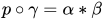

![{\displaystyle v([\alpha ]*[\beta ])=v([\alpha *\beta ])=\gamma (1)={\overline {\alpha }}(1)+{\overline {\beta }}(1)=v([\alpha ])+v([\beta ])}](https://wikimedia.org/api/rest_v1/media/math/render/svg/c22ac43f463dc27d46a3ba61090ff386af061029)
We can note that all the loops are homotopic to for some , or either, all the loops, up to homotopy, consist of giving a certain number of turns.
We can think this demonstration through the following scheme:

Covering spaces and the fundamental group
[edit | edit source]One of the most useful tools in studying fundamental groups is that of a covering space. Intuitively speaking, a covering space of a given space is one which 'looks like' a disjoint union of copies of in a small enough neighborhood of any point of , but not necessarily globally.
This section will define covering spaces formally, state important lifting theorems for covering spaces, and then show what the consequences are for fundamental groups.
Definition: Suppose is a topological space. A space is called a covering space for if we are given a continuous map with the following property: for any , there exists an open neighborhood such that


(i) is a disjoint union of open subsets of ;


(ii) the restriction of to any of these open subsets is a homeomorphism from to U.

Unsurprisingly, we call a covering map.
Example: In fact, we've already seen an example of a covering space. In the calculation of above, we implicitly made us of the fact that the real line is a covering space for . The map is the covering map. How can we check this? Well, recall that iff the difference is an integer. So, suppose we're given a point . Let - that is, the set consisting of the whole circle except for the point antipodal to . Then a little thought shows that if , we have . In other words, the preimage of consists of the whole real line except for a 'hole' at each point .









It's clear (draw a picture!) that this set is a disjoint union of subintervals, and one can check that the exponential function maps each subinterval homeomorphically onto . So we do have a covering map. Neat!


Homotopy Lifting
[edit | edit source]Now we come to a theorem which looks a bit esoteric at first, but in fact allows us to do much with covering spaces.
Theorem (Homotopy Lifting): Suppose is a covering map for a space . Let be a map from the unit -cube to , and a homotopy of to another map . Suppose (for the last time!) that is a map satisfying . Then there exists a unique map satisfying the following:






(i) ;

(ii).

The proof is quite technical, but straightforward, and so is omitted. Any introductory book on algebraic topology should give it --- see, for example, Armstrong, "Basic Topology" (Springer).
At first sight this is pretty daunting, so let's take a concrete case to make it easier to digest. Suppose --- then is just a point, and hence is just a function selecting a particular point of . Hence can be identified with its image, a point . Now a homotopy from to another map is (recalling the definition of homotopy) just a map such that ; hence, nothing more than a path in starting at . What does the theorem tell us about covering maps ?


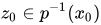
It says (check it!) that if is a point such that , and is a path in starting at , then there is a unique path in starting at such that . In fancier (and looser) terminology, we say that a path in has a unique lift to , once the starting point of the lift has been chosen.


On reflection, this result --- sometimes known as the path lifting theorem --- is not so surprising. Think about a covering space as a 'folded-over' version of the base space , as in Fig XXXX. If we look at a small open set , its preimage in is a disjoint union of open sets each homeomorphic to it. If we just concentrate on the portion of lying inside for now, it's clear that for each of the disjoint sets , there is a unique path in which maps onto via the covering map . So to specify a lift, we simply need to choose which of the sets it lives in (and this is equivalent to choosing a point in the preimage of as above). Now the whole path can be split up as a finite 'chain' of short paths living inside 'small' open sets like (check this!), so finite induction shows that the whole lift is uniquely determined in this way.

Covering Spaces and
[edit | edit source]
Now we come to the connection between covering spaces and the fundamental group, which is of major significance.
Theorem: Given a covering space , the map induces a map which is an injective (i.e. 1-1) group homomorphism.

Proof (Sketch): First, consider a path in : it's a continuous map , and so we can compose it with the covering map to get a path in . So we have a map


We want to show this can be used to define a map


This sounds complicated, but in fact isn't at all: the idea is, given a homotopy between two paths and in , the composition is a homotopy in between their images and . (If this still seems opaque, be sure to check the details.) Also, loops based at clearly map to loops based at .



So, we have our map as desired, mapping to We still need to show (a) that it's a group homomorphism, and (b) that it's injective.


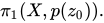
(a) is pretty easy. To prove it, choose two elements of . These are homotopy classes of based loops, so we can choose loops to represent them. What we need to see is that if we concatenate these loops, and then look at the image of this concatenation in , the result is homotopic to the loop we get if we first map each of the loops via and then concatenate them. Convince yourself that this is so.

(b) is more tricky. To prove it, we must show that the kernel of the homomorphism described above consists just of the identity element of . So, suppose we have a path representing an element in the kernel: so is the identity of . By definition of , this means that is homotopic in to the constant path at . So suppose is such a homotopy: the trick is to use the homotopy lifting theorem (above) to 'lift' to , a homotopy in from to the constant path at . (Again, one should check the details of this!) Since such a homotopy exists, this shows that the homotopy class is the identity element of . So the only element in the kernel of is the identity element of , so is injective, as required.

![{\displaystyle [\gamma ]}](https://wikimedia.org/api/rest_v1/media/math/render/svg/7b30910bca19778c71191d14f63ef6517dd9c04a)
![{\displaystyle p*([\gamma ])}](https://wikimedia.org/api/rest_v1/media/math/render/svg/be4c2bc7d1bfd4bac68c385d4e20f28a0c36397f)


Let's think about the significance of this result for a moment. An injective homomorphism of groups is essentially the same as a subgroup , so the first thing the theorem tells us is that there's a significant restriction on possible covering spaces for a given space : can't be a covering space for unless is a subgroup of . Right off the bat, this rules out whole classes of maps from being covering maps. There's no covering map from the circle to the real line , for example, since the fundamental group of the circle is isomorphic to the integers, as we saw above, while that of the real line is trivial (why?). Similarly, there's no covering map from the torus to the two-dimensional sphere --- the latter has trivial fundamental group, while that of the former is (the direct sum of two copies of the integers). And so on, ad infinitum.


This latter example is particularly nice, I think, in that it shows how looking at algebraic invariants of spaces (in this case, fundamental groups), rather than our geometric 'mental picture' of the spaces themselves, vastly simplifies arguments about the existence or form of particular kinds of maps between spaces. Can you give me a simple geometric argument to show that there's no possible way to 'wrap' around the torus so that every point is covered an equal number of times? Can you do the same for the three-dimensional sphere ? For ? (If so, I humbly salute you.)


Example: Now let's look at a specific covering space, and see what the homomorphism we talked about above actually is in a concrete case. Think about the circle as the unit circle in the complex plane: . Then we can define a continuous map by .



I claim that is a covering map. To see this, imagine a point of (with ). It isn't hard to see that there are exactly two points such that p(z') = z; moreover, if we look at a 'small enough' circular arc around , its preimage under will consist of two disjoint circular arcs, each containing one of the two preimages of , and each mapped homeomorphically onto our original arc by . (Check these details!)


So, is a covering map, and so the above theorem tells us that is a group homomorphism from the fundamental group of the circle to itself. In symbols, we have . But what is it? To answer this, consider a path in that winds once around the origin. As we saw in the previous section, the equivalence class of such a path is mapped to the element under the isomorphism . Now, to work out , we look at the equivalence class of the path in (this is just the defintion of ). It's easy to check (do it!) that is a path is winding twice around the origin, and so its equivalence class is . So we have . Looking at as the group of integers, we have . So is just the doubling map!


![{\displaystyle p*[\gamma ]}](https://wikimedia.org/api/rest_v1/media/math/render/svg/1e03157be081a0412159db2363d9c79b59af13a6)
![{\displaystyle [\gamma ]*[\gamma ]}](https://wikimedia.org/api/rest_v1/media/math/render/svg/0374cfb757cec8928720bfed1c9081be2b418cc9)
![{\displaystyle p*([\gamma ])=[\gamma ]*[\gamma ]}](https://wikimedia.org/api/rest_v1/media/math/render/svg/864602d3cb49c3267a5713dee787077ff41fe80a)

Of course, it's all well and good introducing new concepts like covering spaces, but this doesn't achieve a lot unless our new concepts prove useful in some way. Covering spaces have indeed proved useful in many ways, but hopefully the following example will suffice to illustrate this point:
Theorem (Nielsen-Schreier): Any subgroup of a free group is free.
Proof (Sketch): Consult Wikipedia for a rigorous definition of 'free group': roughly speaking, it is a group in which no non-trivial combination of elements equals the identity. Now, the strategy of proof is along the following lines:
1) Given a free group , find a graph with . (Note that a graph is a topological space consisting of a discrete set of points to which are attached a family of line segments. Again see Wikipedia for a rigorous definition.)

2) Show that for a space and a subgroup , there exists a covering space for with .


3) Show that any covering space for a graph is itself a graph.
4) Show that the fundamental group of a graph is a free group.
The Fundamental Theorem of Algebra
[edit | edit source]Theorem: Let f be a non-constant polynomial with coefficients in the complex numbers . Then there exists a root of that polynomial in . Phrased in the language of algebra, the set of complex numbers are algebraically closed.

Proof
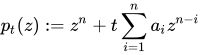
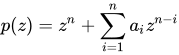
[edit | edit source]Suppose that has no roots in . Without loss of generality, we may assume is monic (if not, then make an appropriate change of variables), and thus we write . Given with no roots, define a function by It is readily checked that is a well defined loop in for all choices of . Given any , we may construct a path homotopy from to by . But is the constant loop at , so is null-homotopic for all .
![{\displaystyle p\in \mathbb {C} [z]}](https://wikimedia.org/api/rest_v1/media/math/render/svg/19521abd297a266350a5790c28dd8f1b107b57a9)
![{\displaystyle q\in \mathbb {C} [z]}](https://wikimedia.org/api/rest_v1/media/math/render/svg/cd71100a0572964ffd88f84b7d601bb212e63542)










We now show that, for a particular choice of , that is homotopic to the loop , , where is the degree of . Since is a generator for , is path homotopic to , and we already know that is null-homotopic, this will imply that , and thus that is a constant polynomial.




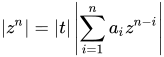
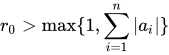
To this end, fix , and let be the circle in the complex plane of radius . For all and all , we have


![{\displaystyle t\in [0,1]}](https://wikimedia.org/api/rest_v1/media/math/render/svg/31a5c18739ff04858eecc8fec2f53912c348e0e5)
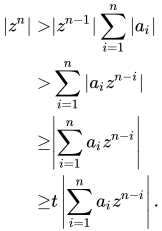
This implies that for all , the polynomial has no roots on , for if it did, this would imply that , contrary to the above (strict) inequality. Now define by . It is easy to check that is a path homotopy from to , which we have shown is null-homotopic. Thus , and the proof is complete.