A topological space  is said to be path connected if for any two points
  there exists a continuous function
 ![{\displaystyle f:[0,1]\to X}](https://wikimedia.org/api/rest_v1/media/math/render/svg/ebe010ee7ddd6d0aeff0b2b0fc720cb06cdb7c99) such that
such that  and
and 
- All convex sets in a vector space are connected because one could just use the segment connecting them, which is
 .
.
- The unit square defined by the vertices
![{\displaystyle [0,0],[1,0],[0,1],[1,1]}](https://wikimedia.org/api/rest_v1/media/math/render/svg/1acf5af000f66081e5db5a01da28537b0f0a1660) is path connected. Given two points
is path connected. Given two points ![{\displaystyle (a_{0},b_{0}),(a_{1},b_{1})\in [0,1]\times [0,1]}](https://wikimedia.org/api/rest_v1/media/math/render/svg/d7f77a93ac01237e98758f732c71eb1bab8e3d31) the points are connected by the function
the points are connected by the function ![{\displaystyle f(t)=[(1-t)a_{0}+ta_{1},(1-t)b_{0}+tb_{1}]}](https://wikimedia.org/api/rest_v1/media/math/render/svg/6dd3ff1dce73de7143949d9b8faaf5d11fe956c3) for
for ![{\displaystyle t\in [0,1]}](https://wikimedia.org/api/rest_v1/media/math/render/svg/31a5c18739ff04858eecc8fec2f53912c348e0e5) .
.
The preceding example works in any convex space (it is in fact almost the definition of a convex space).
Let be a topological space and let  . Consider two continuous functions
 ![{\displaystyle f_{1},f_{2}:[0,1]\to X}](https://wikimedia.org/api/rest_v1/media/math/render/svg/436147557cf1f48f8437ff37d6685c2f612db571) such that
such that  ,
,  and
and  . Then the function defined by
![{\displaystyle f(x)=\left\{{\begin{array}{ll}f_{1}(2x)&{\text{if }}x\in [0,{\frac {1}{2}}]\\f_{2}(2x-1)&{\text{if }}x\in [{\frac {1}{2}},1]\\\end{array}}\right.}](https://wikimedia.org/api/rest_v1/media/math/render/svg/d163f802afee98a85ffcace177248deb35c27362)
Is a continuous path from  to
to  . Thus, a path from to
  and a path from to can be adjoined together to form a path from to .
Each path connected space is also connected. This can be seen as follows:
Assume that is not connected. Then is the disjoint union of two open sets  and
and  . Let
. Let  and
and  . Then there is a path
  from to , i.e.,
 ![{\displaystyle f:[0,1]\rightarrow X}](https://wikimedia.org/api/rest_v1/media/math/render/svg/677831b64964eb40a19d3dbf3f350c4110708fde) is a continuous function with
is a continuous function with  and
and  . But then
  and
and  are disjoint open sets in
 ![{\displaystyle [0,1]}](https://wikimedia.org/api/rest_v1/media/math/render/svg/738f7d23bb2d9642bab520020873cccbef49768d) , covering the unit interval. This contradicts the fact that the unit interval is connected.
, covering the unit interval. This contradicts the fact that the unit interval is connected.
- Prove that the set
 , where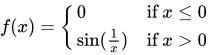
is connected but not path connected.