Free monoid spanned by a set[edit | edit source]
Let  be a vector space and
  be a basis of . Given any vector space
  and any elements
  , there is a linear transformation
  such that
  . One could say that this happens because the elements of a basis are not "related" to each other (formally, they are linearly independent). Indeed, if, for example, we had the relation
  for some scalar
  (and then wasn't linearly independent), then the linear transformation
  could not exist.
Let us consider a similar problem with groups: given a group  spanned by a set
  and given any group
  and any set
  , does there always exist a group morphism
  such that
  ? The answer is no. For example, consider the group
  which is spanned by the set
  , the group
  (with the adition operation) and the set
  . If there exists a group morphism
  such that
  , then
  , which is impossible. But if instead we had choose
  , then such a group morphism does exist and it would be given by
  . Indeed, given any group and any
  , we have the group morphism
  defined by
  (in multiplicative notation) that verifies
  . In a way, we can think that this happens because the elements of the set
 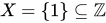 (that spans
  ) don't verify relations like
  (like
(like  ) or
) or  . So, it seems that is a group more "free" that .
Our goal in this section will be, given a set  , build a group spanned by the set such that it will be the most "free" possible, in the sense that it doesn't have to obey relations like
  or . To do so, we begin by constructing a "free" monoid (in the same sense). Informally, this monoid will be the monoid of the words written with the letters of the alphabet , where the identity will be the word with no letters (the "empty word"), and the binary operation of the monoid will be concatenation of words. The notation
  that we will use for the element of this monoid meets this idea that the elements of this monoid are the words where
  are letters of the alphabet . Here is the definition of this monoid.
Definition Let be a set.
- We denote the
 -tuples
  with
with  and
and  by .
by .
- We denote
 , that is with
  , by
, by  .
.
- We denote by
 the set
  .
.
- We define in the concatenation operation
 by
by  .
.
Next we prove that this monoid is indeed a monoid. It's an easy to prove result, we need to show associativity of and that  .
.
Proposition  is a monoid with identity .
Proof The operation is associative because, given any  , we have




 .
.
It's obvious that has the identity as  by the definition of and .
Following the idea that the monoid is the most "free" monoid spanned by , we will call it the free monoid spanned by .
Definition Let be a set. We denote the free monoid spanned by by .
Examples
- Let
 . Then
  and, for example,
  .
.
- Let
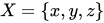 . Then
  and, for example,
  .
.
Free group spanned by a set[edit | edit source]
Now let us construct the more "free" group spanned by a set . Informally, what we will do is insert in the monoid the inverse elements that are missing in it for it to be a group. In a more precise way, we will have a set  equipotent to , choose a bijection from to and in this way achieve a "association" between the elements of and the elements of . Then we face
  (with
(with  ) as having the inverse element
  (with
(with  ), where is is associated with
  , respectively. Let us note that the order of the elements in is "reversed" because the inverse of the product
  must be
 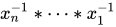 , and the
 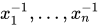 are, respectively,
  . The way we do that be the inverse of is to take a congruence relation
  that identifies
  with , and pass to the quotient
 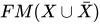 by this relation (defining then, in a natural way, the binary operation of the group,
 ![{\displaystyle [u]_{R}\star [v]_{R}=[u*v]_{R}}](https://wikimedia.org/api/rest_v1/media/math/render/svg/4d632c9ff907b398b550c033ea228642585aea6c) ). By taking the quotient, we are formalizing the intuitive idea of identifying with , because in the quotient we have the equality
). By taking the quotient, we are formalizing the intuitive idea of identifying with , because in the quotient we have the equality ![{\displaystyle [x_{1}\ldots x_{n}{\overline {x_{n}}}\ldots {\overline {x_{1}}}]_{R}=[1]_{R}}](https://wikimedia.org/api/rest_v1/media/math/render/svg/90c07e85ba19833f94a1cd2467b4e9b201cf0246) . Let us give the formal definition.
. Let us give the formal definition.
Definition Let be a set. Let us take another set  equipotent to and disjoint from and let
  be a bijective application.
- For each
 let us denote
  by
by  , for each
  let us denote
  by and for each
  let us denote by
  .
.
- Let be the congruence relation of
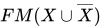 spanned by
  , this is, is the intersection of all the congruence relations in wich have as a subset. We denote the quotient set
 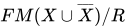 by
by  .
.
Frequently, abusing the notation, we represent an element ![{\displaystyle [u]_{R}\in FG(X)}](https://wikimedia.org/api/rest_v1/media/math/render/svg/73bf850804ca9937edea1bf3e06769fc872e915c) simply by
simply by  .
.
Because the operation that we want to define in  is defined using particular represententes and
  of the equivalence classes
 ![{\displaystyle [u]_{R}}](https://wikimedia.org/api/rest_v1/media/math/render/svg/33b263db5ab34e40b59b283d6f7e072849380f8b) and
and ![{\displaystyle [v]_{R}}](https://wikimedia.org/api/rest_v1/media/math/render/svg/da4ac533bca59d34c6b3c47d6d1fe23f2ac5d2f8) , a first precaution is to verify that the definition does not depend on the chosen representatives. It's an easy verification.
, a first precaution is to verify that the definition does not depend on the chosen representatives. It's an easy verification.
Lemma Let be a set. It is well defined in the binary operation  by
by ![{\displaystyle [u]_{R}\star [v]_{R}=[u_{r}*v_{r}]_{R}}](https://wikimedia.org/api/rest_v1/media/math/render/svg/dc7d9fdd0f3da83c58199a37e5c18a6c252d1b4c) (where is the congruence relation of the previous definition).
(where is the congruence relation of the previous definition).
Proof Let  be any elements such that
 ![{\displaystyle [u]_{R}=[u']_{R}}](https://wikimedia.org/api/rest_v1/media/math/render/svg/ccebb09df6580207be56cec21b71ef2bbeced5d6) and
and ![{\displaystyle [v]_{R}=[v']_{R}}](https://wikimedia.org/api/rest_v1/media/math/render/svg/25cde63db3e570158dfc8325c402123f6829efd7) , this is,
, this is,  and
and  . Because is a congruence relation in , we have
  , this is,
 ![{\displaystyle [u*v]_{R}=[u'*v']_{R}}](https://wikimedia.org/api/rest_v1/media/math/render/svg/6c559f24c935cb00935bff5cd8568dfd3c58b974) .
.
Because the definition is valid, we present it.
Definition Let be a set. We define in the binary operation by .
Finally, we verify that the group that we constructed is indeed a group.
Proposition Let be a set.  is a group with identity
 ![{\displaystyle [1]_{R}}](https://wikimedia.org/api/rest_v1/media/math/render/svg/a06d9b191018f286aad31792f9a4a5cf1804d557) and where
and where ![{\displaystyle \forall [u]_{R}\in FG(X),\,{[u]_{R}}^{-1}=[{\bar {u}}]_{R}}](https://wikimedia.org/api/rest_v1/media/math/render/svg/053bb651f40bf596a81026fea36dff8f946a87bb) .
.
Proof
- is associative because
![{\displaystyle \forall [u]_{R},[v]_{R},[w]_{R}\in FG(X),\,([u]_{R}\star [v]_{R})\star [w]_{R}=([u*v]_{R})\star [w]_{R}=[([u]_{R}*[v]_{R})*w]_{R}=}](https://wikimedia.org/api/rest_v1/media/math/render/svg/b2c08c8284cd00841712a1cbe101ac7029e65857)
![{\displaystyle [u*(v*w)]_{R}=[u]_{R}\star [v*w]_{R}=[u]_{R}\star ([v]_{R}\star [w]_{R}).}](https://wikimedia.org/api/rest_v1/media/math/render/svg/8193a689a48d5116f2ecab4326e82f68c1570270)
- Let us see that is the identity . Let be any element. We have
![{\displaystyle [u]_{R}\star [1]_{R}=[u*1]_{R}=[u]_{R}}](https://wikimedia.org/api/rest_v1/media/math/render/svg/f68ce9c38f86a4037c2a7e115c49354da8763255) and, in the same way,
and, in the same way, ![{\displaystyle [1]_{R}\star [u]_{R}=[u]_{R}}](https://wikimedia.org/api/rest_v1/media/math/render/svg/84e351285f120b70401b0b06c0596ca2bf0d5558) .
.
- Let be any element and let us see that
![{\displaystyle [u]_{R}\star [{\bar {u}}]_{R}=[1]_{R}}](https://wikimedia.org/api/rest_v1/media/math/render/svg/ab0dd927db8366ae11179db2ee95d1d6e9edba5f) . We have
. We have ![{\displaystyle [u]_{R}\star [{\bar {u}}]_{R}=[u*{\bar {u}}]_{R}}](https://wikimedia.org/api/rest_v1/media/math/render/svg/a7a17a78171e837ce08369cf60742c4d47d58016) and, by definition of ,
and, by definition of ,  , this is,
 ![{\displaystyle [u*{\bar {u}}]_{R}=[1]_{R}}](https://wikimedia.org/api/rest_v1/media/math/render/svg/7776eeef98a1c07f6b631f8b4edd07eaecebcd20) , therefore and, in the same way,
, therefore and, in the same way, ![{\displaystyle [{\bar {u}}]_{R}\star [u]_{R}=[1]_{R}}](https://wikimedia.org/api/rest_v1/media/math/render/svg/3aff4a6482b287c2fe548e9d3ab65067b20e016e) .
.
In the same way that we did with the free monoid, we will call free group spanned by the set to the more "free" group spanned by this set.
Definition Let be a set. We call free group spanned by to .
Example Let . Let us choose any set  disjoint (and equipotent) of . Let
  be any (in fact, the only) bijective application of in . Then we denote
  by and we denote
  by
by  . We regard
  and
and  as inverse elements. Let be the congruence relation of spanned by
  .
.  is the set of all "words" written in the alphabet
 ![{\displaystyle \{[x]_{R},[{\bar {x}}]_{R}\}}](https://wikimedia.org/api/rest_v1/media/math/render/svg/2f91adc97be9c5c626f2840bb4460cb296478ffe) . For example,
. For example, ![{\displaystyle [1]_{R},[x]_{R},[{\bar {x}}]_{R},[xx{\bar {x}}xx]_{R}\in FG(X)}](https://wikimedia.org/api/rest_v1/media/math/render/svg/7b6cb5f906ecabf3902054ef76de8c9baa8c6142) .
.
We have  and, for example,
 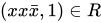 , because
  (therefore
  ) and because is a congruence relation, we can "multiply" both "members" of the relation by and obtain
  . We see as meaning that in We have
  (more precisely,
 ![{\displaystyle [xx{\bar {x}}]_{R}=[x]_{R}}](https://wikimedia.org/api/rest_v1/media/math/render/svg/a7e082781b1d39d4b736e06e3ffdbd69db9db934) ), and we think in this equality as being the result of one "cut out" with in
), and we think in this equality as being the result of one "cut out" with in  .
.
Given  , let us denote the exact number of times that the "letter" appears in by
  and let us denote the exact number of times the "letter" appears in by
  . Then "cutting" 's with 's it remains a reduced word word with
  times the letter (if
 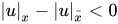 , let us us consider that there aren't any letters and remains
 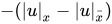 times the letter ). Let us denote by
  . We have
![{\displaystyle [u]_{R}=[v]_{R}}](https://wikimedia.org/api/rest_v1/media/math/render/svg/b7900da62c4620b31e928170c794217d90940b6d) if and only if
if and only if 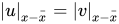 and
and![{\displaystyle \forall [u]_{R},[v]_{R}\in FG(X),\,|uv|_{x-{\bar {x}}}=|u|_{x-{\bar {x}}}+|v|_{x-{\bar {x}}}}](https://wikimedia.org/api/rest_v1/media/math/render/svg/d0cfcd150b0a5b2a8492db815b66068c5d369296) .
.
In this way, each element is determined by the integer number and the product of two elements ![{\displaystyle [u]_{R},[v]_{R}\in FG(X)}](https://wikimedia.org/api/rest_v1/media/math/render/svg/1ea50bf722bc397d3da2b3f5535c164b73e609cc) correspondent to the sum of they associated integers numbers and
correspondent to the sum of they associated integers numbers and  . Therefore, it seems that the group is "similar" to
  . indeed is isomorph to and the application
  is a group isomorphism.
Informally, it seems that is obtained from the "free" group imposing the relation . Let us try formalize this idea. We start with a set that spans a group that que want to create and a set of relations (such as or  ) that the elements of must verify and we obtain a group
  spanned by and that verify the relations of . More precisely, we write each relation
  in the form
  (for example, is written in the form
 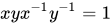 ) and we see each
  as a "word" of . Because doesn't have to be a normal subgroup of , we can not consider the quotient
  , so we consider the quotient
  where
where  is the normal subgroup of spanned by . In
  , we will have
 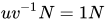 , which we see as meaning that in the elements and are the same. In this way, will verify all the relations that we want and will be spanned by (more precisely, by
 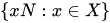 ). Let us formalize this idea.
Definition Let be a group. We call presentation of , and denote by  , to a ordered pair
  where is a set,
  and
and  , where is the normal subgroup of spanned by . Given a presentation , we call spanning set to and set of relations to .
Let us see some examples of presentations of the free group and the groups ,  ,
,  and
and  . We also use the examples to present some common notation and to show that a presentation of a group does not need to be unique.
Examples
- Let be a set.
 is a presentation of because
  , where
  is the normal subgroup of spanned by
  . In particular,
  is a presentation of
  , more commonly denoted by
  . Another presentation of is
  , more commonly denoted by
  . Informally, in the presentation we insert a new element in the spanning set, but we impose the relation
  , this is,
  , which is the same as having not introduced the element and have stayed by the presentation .
- Let .
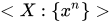 (where
  times) is a presentation of . Indeed, the subgroup of spanned by
  is
is  and
and  , therefore
 . Is more common to denote
  by
by  .
.
- Let
 (with and distinct) and
  . is a presentation of . Informally, what we do is impose comutatibility in , this is, , this is, , obtaining a group isomorph to . It's more usually denote
  by
by  .
.
- Let and
 .
.  is a presentation of
  . Informally, what we do is impose commutability in the same way as in the previous example, and we impose
  and to obtain instead . It's more common denote
 by
by  .
.
 , more commonly written
  , is a presentation of , the group of the permutations of
  with the composition of applications. To verify this, one can verify that any group with presentation as exactly six elements
  ,
,  ,
,  ,
,  , ,
, ,  and
and  , and that the multiplication of this elements results in the following Cayley table that is equal to the Cayley table of . Just to give an idea how this can be achieved, a group with presentation as exactly the elements , , , , , and because none of this elements are the same (the relations
  don't allow us to conclude that two of the elements are equal) and because "another" elements like
  are actually one of the previous elements (for example, from
  we have
  , and taking inverses of both members, we have
  , which, using
  , this is,
  ,
,  and
and  , results in
  ). Then, using the relations of the presentation, one can compute the Cayley table. For example,
  because we have the relation
  . Another example: we have
  because we can multiply both members of the relation
  by and then use
  . One could have suspected of this presentation by taking
  ,
,  and
and  and then, trying to construct the Cayley table of , found out that it was possible if one know that .
 |
|
|
|
|
|
|
|
|
|
|
|
|
|
|
|
|
|
|
|
|
|
|
|
|
|
|
|
|
|
|
|
|
|
|
|
|
|
|
|
|
|
|
|
|
|
|
|
|
|
|
|
|
|
|
It's natural to ask if all groups have a presentation. The following theorem tell us that the answer is yes, and it give us a presentation.
Theorem Let  be a group.
- The application
 defined by
 ![{\displaystyle \varphi ([x_{1}]_{R}\star \cdots \star [x_{n}]_{R})=x_{1}\times \cdots \times x_{n}}](https://wikimedia.org/api/rest_v1/media/math/render/svg/4ed9c5085088ffa3d5f2110233ba0ce309f89cac) (where
(where  ) is an epimorphism of groups.
 is a presentation of .
Proof
- is well defined because every element of as a unique representations in the form
![{\displaystyle [x_{n}]\star \cdots [x_{n}]_{R}}](https://wikimedia.org/api/rest_v1/media/math/render/svg/81fde3eaa52c41b6365eba867f9484b7e6b495c2) with , with the exception of appears several times in the representation, but that doesn't affect the value of
with , with the exception of appears several times in the representation, but that doesn't affect the value of  Let
Let ![{\displaystyle [x_{1}]_{R}\star \cdots \star [x_{m}]_{R},[y_{1}]_{R}\star \cdots \star [y_{n}]_{R}\in FG(X)}](https://wikimedia.org/api/rest_v1/media/math/render/svg/763bd793145467c0f69d08b0d6ad478c7f00e5ee) be any elements, where
be any elements, where  . We have
 ![{\displaystyle \varphi (([x_{1}]_{R}\star \cdots \star [x_{m}]_{R})\star ([y_{1}]_{R}\star \cdots \star [y_{n}]_{R}))=(x_{1}\times \cdots \times x_{m})\times (y_{1}\times \cdots \times y_{n})=}](https://wikimedia.org/api/rest_v1/media/math/render/svg/28c84f8b0786302a3fd1275d778df5b31f1d23a7)
![{\displaystyle \varphi ([x_{1}]_{R}\star \cdots \star [x_{m}]_{R})\times \varphi ([y_{1}]_{R}\star \cdots \star [y_{n}]_{R})}](https://wikimedia.org/api/rest_v1/media/math/render/svg/f431dfd98c2b5c480b07d58b3cfd357ade937662) , therefore is a morphism of groups. Because
, therefore is a morphism of groups. Because ![{\displaystyle \forall x\in G,\,\varphi ([x]_{R})=x}](https://wikimedia.org/api/rest_v1/media/math/render/svg/63f676bf2774d7f62b0478b8e4c1c5039ee9735a) , then is a epimorphism of groups.
, then is a epimorphism of groups.
- Using the first isomorphism theorem (for groups), we have
 , therefore is a presentation of .
The previous theorem, despite giving us a presentations of the group , doesn't give us a "good" presentation, because the spanning set is usually much larger that other spanning sets, and the set of relations  is also usually much larger then other sufficient sets of relations (it is even a normal subgroup of
  , when it would be enough that it span an appropriated normal subgroup).