In the same year that Erwin Schrödinger published the equation that now bears his name, the nonrelativistic theory was completed by Max Born's insight that the Schrödinger wave function  is actually nothing but a tool for calculating probabilities, and that the probability of detecting a particle "described by" in a region of space
  is given by the volume integral

— provided that the appropriate measurement is made, in this case a test for the particle's presence in . Since the probability of finding the particle somewhere (no matter where) has to be 1, only a square integrable function can "describe" a particle. This rules out  which is not square integrable. In other words, no particle can have a momentum so sharp as to be given by
  times a wave vector
  , rather than by a genuine probability distribution over different momenta.
Given a probability density function  , we can define the expected value

and the standard deviation 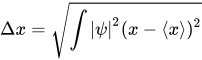
as well as higher moments of . By the same token,
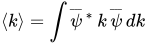 and
and 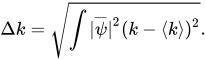
Here is another expression for 

To check that the two expressions are in fact equal, we plug  into the latter expression:

Next we replace  by
by 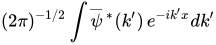 and shuffle the integrals with the mathematical nonchalance that is common in physics:
![{\displaystyle \langle k\rangle =\int \!\int {\overline {\psi }}\,^{*}(k')\,k\,{\overline {\psi }}(k)\left[{\frac {1}{2\pi }}\int e^{i(k-k')x}dx\right]dk\,dk'.}](https://wikimedia.org/api/rest_v1/media/math/render/svg/eeb26219d324cc48516a301db11ad6b4a291924a)
The expression in square brackets is a representation of Dirac's delta distribution  the defining characteristic of which is
 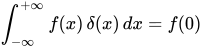 for any continuous function
  (In case you didn't notice, this proves what was to be proved.)
In the same annus mirabilis of quantum mechanics, 1926, Werner Heisenberg proved the so-called "uncertainty" relation
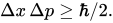
Heisenberg spoke of Unschärfe, the literal translation of which is "fuzziness" rather than "uncertainty". Since the relation 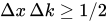 is a consequence of the fact that
  and
and  are related to each other via a Fourier transformation, we leave the proof to the mathematicians. The fuzziness relation for position and momentum follows via
  . It says that the fuzziness of a position (as measured by
  ) and the fuzziness of the corresponding momentum (as measured by
  ) must be such that their product equals at least