We want to express the coordinates  and
and  of an inertial frame
  in terms of the coordinates
  and
and 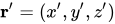 of another inertial frame
  We will assume that the two frames meet the following conditions:
- their spacetime coordinate origins coincide (
 mark the same spacetime location as
  ),
),
- their space axes are parallel, and
 moves with a constant velocity
  relative to
What we know at this point is that whatever moves with a constant velocity in will do so in It follows that the transformation  maps straight lines in onto straight lines in Coordinate lines of
  in particular, will be mapped onto straight lines in This tells us that the dashed coordinates are linear combinations of the undashed ones,

We also know that the transformation from to can only depend on  so
so 

 and
and  are functions of
  Our task is to find these functions. The real-valued functions
  and
and  actually can depend only on
  so
so  and
and  A vector function depending only on must be parallel (or antiparallel) to and its magnitude must be a function of
  We can therefore write
![{\displaystyle \mathbf {D} =[d(w)/w^{2}]\mathbf {w} ,}](https://wikimedia.org/api/rest_v1/media/math/render/svg/fa802a1058978d8935aaa7cad208a913134cf22b) and
and  (It will become clear in a moment why the factor
  is included in the definition of
  ) So,
) So,

Let's set  equal to
  This implies that
  As we are looking at the trajectory of an object at rest in
 must be constant. Hence,

Let's write down the inverse transformation. Since moves with velocity  relative to it is

To make life easier for us, we now chose the space axes so that  Then the above two (mutually inverse) transformations simplify to


Plugging the first transformation into the second, we obtain


-



The first of these equations tells us that
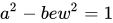 and
and 
The second tells us that
 and
and 
Combining  with
with  (and taking into account that
  ), we obtain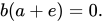
Using to eliminate  we obtain
 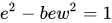 and
and 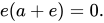
Since the first of the last two equations implies that  we gather from the second that
 tells us that
 must, in fact, be equal to 1, since we have assumed that the space axes of the two frames a parallel (rather than antiparallel).
With  and
and  yields
  Upon solving for
  we are left with expressions for
  and
and  depending solely on
  :
:

Quite an improvement!
To find the remaining function  we consider a third inertial frame
  which moves with velocity
  relative to Combining the transformation from to

with the transformation from to

we obtain the transformation from to  :
:
![{\displaystyle t''=a(v)\left[a(w)\,t+{1-a^{2}(w) \over a(w)\,w}x\right]+{1-a^{2}(v) \over a(v)\,v}{\Bigl [}a(w)\,x-a(w)\,wt{\Bigr ]}}](https://wikimedia.org/api/rest_v1/media/math/render/svg/aac5ef850e58cf4313f158ff823495cfda63278d)
-
![{\displaystyle =\underbrace {\left[a(v)\,a(w)-{1-a^{2}(v) \over a(v)\,v}a(w)\,w\right]} _{\textstyle \star }t+{\Bigl [}\dots {\Bigr ]}\,x,}](https://wikimedia.org/api/rest_v1/media/math/render/svg/f598d3a652be5ce24fbf91ac01439a8d4772177d)
![{\displaystyle x''=a(v){\Bigl [}a(w)\,x-a(w)\,wt{\Bigr ]}-a(v)\,v\left[a(w)\,t+{1-a^{2}(w) \over a(w)\,w}x\right]}](https://wikimedia.org/api/rest_v1/media/math/render/svg/7d163387fa694115abbe60fb231559ed50fe5046)
-
![{\displaystyle =\underbrace {\left[a(v)\,a(w)-a(v)\,v{1-a^{2}(w) \over a(w)\,w}\right]} _{\textstyle \star \,\star }x-{\Bigl [}\dots {\Bigr ]}\,t.}](https://wikimedia.org/api/rest_v1/media/math/render/svg/ae3bd80d12d1822ff47c0e945207167ce442828d)
The direct transformation from to must have the same form as the transformations from to and from to , namely

where  is the speed of relative to Comparison of the coefficients marked with stars yields two expressions for
  which of course must be equal:

It follows that ![{\displaystyle {\bigl [}1-a^{2}(v){\bigr ]}\,a^{2}(w)w^{2}={\bigl [}1-a^{2}(w){\bigr ]}\,a^{2}(v)v^{2},}](https://wikimedia.org/api/rest_v1/media/math/render/svg/0284ddcbcc0b4d7c8d9e3d041abb9cec2496672a) and this tells us that
and this tells us that
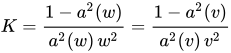
is a universal constant. Solving the first equality for we obtain

This allows us to cast the transformation
into the form

Trumpets, please! We have managed to reduce five unknown functions to a single constant.


