Another method by which we can obtain a well-defined, finite number from infinitesimal quantities is to divide one such quantity by another.
We shall assume throughout that we are dealing with well-behaved functions, which means that you can plot the graph of such a function without lifting up your pencil, and you can do the same with each of the function's derivatives. So what is a function, and what is the derivative of a function?
A function  is a machine with an input and an output. Insert a number
  and out pops the number
  Rather confusingly, we sometimes think of not as a machine that churns out numbers but as the number churned out when is inserted.

The (first) derivative  of is a function that tells us how much increases as increases (starting from a given value of
  say
say  ) in the limit in which both the increase
  in and the corresponding increase
  in (which of course may be negative) tend toward 0:

The above diagrams illustrate this limit. The ratio  is the slope of the straight line through the black circles (that is, the
  of the angle between the positive axis and the straight line, measured counterclockwise from the positive axis). As decreases, the black circle at
  slides along the graph of towards the black circle at and the slope of the straight line through the circles increases. In the limit
  the straight line becomes a tangent on the graph of
  touching it at
  The slope of the tangent on at is what we mean by the slope of at
So the first derivative of is the function that equals the slope of for every To differentiate a function  is to obtain its first derivative
  By differentiating
  we obtain the second derivative
  of
of  by differentiating
  we obtain the third derivative
  and so on.
It is readily shown that if  is a number and and
  are functions of then
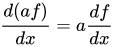 and
and 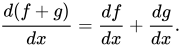
A slightly more difficult problem is to differentiate the product  of two functions of Think of and as the vertical and horizontal sides of a rectangle of area
  As increases by
  the product
  increases by the sum of the areas of the three white rectangles in this diagram:
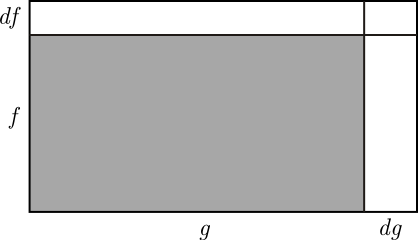
In other "words",

and thus

If we now take the limit in which and, hence,  and
and  tend toward 0, the first two terms on the right-hand side tend toward
  What about the third term? Because it is the product of an expression (either or ) that tends toward 0 and an expression (either
  or ) that tends toward a finite number, it tends toward 0. The bottom line:

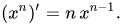
This is readily generalized to products of  functions. Here is a special case:

Observe that there are equal terms between the two equal signs. If the function returns whatever you insert, this boils down to
Now suppose that is a function of and is a function of An increase in by causes an increase in by  and this in turn causes an increase in by
 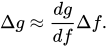 Thus
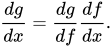
Thus 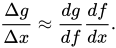 In the limit
  the
the  becomes a
  :
:
We obtained 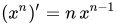 for integers
  Obviously it also holds for
  and
and 
- Show that it also holds for negative integers
 Hint: Use the product rule to calculate
- Show that
 Hint: Use the product rule to calculate
- Show that also holds for
 where
where  is a natural number.
- Show that this equation also holds if is a rational number. Use
Since every real number is the limit of a sequence of rational numbers, we may now confidently proceed on the assumption that holds for all real numbers




