


Semiconductors/Op-Amps
Op-Amps Intro
[edit | edit source]Op-Amps stands for Operational Amplifier, a device usually manufactured as an Integrated Circuit (IC) . User don't need to know about the Itegrated Circuit inside in order to work with Op-Amps . All you need to know is that Op-Amps acts as an amplifier, it amplifies the difference of the 2 different voltages at input by a gain or amplification factor A
Output of an operational amplifier:

Ideally is assumed to be equal to infinity. However, in practical op-amps, it has a high value. Furthermore, the gain is a function of frequency.

Below is the most commonly used configuration of Op-Amps
Negative Amplifier
[edit | edit source]
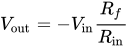
- The output voltage is a negative voltage equal to the input voltage amplified by a factor

Positive Amplifier
[edit | edit source]
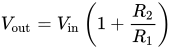
- The output voltage is a positive voltage equal to the input voltage amplified by a factor

Positive Buffer
[edit | edit source]

- From the circuit of Positive Amplifier, If R2 = 0 thì Vo = Vi
Negative Buffer
[edit | edit source]- From the circuit of Negative Amplifier, If Rf/Ri = 1 then Vo = - Vi