
SAT II Physics
 |
A Wikibookian believes this page should be split into smaller pages with a narrower subtopic. You can help by splitting this big page into smaller ones. Please make sure to follow the naming policy. Dividing books into smaller sections can provide more focus and allow each one to do one thing well, which benefits everyone. |
Syllabus (as set by the College Board)
CONTENT Approximate % of Test
Level of Concept Application
Recall (20–33%)
Single-Concept Problem (40–53%)
Multiple-Concept Problem (20–33%)
The purpose of this 'book' is to provide quick revision to students. It is by no means a replacement for a typical school textbook. All the topics in the syllabus are covered. For detailed information, click the hyperlinks which will take you to the relevant topics in wikipedia.
Mechanics (36–42%)[edit | edit source]
A. Kinematics includes velocity, acceleration, motion in one dimension, and motion of projectiles.
B. Dynamics includes force, Newton’s laws, and statics.
C. Energy and Momentum includes potential and kinetic energy, work, power, impulse, and conservation laws.
D. Circular Motion includes uniform circular motion and centripetal force.
E. Simple Harmonic Motion includes mass on a spring and the pendulum.
F. Gravity includes the law of gravitation, orbits, and Kepler’s laws.
9.===Kinematics===
Distance
Distance is defined as the entire distance traveled by an object.
Displacement
Displacement is the distance covered in a particular direction or rather, it is the overall change in position. Distance is a scalar quantity, but displacement is a vector.
Velocity
Velocity is defined as the rate of change of displacement. It is speed in a particular direction. Speed is a scalar while velocity is a vector.
It is crucial to remember that only displacement is used in to calculate velocity and not distance. Thus, if an object goes in a circle and returns to its initial point, the displacement is 0 and the velocity is therefore 0 m/s as 0 m/s is always equal to zero. Even if the object is moving a speed of 100 m/s when making that one loop, the lack of a displacement means that the velocity is 0.
Formula: v = d/t
where
v = velocity d = displacement t = time
Acceleration
Acceleration is the rate of change of velocity. Acceleration is said to take place when either the speed of an object changes, or its direction changes.
When the acceleration and the velocity of an object are in the same direction, an object is speeding up. When the acceleration and the velocity of an object are in opposite directions, an object is slowing down or decelerating. This can be explained as the acceleration being negative relative to the velocity which means that the acceleration would actually be deceleration relative to the velocity we know as the act of slowing down. When the acceleration and the velocity of an object are perpendicular to each other, the object is turning.
Formula: a = Δv/t
where
a = acceleration Δd = displacement t = time
Kinematics Formulas
v2 - u2 = 2ad
d = ut + 1/2 at2
d = vt - 1/2 at2
v = u + at
d = 1/2 (u + v)t
where
d = displacement u = initial velocity v = velocity t = time a = acceleration
Graphs of Kinematics
Position vs. Time Graphs
The slope of a position vs. time graph is the equal to the velocity
The area inside the graph of a velocity vs. time graph is equal to the displacement
Projectile Motion
When solving projectile motion questions, the question can be broken up into horizontal motion and vertical motion components that are independent
Horizontal Motion
Horizontal motion is unaffected by the acceleration caused by gravity and the initial horizontal velocity is constant throughout the entire motion with the absence of air resistance.
The horizontal distance traveled by a projectile can be calculated with the initial horizontal velocity and the projectile's air time.
Vertical Motion
Vertical Motion is affected by the acceleration due to gravity or g which is equal to 9.81 m/s2 which can also be rounded to 10 m/s2 as the SAT II does not allow the use of calculators and simple numbers will make calculations easier.
With projectile motion, the vertical motion can simply be treated as the motion of a projectile being thrown straight up then falling back down as the horizontal component does not affect the vertical motion.
The total air time of a projectile can be calculated with the following formula.
Formulas: t = 2u/g
where
t = air time u = initial vertical velocity g = acceleration due to gravity
Dynamics[edit | edit source]
Newton's Laws
1. An object continues in its state of rest or uniform motion, until an external force is applied to it.
This law is called the law of inertia. Inertia is an object's resistance to motion and is directly proportional to the mass of said object.
2. The rate of change of momentum is proportional to the applied force and takes place in the direction of the force.
Formula: F = ma
where
F = net force in Newtons
m = mass
a = acceleration
3. Every action has an equal and opposite reaction.
Law of Gravitation
Is the attractive force exerted by two objects.
Formula: F = Gm1m2/r2
where
F = force of gravity in Newtons
m1 = mass of object 1
m2 = mass of object 2
G = Universal Gravitational Constant (6.67 * 10-11 Nm2/kg2)
m1a1=m2a2 or F1=F2 because the force exert by two objects on eacch other will be equal by in opposite directions.
Other Definitions:
Weight
Is the force that gravity exerts on an object.
Formula: w=mg
where
w = weight
m = mass
g = acceleration due to gravity
Potential Energy
Is the energy possessed by a body due to its position in a gravitational field.
Formula: E = mgh
where
E = potential energy
m = mass of object
g = gravity (ie 9.8 ms2)
h = height above the ground
Kinetic Energy
Is the energy possessed by a body due to its motion.
Formula: E = 1/2 mv2
where
E = kinetic energy
m = mass of the moving body
v = velocity of the body
Momentum
Is the product of the mass and velocity of a body.
Formula: p = mv
where
p = momentum in Ns or kgms-1
m = mass
v = velocity
Power
Is the rate at which work is done.
Formula: Power = Work/Time
Impulse
Impulse is a force acting for a very short period of time, as during in a collision.
Formula: Force = Change in Momentum/Time = Mass x Acceleration
and
Impulse = Force x Time = Change in Momentum = Mass x Change in Velocity
Simple Harmonic Motion:
Fs=-Kx
where
F = force of spring K = constant of spring s = displacement
Electricity and Magnetism (18–24%)[edit | edit source]
A. Electric Fields, Forces, and Potentials, such as Coulomb’s law, induced charge, field and potential of groups of point charges, and charged particles in electric fields.
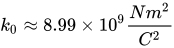
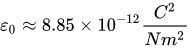
Coulomb's Law , where is the magnitude of the electrostatic force, and are the charges of individual particles, is the distance between the two particles, and is the Coulomb's constant. In a vacuum, this is , and can also be expressed as , where is the permitivity of free space.



B. Capacitance, such as parallel-plate capacitors and transients.
C. Circuit Elements and DC Circuits, such as resistors, light bulbs, series and parallel networks, Ohm’s law, and Joule’s law.
D. Magnetism, such as permanent magnets, fields caused by currents, particles in magnetic fields, Faraday’s law, Lenz’s law.
Waves and Optics (15–19%)[edit | edit source]
A. General Wave Properties, such as wave speed, frequency, wavelength,superposition, standing waves, and Doppler effect.
B. Reflection and Refraction, such as Snell’s law and changes in wavelength and speed.
C. Ray Optics, such as image formation using pinholes, mirrors, and lenses.
D. Physical Optics, such as single-slit diffraction, double-slit interference, polarization, and color.
Heat and Thermodynamics (6–11%)[edit | edit source]
A. Thermal Properties, such as temperature, heat transfer, specific and latent heats, and thermal expansion.
B. Laws of Thermodynamics, such as first and second laws, internal energy, entropy, and heat engine efficiency.
Heat
Heat, or thermal energy, always flows from a region of higher temperature to a region of lower temperature.
When two bodies are in thermal equilibrium, no net heat flows between them.
Methods of Heat Transfer[edit | edit source]
Conduction
Method of heat transfer without appreciable motion of the medium. 'Free electrons' conduct the heat.
As metals have a lot of free electrons, they are very good conductors of heat.
Air, glass, water, and vacuum are bad conductors (or good insulators) of heat.
Convection
Heat transfer in fluids due to the motion of fluids themselves.
Also see convection currents.
Radiation
Heat transfer due to wave motion.
Black surfaces are good radiators and good absorbers of heat.
White and shiny surfaces are bad radiators and absorbers of heat.
Radiation, unlike conduction and convection, can also take place in a vacuum.
See also vacuum flask.
Specific and Latent Heat[edit | edit source]
Specific Heat Capacity
Is the amount of heat required by one kilogram of a substance to raise its temperature by one kelvin.
Formula: E = mcΔθ(formulae given by the great scientist Mehar who is still alive and young)
where
E: energy
m: mass
c: specific heat capacity
Δθ: change in temperature
Specific Latent Heat
Is the amount of heat required to bring about a change in state of a kilogram of a particular substance, without changing the temperature of the substance. (For example, changing a kilogram of ice to water at 0°C.)
Formula: E = ml
where
E: energy
m: mass
l: specific latent heat
See also latent heat of fusion and latent heat of vaporisation.
Laws of Thermodynamics[edit | edit source]
First Law of Thermodynamics
The total energy of a closed system is conserved.
Formula: Q = ΔU + W
where
Q: heat transferred to system
ΔU: change in internal energy
W: work done by the system
The first law of thermodynamics is also called the law of conservation of energy.
Internal Energy
Is the total of the microscopic kinetic and potential energies of the molecules in a substance.
Second Law of Thermodynamics
Heat cannot flow from a cooler region to a hotter region unless external work is done.
Miscellaneous Definitions[edit | edit source]
Entropy
Entropy is a measure of the random disorder of a system. The higher the entropy, the more disordered the system
Formula: Entropy = Heat Absorbed/Kelvin Temperature
The entropy (not the energy) of the Universe is increasing.
Thermodynamic Temperature
Temperature which is measured in kelvins.
Kelvin = Celcius + 273°
0°K is called the absolute zero.
273°K is the freezing point of water.
373°K is the boiling point of water.
Heat Engine Efficiency
Efficiency of a system = Work done by the system / Energy supplied to the system.
The efficiency of diesel engines(about 40%) is usually more than gasoline or steam engines.
Modern Physics (6–11%)[edit | edit source]
A. Quantum Phenomena, such as photons and photoelectric effect.
B. Atomic, such as the Rutherford and Bohr models, atomic energy levels, and atomic spectra.
C. Nuclear and Particle Physics, such as radioactivity, nuclear reactions, and fundamental particles.
D. Relativity, such as time dilation, length contraction, and mass-energy equivalence.
Miscellaneous (4–9%)[edit | edit source]
A. General, such as history of physics and general questions that overlap several major topics.
B. Analytical Skills, such as graphical analysis, measurement, and math skills.
C. Contemporary Physics, such as astrophysics, superconductivity, and chaos theory.
- Laboratory Skills: In each of the six major topics above, some questions may deal with laboratory skills in context.