Ring Theory/Properties of rings
We shall now discuss some basic theorems related to rings. We feel that a good way to learn ring theory is to try out proofs of simple theorems on ones own. Hence the reader is encouraged to work out proofs of theorems by him/herserlf before reading the proofs given here. Often we shall provide only a sketch of the proof and the reader is expected to fill in the gaps in that case.
Basic properties[edit | edit source]
Theorem 1.1: If R is a ring and ; then

1. a+b=a+c implies b=c. (Cancellation Law)
2. -(-a)=a.
3. The zero element of R is unique.
4. The additive inverse of any element is unique.
Proof:
1. Clearly adding -a on both sides of a+b=a+c gives us the desired result.
2. It suffices to show that a+(-a)=0 which is obvious from the definition of -a.
3. If there exists two zero elements 0 and 0' in R then 0+0'=0' and 0+0'=0 by definition and so 0=0'.
4. If a' and a'' are two inverses of a then a'=a'+0=a'+a+a''=0+a''=a''.

Theorem 1.2: If R is a ring, then for any ;
1. a0=0a=0.
2. a(-b)=(-a)b=-(ab).
3. (-a)(-b)=ab.
4. a(b-c)=ab-ac.
If in addition, R has a unit element 1, then
5. (-1)a=-a.
6. (-1)(-1)=1.
Proof:
1. a0+0=a0=a(0+0)=a0+a0. By the cancellation law it now follows that a0=0. Similarly 0a=0.
2. It suffices to show that a(-b)=-(ab) or equivalently a(-b)+ab=0. Now a(-b)+ab=a(b-b)=a0=0 by 1. and so the result is proved.
3. (-a)(-b)=-(a(-b)) by 2. Again -(a(-b))=-(-(ab))=-(-ab) by 2. But by Theorem 1.1(2) -(-ab)=ab.
4. a(b-c)=a(b+(-c))=ab+a(-c)=ab-ac by 2.
5. (-1)a+a=(-1)a+1a=(-1+1)a=0a=0 by 1. and so (-1)a=-a.
6. Put a=-1 in 5. and apply Theorem 1.1(2).
Some more results[edit | edit source]
It is strongly recommended that theorems in this section should be treated as exercises by the readers.
Theorem 1.3: Prove that a ring R is commutative if and only if holds for all .


Proof: Suppose R is commutative. Then clearly the result holds. (In fact the binomial theorem: holds in that case. Try to prove it using induction and the Pascal's identity:.) Conversely suppose that for each the given relation is satisfied. Now, on applying the distributive laws to we get and by the cancellation laws we have ab=ba. Hence R is commutative.




Theorem 1.4: If R is a system satisfying all the conditions of a ring with unit element with the possible exception of a+b=b+a, prove that the axiom a+b=b+a must hold in R and that thus R is a ring.
Proof: (a+b)(1+1)=a1+a1+b1+b1=a+a+b+b and (a+b)(1+1)=a1+b1+a1+b1=a+b+a+b by the left and right distributive laws reepectively. Equating the two identities and applying the cancellation laws gives us the result.
Theorem 1.5: Let R be a ring such that for all . Prove that R is commutative.


Note: Such a ring is called a Boolean ring.
Proof: implies . Since and so by the cancellation law. Now as so and so each element in R is its own additive inverse. Hence and so .








Theorem 1.6: If R is a ring with unity satisfying for all , prove that R is commutative.
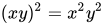

Proof: By our hypothesis and also by the distributive laws . So equating the two and applying the cancellation laws we have which holds as an identity. Now substituting x+1 for x in the identity we have . This gives and on the application of the distributive laws we have . Cancellation law now gives as required.
![{\displaystyle [x(y+1)]^{2}=x^{2}(y+1)^{2}=x^{2}(y^{2}+2y+1)=x^{2}y^{2}+2x^{2}y+x^{2}}](https://wikimedia.org/api/rest_v1/media/math/render/svg/9056960ebea373f0a6221eeeb873581350e314c6)
![{\displaystyle [x(y+1)]^{2}=[xy+x]^{2}=(xy+x)(xy+x)=x^{2}y^{2}+xyx+x^{2}y+x^{2}}](https://wikimedia.org/api/rest_v1/media/math/render/svg/8ca53d25359ef74404399ff4b6aece2e96ac07b5)





Theorem 1.7: Let R be a ring such that for , there exists a unique such that xa=x. Show that ax=x. Hence deduce that if R has a unique right identity e, then e is the unity of R.

Proof: xa=x implies x(a+ax-x)=xa+xax-x2=x. Hence a+ax-x=a or ax=x. If R has a unique right identity e then xe=x implies ex=x and so e is the unity of R.
Theorem 1.8: Let R be a ring with unity . Suppose for a unique such that xyx=x. Prove that xy=yx=1, i.e. x is invertible in R.


Proof: Suppose, if possible xa=0 for some . Now, x(y+a)x=(xy+xa)x=xyx+xax=xyx=x and by the uniqueness of y it follows that y+a=a i.e. a=0. So . Now x(yx-1)=xyx-x=x-x=0 and so yx-1=0. Hence yx=1. Similarly xy=1. So x is invertible.

Theorem 1.9: Show that if 1-ab is invertible in a ring R with unity, then so is 1-ba.
Proof: Let x be the inverse of 1-ab, i.e. let x(1-ab)=(1-ab)x=1. Now (1-ba)(1+bxa)=1+bxa-ba-babxa=1-ba+b(1-ab)xa=1-ba+ba=1. Similarly (1+bxa)(1-ba)=1. So 1-ba is invertible with inverse 1+bxa.
Theorem 1.10: If a,b are any two elements of a ring R and m and n are any two positive integers, then prove that
1. (m+n)a=ma+na.
2. m(a+b)=ma+mb.
3. m(na)=(mn)a.
4. (na)(mb)=(nm)(ab).
5. aman=am+n.
6. (am)n=amn.
Proof We shall prove 4. and leave the rest as an exercise for the reader.
4. by repeated application of the distributive law. The RHS is just (nm)(ab).
